


The 5 alpha-reductase isozyme family: a review of basic biology and their role in human diseases
- PMID: 22235201
- PMCID: PMC3253436
- DOI: 10.1155/2012/530121
The 5 alpha-reductase isozyme family: a review of basic biology and their role in human diseases
Abstract
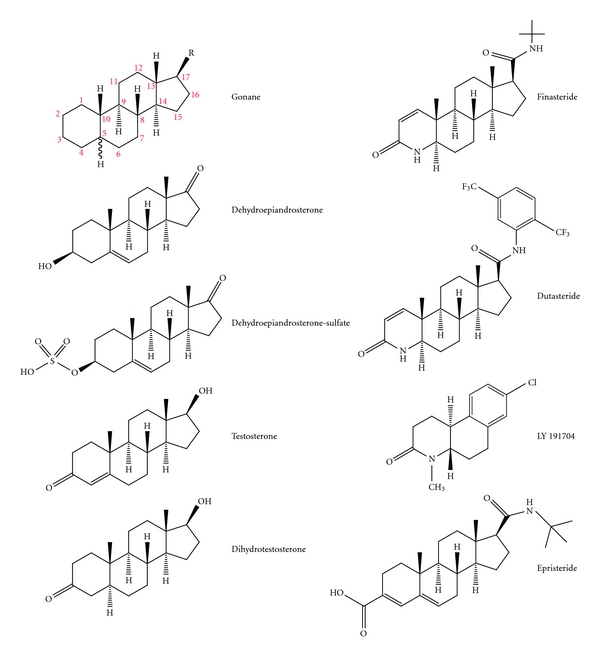
Despite the discovery of 5 alpha-reduction as an enzymatic step in steroid metabolism in 1951, and the discovery that dihydrotestosterone is more potent than testosterone in 1968, the significance of 5 alpha-reduced steroids in human diseases was not appreciated until the discovery of 5 alpha-reductase type 2 deficiency in 1974. Affected males are born with ambiguous external genitalia, despite normal internal genitalia. The prostate is hypoplastic, nonpalpable on rectal examination and approximately 1/10th the size of age-matched normal glands. Benign prostate hyperplasia or prostate cancer does not develop in these patients. At puberty, the external genitalia virilize partially, however, secondary sexual hair remains sparse and male pattern baldness and acne develop rarely. Several compounds have been developed to inhibit the 5 alpha-reductase isozymes and they play an important role in the prevention and treatment of many common diseases. This review describes the basic biochemical properties, functions, tissue distribution, chromosomal location, and clinical significance of the 5 alpha-reductase isozyme family.
References
-
- Imperato-McGinley J, Zhu YS. Androgens and male physiology the syndrome of 5α-reductase-2 deficiency. Molecular and Cellular Endocrinology. 2002;198(1-2):51–59. - PubMed
-
- Siiteri PK, Wilson JD. Testosterone formation and metabolism during male sexual differentiation in the human embryo. Journal of Clinical Endocrinology and Metabolism. 1974;38(1):113–125. - PubMed
-
- Cilotti A, Danza G, Serio M. Clinical application of 5α-reductase inhibitors. Journal of Endocrinological Investigation. 2001;24(3):199–203. - PubMed
-
- Imperato McGinley J, Guerrero L, Gautier T, Peterson RE. Steroid 5α reductase deficiency in man: an inherited form of male pseudohermaphroditism. Science. 1974;186(4170):1213–1215. - PubMed
-
- Saartok T, Dahlberg E, Gustafsson JA. Relative binding affinity of anabolic-androgenic steroids: comparison of the binding to the androgen receptors in skeletal muscle and in prostate, as well as to sex hormone-binding globulin. Endocrinology. 1984;114(6):2100–2106. - PubMed
LinkOut - more resources
Full Text Sources
Other Literature Sources
Medical
