


Body composition, symptoms, and survival in advanced cancer patients referred to a phase I service
- PMID: 22235285
- PMCID: PMC3250428
- DOI: 10.1371/journal.pone.0029330
Body composition, symptoms, and survival in advanced cancer patients referred to a phase I service
Abstract
Background: Body weight and body composition are relevant to the outcomes of cancer and antineoplastic therapy. However, their role in Phase I clinical trial patients is unknown.
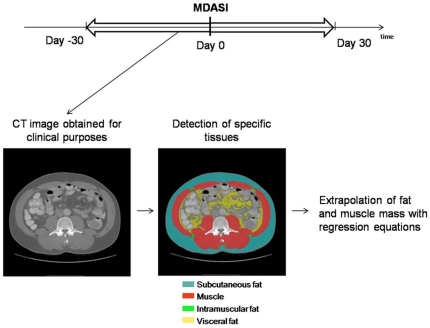
Methods: We reviewed symptom burden, body composition, and survival in 104 patients with advanced cancer referred to a Phase I oncology service. Symptom burden was analyzed using the MD Anderson Symptom Assessment Inventory(MDASI); body composition was evaluated utilizing computerized tomography(CT) images. A body mass index (BMI)≥25 kg/m² was considered overweight. Sarcopenia, severe muscle depletion, was assessed using CT-based criteria.
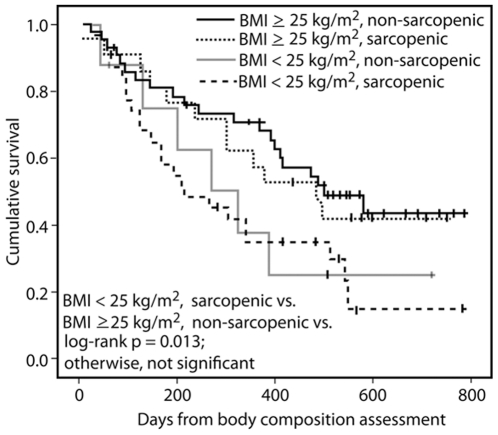
Results: Most patients were overweight (n = 65, 63%); 53 patients were sarcopenic (51%), including 79% of patients with a BMI<25 kg/m² and 34% of those with BMI≥25 kg/m². Sarcopenic patients were older and less frequently African-American. Symptom burden did not differ among patients classified according to BMI and presence of sarcopenia. Median (95% confidence interval) survival (days) varied according to body composition: 215 (71-358) (BMI<25 kg/m²; sarcopenic), 271 (99-443) (BMI<25 kg/m²; non-sarcopenic), 484 (286-681) (BMI≥25 kg/m²; sarcopenic); 501 d (309-693) (BMI≥25 kg/m²; non-sarcopenic). Higher muscle index and gastrointestinal cancer diagnosis predicted longer survival in multivariate analysis after controlling for age, gender, performance status, and fat index.
Conclusions: Patients referred to a Phase I clinic had a high frequency of sarcopenia and a BMI≥25 kg/m², independent of symptom burden. Body composition variables were predictive of clinically relevant survival differences, which is potentially important in developing Phase I studies.
Conflict of interest statement
Figures
References
-
- Murthy NS, Mukherjee S, Ray G, Ray A. Dietary factors and cancer chemoprevention: an overview of obesity-related malignancies. J Postgrad Med. 2009;55:45–54. - PubMed
-
- Sarhill N, Mahmoud F, Walsh D, Nelson KA, Komurcu S, et al. Evaluation of nutritional status in advanced metastatic cancer. Support Care Cancer. 2003;11:652–659. - PubMed
-
- Evans WJ, Morley JE, Argiles J, Bales C, Baracos V, et al. Cachexia: a new definition. Clin Nutr. 2008;27:793–799. - PubMed
-
- Ma G, Alexander HR. Prevalence and pathophysiology of cancer cachexia. In: Bruera E, Portenoy R, editors. Topics in Palliative Care. New York: Oxford University Press; 1998. pp. 91–129.
-
- Deans DA, Wigmore SJ, de Beaux AC, Paterson-Brown S, Garden OJ, et al. Clinical prognostic scoring system to aid decision-making in gastro-oesophageal cancer. Br J Surg. 2007;94:1501–1508. - PubMed
