


Roles of the locus coeruleus and adrenergic receptors in brain-mediated hypothalamic-pituitary-adrenal axis responses to intracerebroventricular alcohol
- PMID: 22236039
- PMCID: PMC3326197
- DOI: 10.1111/j.1530-0277.2011.01707.x
Roles of the locus coeruleus and adrenergic receptors in brain-mediated hypothalamic-pituitary-adrenal axis responses to intracerebroventricular alcohol
Abstract
Background: Alcohol activates the hypothalamic-pituitary-adrenal (HPA) axis through its actions in both the periphery and the central nervous system (CNS). The studies presented here were designed to test the CNS-specific noradrenergic mechanisms by which alcohol stimulates HPA activity in the male rat.
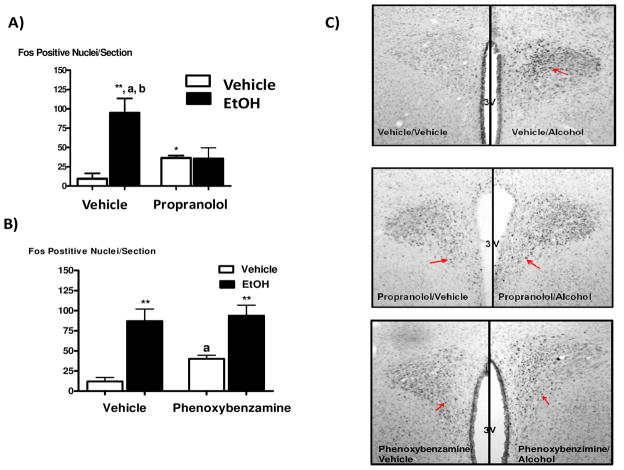
Methods: We used an experimental paradigm in which a small, nontoxic amount (5 μl) of alcohol was slowly microinfused intracerebroventricularly (icv). Alcohol was administered icv to animals with lesions of the locus coeruleus (LC) or in animals pretreated with α- or β-adrenergic receptor antagonists. Hormonal HPA activation was determined by measuring secretion of the pituitary stress hormone adrenocorticotropin (ACTH). Neuronal activation was determined by quantification of the expression of the transcription factor c-fos (Fos).
Results: As expected, icv alcohol stimulated ACTH secretion from the pituitary and Fos expression in the paraventricular nucleus of the hypothalamus (PVN). Bilateral electrolytic LC lesions blocked the ability of icv alcohol to stimulate ACTH secretion. Pretreatment with icv propranolol increased basal ACTH secretion levels, but icv alcohol did not increase this effect. Propranolol also blunted icv alcohol-induced PVN Fos expression. A low dose of phenoxybenzamine, an α-adrenergic receptor antagonist, did not affect the ability of icv alcohol to stimulate ACTH release. However, a higher dose of the drug was able to block the ACTH response to icv alcohol. Despite this, phenoxybenzamine did not inhibit alcohol-induced Fos expression. Icv pretreatment with corynanthine, a selective α-1 adrenergic receptor antagonist, modestly raised basal ACTH levels and blocked the icv alcohol-induced secretion of this hormone.
Conclusions: These results indicate that the LC and norepinephrine play important roles in HPA activation caused by icv alcohol administration, but that the specific adrenergic receptor subtypes involved in this phenomenon still need to be identified.
Copyright © 2012 by the Research Society on Alcoholism.
Figures


References
-
- CHEN XQ, DU JZ, WANG YS. Regulation of hypoxia-induced release of corticotropin-releasing factor in the rat hypothalamus by norepinephrine. Regul Pept. 2004;119:221–8. - PubMed
-
- COBB CF, VAN THIEL DH. Mechanism of ethanol-induced adrenal stimulation. Alcohol Clin Exp Res. 1982;6:202–6. - PubMed
-
- DUNN AJ, SWIERGIEL AH, PALAMARCHOUK V. Brain circuits involved in corticotropin-releasing factor-norepinephrine interactions during stress. Ann N Y Acad Sci. 2004;1018:25–34. - PubMed
-
- EL-MAS MM, ZHANG J, ABDEL-RAHMAN AA. Upregulation of vascular inducible nitric oxide synthase mediates the hypotensive effect of ethanol in conscious female rats. J Appl Physiol. 2006;100:1011–8. - PubMed
Publication types
MeSH terms
Substances
Grants and funding
LinkOut - more resources
Full Text Sources
Research Materials
