


Co-occurrence of sexual risk behaviors and substance use across emerging adulthood: evidence for state- and trait-level associations
- PMID: 22236216
- PMCID: PMC3362680
- DOI: 10.1111/j.1360-0443.2012.03792.x
Co-occurrence of sexual risk behaviors and substance use across emerging adulthood: evidence for state- and trait-level associations
Abstract
Aims: Prior research has suggested that problematic alcohol and drug use are related to risky sexual behaviors, either due to trait-level associations driven by shared risk factors such as sensation seeking or by state-specific effects, such as the direct effects of substance use on sexual behaviors. Although the prevalence of both high-risk sexual activity and alcohol problems decline with age, little is known about how the associations between substance use disorder symptoms and high-risk sexual behaviors change across young adulthood.
Design, setting and participants: Using a community sample (n = 790) interviewed every 3 years from age 21 to age 30 years, we tested trait- and state-level associations among symptoms of alcohol and drug abuse and dependence and high-risk sexual behaviors across young adulthood using latent growth curve models.
Measurements: We utilized diagnostic interviews to obtain self-report of past-year drug and alcohol abuse and dependence symptoms. High-risk sexual behaviors were assessed with a composite of four self-reported behaviors.
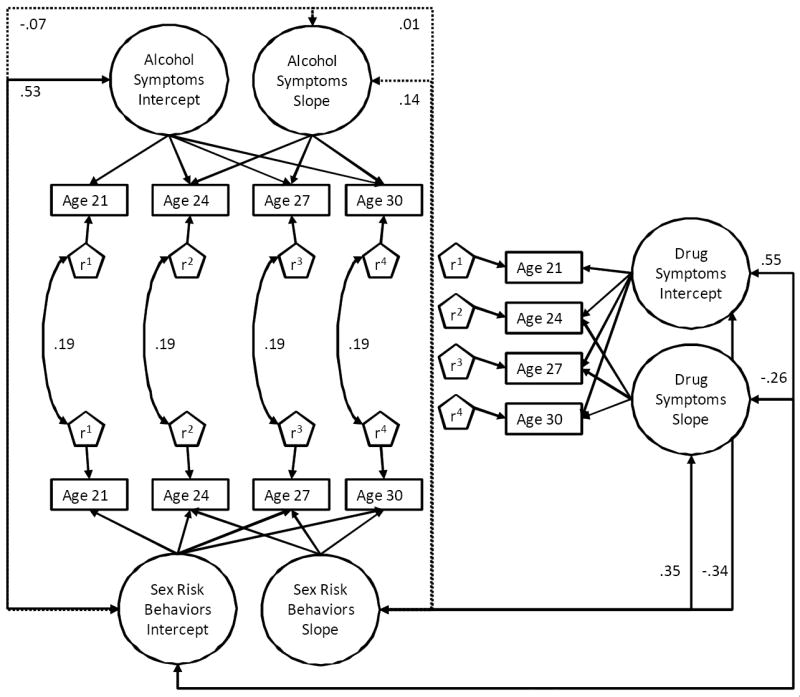
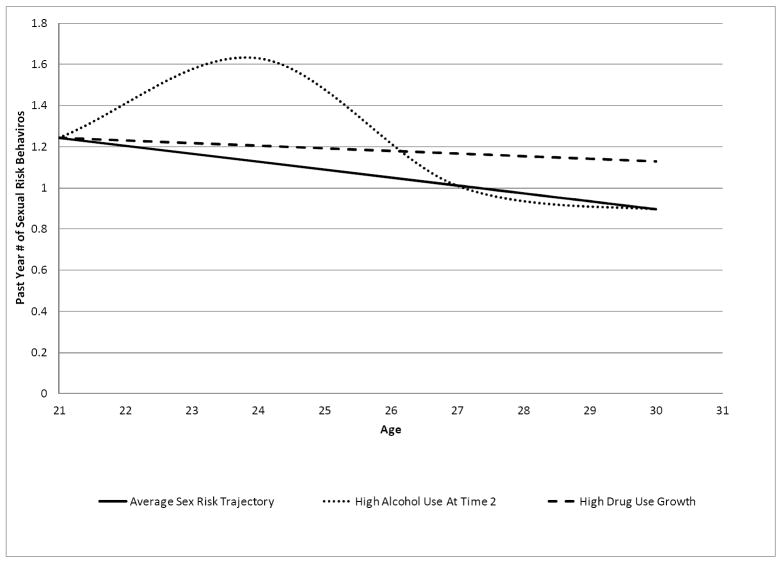
Findings: Results showed time-specific associations between alcohol disorder symptoms and risky sexual behaviors (r = 0.195, P < 0.001), but not associations between their trajectories of change. Conversely, risky sexual behaviors and drug disorder symptoms were associated only at the trait level, not the state level, such that the levels and rate of change over time of both were correlated (r = 0.35, P < 0.001).
Conclusions: High-risk sexual behaviors during young adulthood seem to be driven both by trait and state factors, and intervention efforts may be successful if they are either aimed at high-risk individuals or if they work to disaggregate alcohol use from risky sexual activities.
© 2012 The Authors, Addiction © 2012 Society for the Study of Addiction.
Figures
References
-
- Arnett JJ. Emerging adulthood: What is it, and what is it good for? Child Dev Perspect. 2007;1:68–73.
-
- Steinberg L. Risk taking in adolescence: what changes, and why? Ann NY Acad Sci. 2004;1021:51–8. - PubMed
-
- Kessler RC, Berglund P, Demler O, Jin R, Walters EE. Lifetime prevalence and age-of-onset distributions of DSM-IV disorders in the National Comorbidity Survey Replication. Arch Gen Psychiatry. 2005;62:593–602. - PubMed
-
- Centers for Disease Control and Prevention. U.S. Department of Health and Human Services; 2008. [April, 19, 2011]. Sexually transmitted disease surveillance. Available at: http://www.cdc.gov/std/stats08/surv2008-complete.pdf.
Publication types
MeSH terms
Grants and funding
LinkOut - more resources
Full Text Sources
Medical
Miscellaneous
