Age-related changes in oxidative capacity differ between locomotory muscles and are associated with physical activity behavior
- PMID: 22236246
- PMCID: PMC3725816
- DOI: 10.1139/h11-135
Age-related changes in oxidative capacity differ between locomotory muscles and are associated with physical activity behavior
Abstract
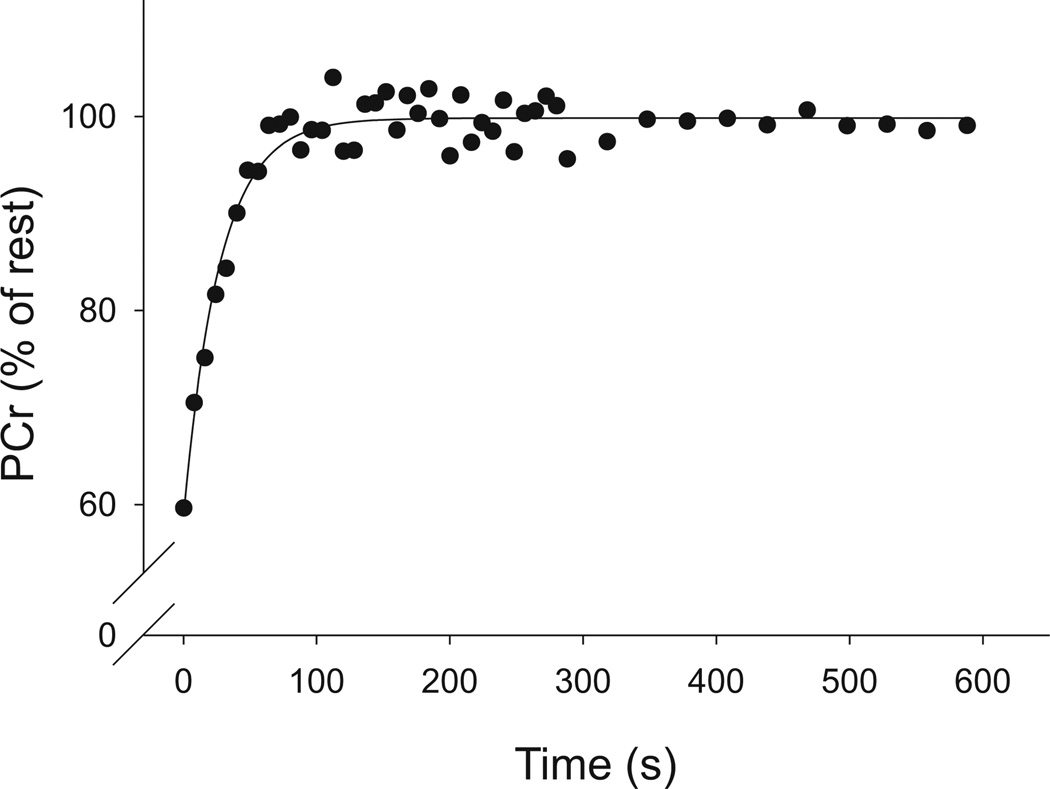
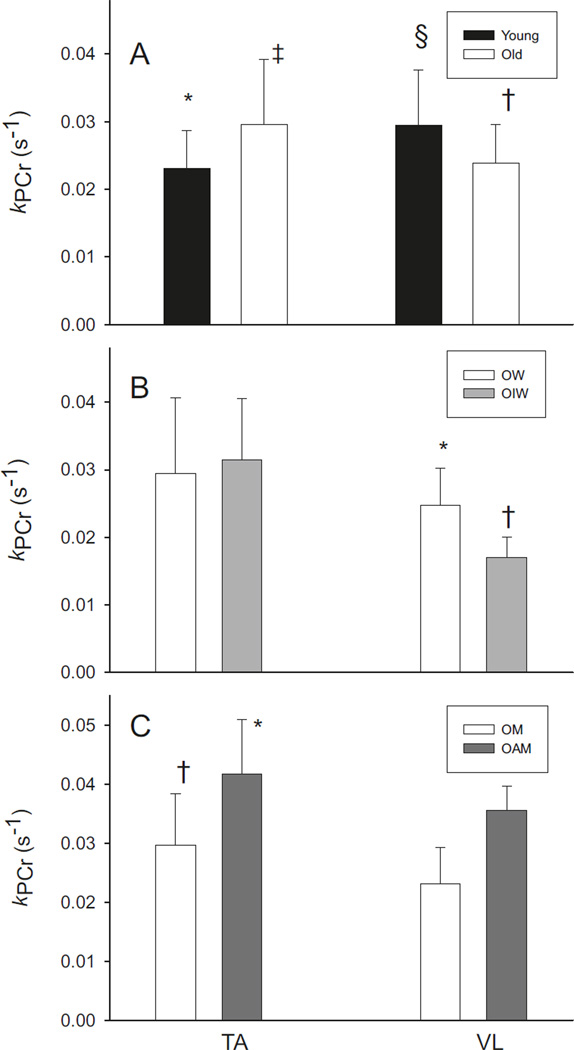
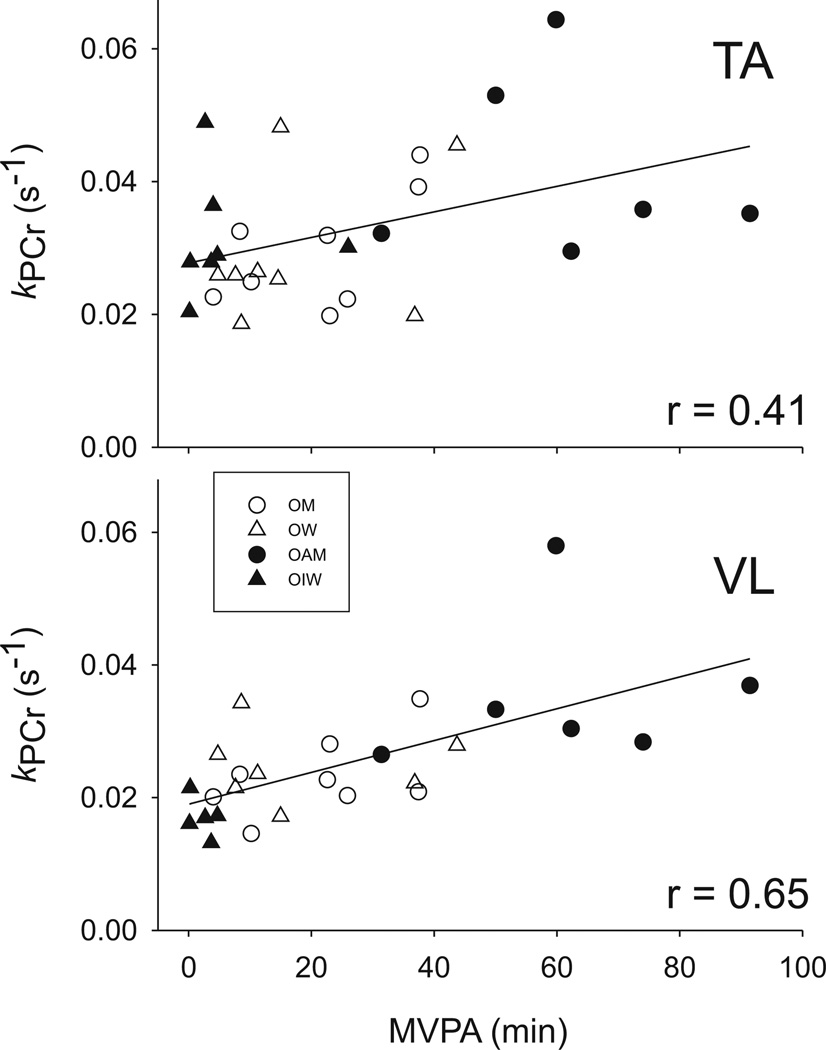
There is discrepancy in the literature regarding the degree to which old age affects muscle bioenergetics. These discrepancies are likely influenced by several factors, including variations in physical activity (PA) and differences in the muscle group investigated. To test the hypothesis that age may affect muscles differently, we quantified oxidative capacity of tibialis anterior (TA) and vastus lateralis (VL) muscles in healthy, relatively sedentary younger (8 YW, 8 YM; 21-35 years) and older (8 OW, 8 OM; 65-80 years) adults. To investigate the effect of physical activity on muscle oxidative capacity in older adults, we compared older sedentary women to older women with mild-to-moderate mobility impairment and lower physical activity (OIW, n = 7), and older sedentary men with older active male runners (OAM, n = 6). Oxidative capacity was measured in vivo as the rate constant, k(PCr), of postcontraction phosphocreatine recovery, obtained by (31)P magnetic resonance spectroscopy following maximal isometric contractions. While k(PCr) was higher in TA of older than activity-matched younger adults (28%; p = 0.03), older adults had lower k(PCr) in VL (23%; p = 0.04). In OIW compared with OW, k(PCr) was lower in VL (∼45%; p = 0.01), but not different in TA. In contrast, OAM had higher k(PCr) than OM (p = 0.03) in both TA (41%) and VL (54%). In older adults, moderate-to-vigorous PA was positively associated with k(PCr) in VL (r = 0.65, p < 0.001) and TA (r = 0.41, p = 0.03). Collectively, these results indicate that age-related changes in oxidative capacity vary markedly between locomotory muscles, and that altered PA behavior may play a role in these changes.
Figures
References
-
- Arnold DL, Matthews PM, Radda GK. Metabolic recovery after exercise and the assessment of mitochondrial function in vivo in human skeletal muscle by means of 31P NMR. Magn. Reson. Med. 1984;1(3):307–315. PMID:6571561. - PubMed
-
- Barrientos A, Casademont J, Rotig A, Miro O, Urbano-Marquez A, Rustin P, Cardellach F. Absence of relationship between the level of electron transport chain activities and aging in human skeletal muscle. Biochem. Biophys. Res. Commun. 1996;229(2):536–539. PMID:8954933. - PubMed
-
- Bass A, Gutmann E, Hanzlikova V. Biochemical and histochemical changes in energy supply enzyme pattern of muscles of the rat during old age. Gerontologia. 1975;21(1):31–45. PMID:166901. - PubMed
-
- Brierley EJ, Johnson MA, James OFW, Turnbull DM. Effects of physical activity and age on mitochondrial function. QJM. 1996;89(4):251–258. PMID:8733511. - PubMed
-
- Brierley EJ, Johnson MA, Bowman A, Ford GA, Subhan F, Reed JW, et al. Mitochondrial function in muscle from elderly athletes. Ann. Neurol. 1997;41(1):114–116. PMID:9005875. - PubMed
Publication types
MeSH terms
Substances
Grants and funding
LinkOut - more resources
Full Text Sources
Medical