


Outcomes of extremely low birth weight infants with bronchopulmonary dysplasia: impact of the physiologic definition
- PMID: 22236557
- PMCID: PMC3686277
- DOI: 10.1016/j.earlhumdev.2011.12.013
Outcomes of extremely low birth weight infants with bronchopulmonary dysplasia: impact of the physiologic definition
Abstract
Aims: We compared neurodevelopmental outcomes of extremely low birth weight (ELBW) infants with and without bronchopulmonary dysplasia (BPD), using the physiologic definition.
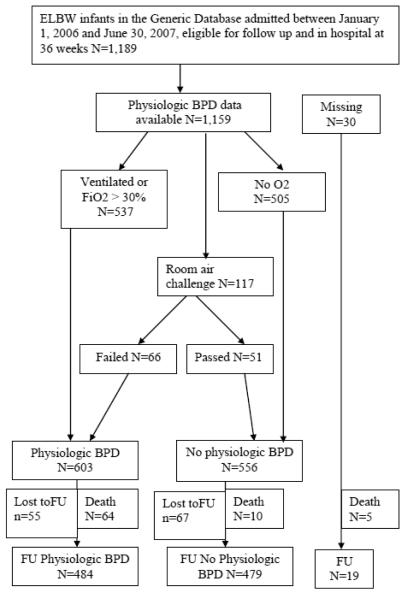
Study design: ELBW (birth weights<1000 g) infants admitted to the Neonatal Research Network centers and hospitalized at 36 weeks postmenstrual age (n=1189) were classified using the physiologic definition of BPD. Infants underwent Bayley III assessment at 18-22 months corrected age. Multivariable logistic regression was used to determine the association between physiologic BPD and cognitive impairment (score<70).
Results: BPD by the physiologic definition was diagnosed in 603 (52%) infants, 537 of whom were mechanically ventilated or on FiO(2)>30% and 66 who failed the room air challenge. Infants on room air (n=505) and those who passed the room air challenge (n=51) were classified as "no BPD" (n=556). At follow up, infants with BPD had significantly lower mean weight and head circumference. Moderate to severe cerebral palsy (7 vs. 2.1%) and spastic diplegia (7.8 vs. 4.1%) and quadriplegia (3.9 vs. 0.9%) phenotypes as well as cognitive (12.8 vs. 4.6%) and language scores<70 (24.2 vs. 12.3%) were significantly more frequent in those with BPD compared to those without BPD. BPD was independently associated (adjusted OR 2.4; 95% CI 1.40-4.13) with cognitive impairment.
Conclusions: Rates of adverse neurodevelopmental outcomes in early childhood were significantly higher in those with BPD. BPD by the physiologic definition was independently associated with cognitive impairment using Bayley Scales III. These findings have implications for targeted post-discharge surveillance and early intervention.
Copyright © 2012 Elsevier Ltd. All rights reserved.
References
-
- Bhandari A, Bhandari V. Pitfalls, problems and progress in bronchopulmonary dysplasia. Pediatrics. 2009;123:1562–73. - PubMed
-
- Vohr BR, Wright LL, Dusick AM, et al. Neurodevelopmental and functional outcomes of extremely low birth weight infants in the National Institute of Child Health and human Development Neonatal research Network, 1993-1994. Pediatrics. 2000;105(6):1216–26. - PubMed
-
- Anderson PJ, Doyle LW. Neurodevelopmental outcome of bronchopulmonary dysplasia. Semin Perinatol. 2006;30(4):227–32. - PubMed
Publication types
MeSH terms
Grants and funding
- U10 HD27851/HD/NICHD NIH HHS/United States
- U10 HD40689/HD/NICHD NIH HHS/United States
- M01 RR633/RR/NCRR NIH HHS/United States
- M01 RR7122/RR/NCRR NIH HHS/United States
- UL1 TR000454/TR/NCATS NIH HHS/United States
- M01 RR80/RR/NCRR NIH HHS/United States
- U10 HD21385/HD/NICHD NIH HHS/United States
- M01 RR32/RR/NCRR NIH HHS/United States
- UL1 RR24139/RR/NCRR NIH HHS/United States
- U10 HD021385/HD/NICHD NIH HHS/United States
- M01 RR44/RR/NCRR NIH HHS/United States
- U10 HD40492/HD/NICHD NIH HHS/United States
- U10 HD53119/HD/NICHD NIH HHS/United States
- M01 RR59/RR/NCRR NIH HHS/United States
- U10 HD21364/HD/NICHD NIH HHS/United States
- U10 HD34216/HD/NICHD NIH HHS/United States
- M01 RR70/RR/NCRR NIH HHS/United States
- U10 HD36790/HD/NICHD NIH HHS/United States
- U10HD53109/HD/NICHD NIH HHS/United States
- U10 HD40521/HD/NICHD NIH HHS/United States
- U10 HD27880/HD/NICHD NIH HHS/United States
- M01 RR125/RR/NCRR NIH HHS/United States
- U10 HD27904/HD/NICHD NIH HHS/United States
- U10 HD40498/HD/NICHD NIH HHS/United States
- U10 HD53089/HD/NICHD NIH HHS/United States
- U10 HD27871/HD/NICHD NIH HHS/United States
- U10 HD027904/HD/NICHD NIH HHS/United States
- U10 HD27856/HD/NICHD NIH HHS/United States
- U10 HD40461/HD/NICHD NIH HHS/United States
- U10 HD27853/HD/NICHD NIH HHS/United States
- M01 RR39/RR/NCRR NIH HHS/United States
- M01 RR30/RR/NCRR NIH HHS/United States
- M01 RR750/RR/NCRR NIH HHS/United States
- M01 RR8084/RR/NCRR NIH HHS/United States
- M01 RR54/RR/NCRR NIH HHS/United States
- M01 RR997/RR/NCRR NIH HHS/United States
- U10 HD21373/HD/NICHD NIH HHS/United States
LinkOut - more resources
Full Text Sources
Other Literature Sources
