


Review
doi: 10.1038/cddis.2011.122.
Role of the promyelocytic leukaemia protein in cell death regulation
Affiliations
- PMID: 22237204
- PMCID: PMC3270264
- DOI: 10.1038/cddis.2011.122
Item in Clipboard
Review
Role of the promyelocytic leukaemia protein in cell death regulation
Cell Death Dis.
.
Abstract
The promyelocytic leukaemia gene PML was originally identified at the t(15;17) translocation of acute promyelocytic leukaemia, which generates the oncogene PML-retinoic acid receptor α. PML epitomises a subnuclear structure called PML nuclear body. Current models propose that PML through its scaffold properties is able to control cell growth and survival at many different levels. Here we discuss the current literature and propose new avenues for investigation.
Figures
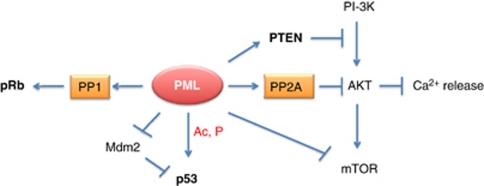
Multifaceted role of PML in regulation of apoptosis and growth suppression. PML activates pRb and inhibits AKT via interactions with PP1 and PP2A phosphatases, respectively. In addition, it negatively affects the PI-3K pathway by inhibiting mTOR and activating PTEN. cPML retains the ability to promote PP2A-dependent AKT inhibition, thus causing Ca2+ release at contact sites between the mitochondria and the ER. Finally, PML positively regulates p53 by acting at different levels (that is, acetylation, phosphorylation and Mdm2-dependent degradation). It is presently unclear whether sequestration of PP1 and PP2A into PML-NBs can inhibit their function
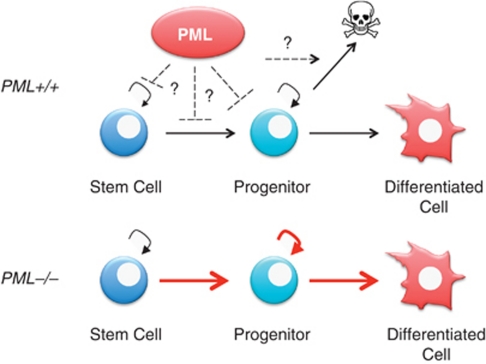
Role of PML in stem/progenitor cells. PML regulates stem cell function in different tissues. In the haematopoietic system, PML loss leads to expansion of the progenitor pool and increased entry into differentiation, accompanied by reduction in the stem cell pool. This phenotype could be explained by increased transition to committed progenitors, augmented proliferation and/or decreased cell death. Further research is needed to determine whether PML can promote cell death in committed progenitors, and by which mechanism(s)
References
-
- de The H, Chen Z. Acute promyelocytic leukaemia: novel insights into the mechanisms of cure. Nat Rev Cancer. 2010;10:775–783. - PubMed
-
- Piazza F, Gurrieri C, Pandolfi PP. The theory of APL. Oncogene. 2001;20:7216–7222. - PubMed
-
- Salomoni P, Pandolfi PP. The role of PML in tumor suppression. Cell. 2002;108:165–170. - PubMed
-
- Salomoni P, Ferguson BJ, Wyllie AH, Rich T. New insights into the role of PML in tumour suppression. Cell Res. 2008;18:622–640. - PubMed
-
- Salomoni P. Stemming out of a new PML era. Cell Death Differ. 2009;16:1083–1092. - PubMed
Publication types
MeSH terms
Substances
Grants and funding
LinkOut - more resources
Full Text Sources
Molecular Biology Databases
