


DNA damage induces reactive oxygen species generation through the H2AX-Nox1/Rac1 pathway
- PMID: 22237206
- PMCID: PMC3270268
- DOI: 10.1038/cddis.2011.134
DNA damage induces reactive oxygen species generation through the H2AX-Nox1/Rac1 pathway
Abstract
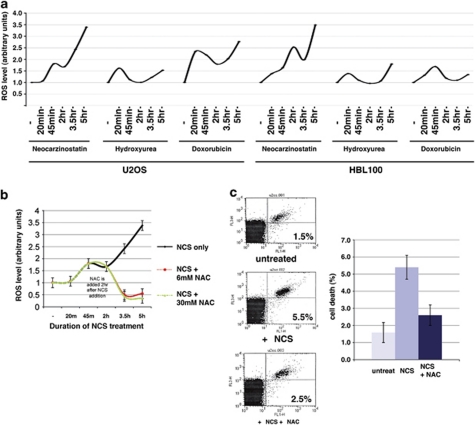
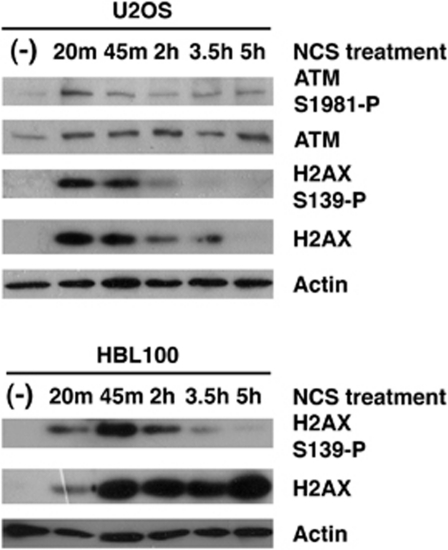
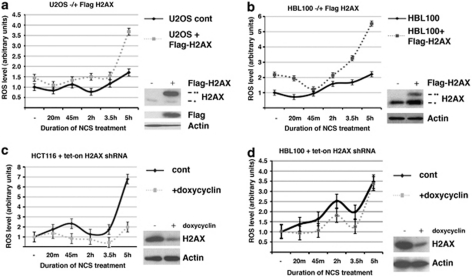
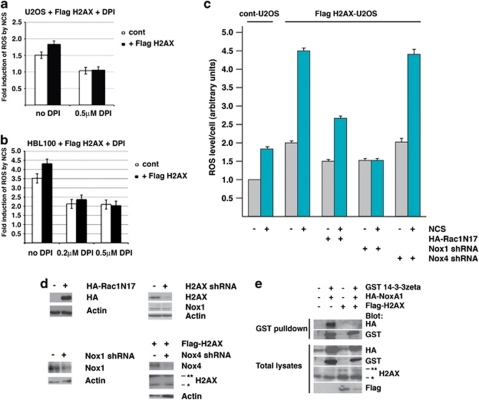
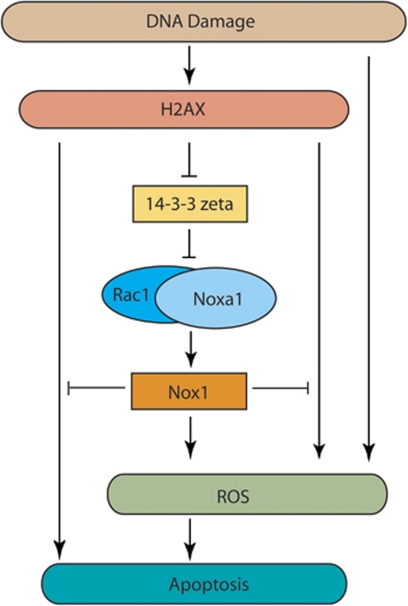
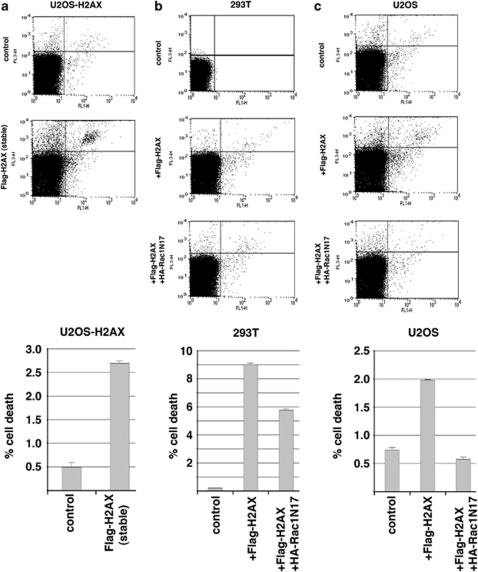
The DNA damage response (DDR) cascade and ROS (reactive oxygen species) signaling are both involved in the induction of cell death after DNA damage, but a mechanistic link between these two pathways has not been clearly elucidated. This study demonstrates that ROS induction after treatment of cells with neocarzinostatin (NCS), an ionizing radiation mimetic, is at least partly mediated by increasing histone H2AX. Increased levels of ROS and cell death induced by H2AX overexpression alone or DNA damage leading to H2AX accumulation are reduced by treating cells with the antioxidant N-Acetyl-L-Cysteine (NAC), the NADP(H) oxidase (Nox) inhibitor DPI, expression of Rac1N17, and knockdown of Nox1, but not Nox4, indicating that induction of ROS by H2AX is mediated through Nox1 and Rac1 GTPase. H2AX increases Nox1 activity partly by reducing the interaction between a Nox1 activator NOXA1 and its inhibitor 14-3-3zeta. These results point to a novel role of histone H2AX that regulates Nox1-mediated ROS generation after DNA damage.
Figures
References
-
- Bassing CH, Alt FW. The cellular response to general and programmed DNA double strand breaks. DNA Repair. 2004;3:781–796. - PubMed
-
- Zhou BB, Elledge SJ. The DNA damage response: putting checkpoints in perspective. Nature. 2000;408:433–439. - PubMed
-
- Fernandez-Capetillo O, Lee A, Nussenzweig M, Nussenzweig A. H2AX: the histone guardian of the genome. DNA Repair. 2004;3:959–967. - PubMed
-
- Stucki M, Clapperton JA, Mohammad D, Yaffe MB, Smerdon SJ, Jackson SP. MDC1 directly binds phosphorylated histone H2AX to regulate cellular responses to DNA double-strand breaks. Cell. 2005;123:1213–1226. - PubMed
Publication types
MeSH terms
Substances
Grants and funding
LinkOut - more resources
Full Text Sources
Research Materials
