


Review
doi: 10.1007/s00262-011-1181-5.
Epub 2012 Jan 12.
Immune suppression in the tumor microenvironment: a role for dendritic cell-mediated tolerization of T cells
Affiliations
- PMID: 22237887
- PMCID: PMC6948839
- DOI: 10.1007/s00262-011-1181-5
Item in Clipboard
Review
Immune suppression in the tumor microenvironment: a role for dendritic cell-mediated tolerization of T cells
Cancer Immunol Immunother.
2012 Feb.
Abstract
Immune suppression remains a consistent obstacle to successful anti-tumor immune responses. As tumors develop, they create a microenvironment that not only supports tumor growth and metastasis but also reduces potential adaptive immunity to tumor antigens. Among the many components of this tumor microenvironment is a population of dendritic cells which exert profound immune suppressive effects on T cells. In this review, we discuss our recent findings related to these tumor-associated dendritic cells and how targeting them may serve to generate more durable anti-tumor immune responses.
Conflict of interest statement
The authors declare they have no conflict of interest.
Figures
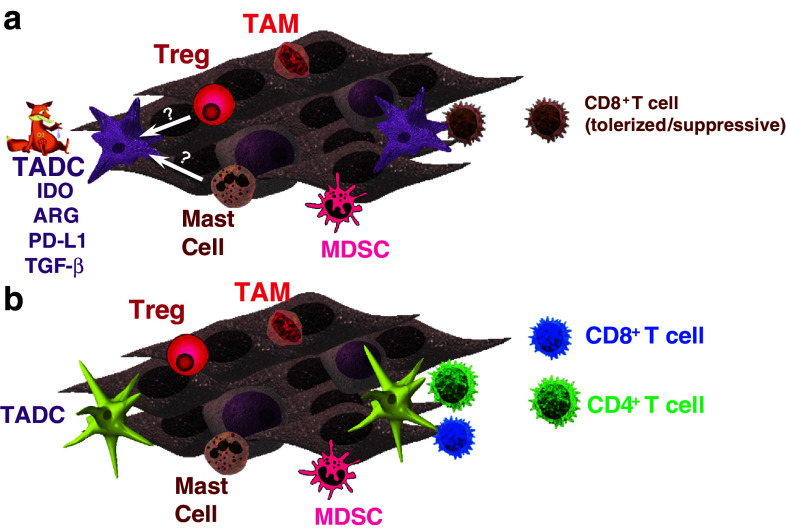
Tumor-associated dendritic cells regulate T cell responsiveness in the tumor microenvironment. a The prostatic tumor microenvironment (TME) contains a variety of inflammatory cells that contribute to immune suppression. Tumor-associated dendritic cells (TADCs) tolerize CD8+ T cells that enter the TME in a FOXO3-dependent mechanism. Induction of this tolerogenic behavior by TADCs may be mediated by Treg cells, mast cells, or tumor-derived factors. b Provision of tumor-specific CD4+ T cells alters the TME and prevents tolerization of CD8+ T cells. This is in part mediated by the activation of TADC and down-regulation of FOXO3 expression by TADC
References
-
- Belladonna ML, Volpi C, Bianchi R, et al. Cutting edge: autocrine TGF-beta sustains default tolerogenesis by IDO-competent dendritic cells. J Immunol. 2008;181:5194–5198. - PubMed
Publication types
MeSH terms
Substances
Grants and funding
LinkOut - more resources
Full Text Sources
Research Materials
