


Review
doi: 10.1002/msj.21288.
Long-term outcomes in elderly surgical patients
Affiliations
- PMID: 22238042
- PMCID: PMC3261586
- DOI: 10.1002/msj.21288
Item in Clipboard
Review
Long-term outcomes in elderly surgical patients
Mt Sinai J Med.
2012 Jan-Feb.
Abstract
Anesthesia has developed to the point where long-term outcomes are important endpoints. Elderly patients are becoming an increasingly large part of most surgical practices, consistent with demographic shifts. Long-term outcomes are particularly important for this group. In this review, we discuss functional outcomes in the elderly. We describe the areas of cognitive change and frailty, both of which are specific to the elderly. We also discuss prevention of surgical infections and emerging evidence around hemodynamic alterations in the operating room and their impact on long-term outcomes.
© 2012 Mount Sinai School of Medicine.
Figures
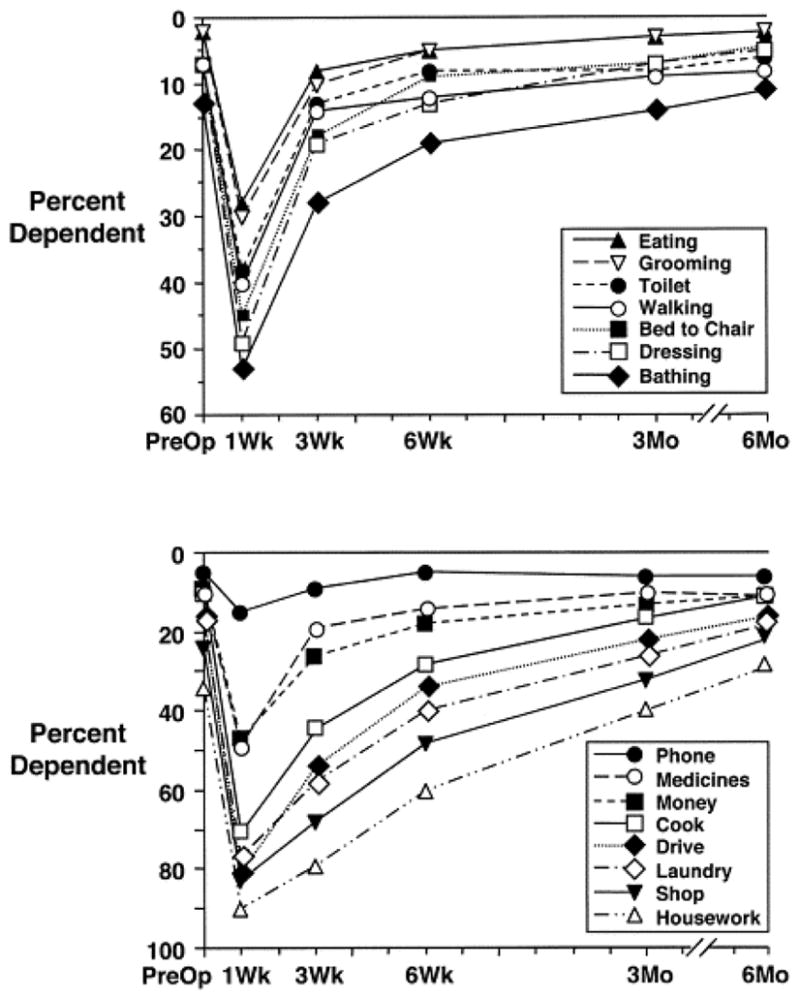
Rates of dependency in individual Activities of Daily Living (ADL) and Instrumental Activities of Daily Living (IADL) activities. (used with permission from : Journal of the American College of Surgeons, 2004; 199, : 762–772).
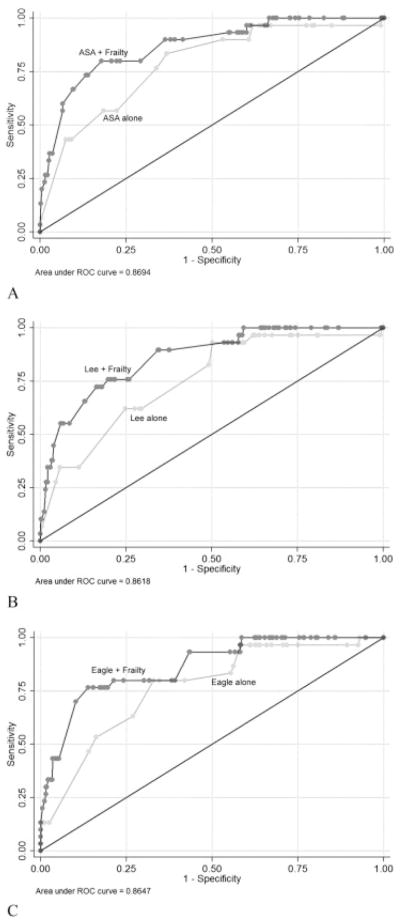
(A) American Society of Anesthesiologists (ASA), (B) Lee, and (C) Eagle risk indices. Each panel shows the area under the receiver operator characteristics (ROC) curve to demonstrate the ability of the specific risk index to predict surgical complications and discharge to an assisted or skilled nursing facility. Frailty was added to the risk index scoring to demonstrate the combined ability of these indices to predict discharge disposition. (used with permission from Journal of the American College of Surgeons, 2010; 210: 901–908)
References
-
- Bentrem DJ, Cohen ME, Hynes DM, Ko CY, Bilimoria KY. Identification of specific quality improvement opportunities for the elderly undergoing gastrointestinal surgery. Arch Surg. 2009;144:1013–20. - PubMed
-
- Ochsner A. Is risk of operation too great in the elderly? Geriatrics. 1927;22:121. - PubMed
-
- Rowe JW, Kahn RL. Successful aging. Gerontologist. 1997;37:433–40. - PubMed
-
- Silverstein JH, Rooke GA. Hazzard’s Geriatric Medicine and Gerontology. 6. New York: McGraw Hill; 2009. Anesthesia; p. 417.
Publication types
MeSH terms
Grants and funding
LinkOut - more resources
Full Text Sources
Medical
