


Study of genotypic and phenotypic HIV-1 dynamics of integrase mutations during raltegravir treatment: a refined analysis by ultra-deep 454 pyrosequencing
- PMID: 22238474
- PMCID: PMC3266134
- DOI: 10.1093/infdis/jir821
Study of genotypic and phenotypic HIV-1 dynamics of integrase mutations during raltegravir treatment: a refined analysis by ultra-deep 454 pyrosequencing
Abstract
Background: The dynamics of raltegravir-resistant variants and their impact on virologic response in 23 HIV-1-infected patients, who started a salvage raltegravir-containing regimen, were investigated.
Methods: Integrase population sequencing and Ultra-Deep-454 Pyrosequencing (UDPS) were performed on plasma samples at baseline and at raltegravir failure. All integrase mutations detected at a frequency ≥1% were considered to be reliable for the UDPS analyses. Phylogenetic and phenotypic resistance analyses were also performed.
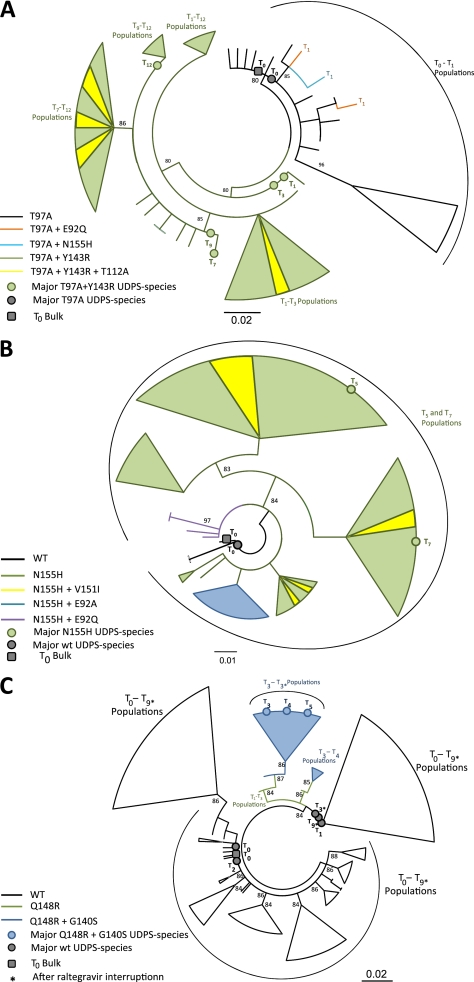
Results: At baseline, primary resistance mutations were not detected by both population and UDPS genotypic assays; few secondary mutations (T97A-V151I-G163R) were rarely detected and did not show any statistically association either with virologic response at 24-weeks or with the development of resistant variants at failure. At UDPS, not all resistant variants appearing early during treatment evolved as major populations during failure; only specific resistance pathways (Y143R-Q148H/R-N155H) associated with an increased rate of fitness and phenotypic resistance were selected.
Conclusions: Resistance to raltegravir in integrase strand transfer inhibitor-naive patients remains today a rare event, which might be changed by future extensive use of such drugs. In our study, pathways of resistance at failure were not predicted by baseline mutations, suggesting that evolution plus stochastic selection plays a major role in the appearance of integrase-resistance mutations, whereas fitness and resistance are dominant factors acting for the late selection of resistant quasispecies.
Figures
References
-
- Johnson JA, Geretti AM. Low-frequency HIV-1 drug resistance mutations can be clinically significant but must be interpreted with caution. J Antimicrob Chemother. 2010;65:1322–6. - PubMed
-
- Kuritzkes DR, Lalama CM, Ribaudo HJ, et al. Preexisting resistance to nonnucleoside reverse-transcriptase inhibitors predicts virologic failure of an efavirenz-based regimen in treatment-naive HIV-1-infected subjects. J Infect Dis. 2008;197:867–70. - PubMed
Publication types
MeSH terms
Substances
Associated data
- Actions
- Actions
- Actions
- Actions
- Actions
- Actions
- Actions
- Actions
- Actions
- Actions
- Actions
- Actions
- Actions
- Actions
- Actions
- Actions
- Actions
- Actions
- Actions
- Actions
- Actions
- Actions
- Actions
- Actions
- Actions
- Actions
- Actions
- Actions
- Actions
- Actions
- Actions
- Actions
- Actions
- Actions
- Actions
- Actions
- Actions
- Actions
- Actions
- Actions
LinkOut - more resources
Full Text Sources
Medical
Molecular Biology Databases
