. 2011:7:1622-35.
doi: 10.3762/bjoc.7.191. Epub 2011 Dec 5.

Natural product biosyntheses in cyanobacteria: A treasure trove of unique enzymes

Affiliations

Natural product biosyntheses in cyanobacteria: A treasure trove of unique enzymes

Jan-Christoph Kehr et al. Beilstein J Org Chem. 2011.

Abstract

Cyanobacteria are prolific producers of natural products. Investigations into the biochemistry responsible for the formation of these compounds have revealed fascinating mechanisms that are not, or only rarely, found in other microorganisms. In this article, we survey the biosynthetic pathways of cyanobacteria isolated from freshwater, marine and terrestrial habitats. We especially emphasize modular nonribosomal peptide synthetase (NRPS) and polyketide synthase (PKS) pathways and highlight the unique enzyme mechanisms that were elucidated or can be anticipated for the individual products. We further include ribosomal natural products and UV-absorbing pigments from cyanobacteria. Mechanistic insights obtained from the biochemical studies of cyanobacterial pathways can inspire the development of concepts for the design of bioactive compounds by synthetic-biology approaches in the future.

Keywords: NRPS; PKS; cyanobacteria; natural products; ribosomal peptides.


Figures
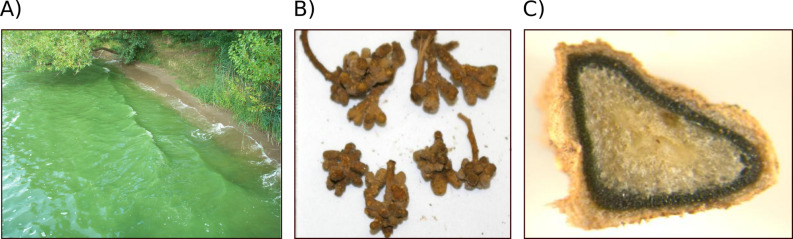
Figure 1
Figure 1
Cyanobacteria proliferate in diverse habitats. A) Bloom-forming freshwater cyanobacteria of the genus Microcystis. B) Roots of cyanobacterial symbiosis host Cycas circinalis. C) Terrestrial cyanobacteria living in corraloid roots of Cycas circinalis.
Figure 2
Figure 2
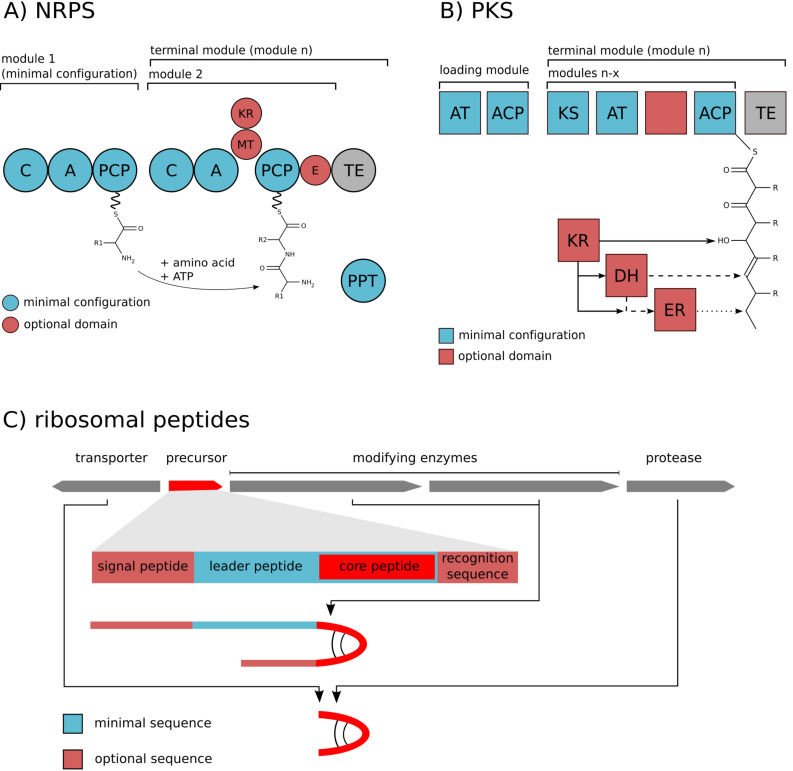
Schematic representation of enzymatic domains in A) nonribosomal peptide synthetases (NRPS); B) polyketide synthases (PKS) and C) the typical organisation of a ribosomal biosynthetic gene cluster. Abbreviations: C: Condensation domain; A: Adenylation domain; PCP: Peptidyl carrier protein; MT: Methyltransferase; E: Epimerase; AT: Acyltransferase; ACP: Acyl carrier protein; KS: Ketosynthase; KR: Ketoreductase; DH: Dehydratase; ER: Enoyl reductase; TE: Thioesterase.
Figure 3
Figure 3
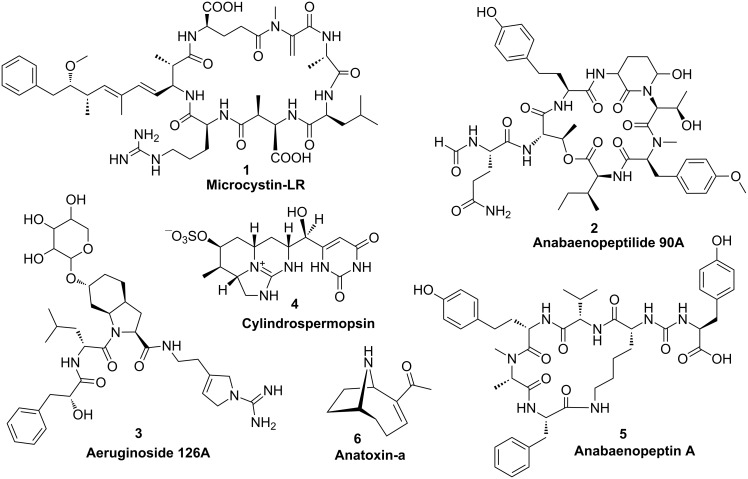
Structures of NRPS and PKS products in freshwater cyanobacteria.
Figure 4
Figure 4
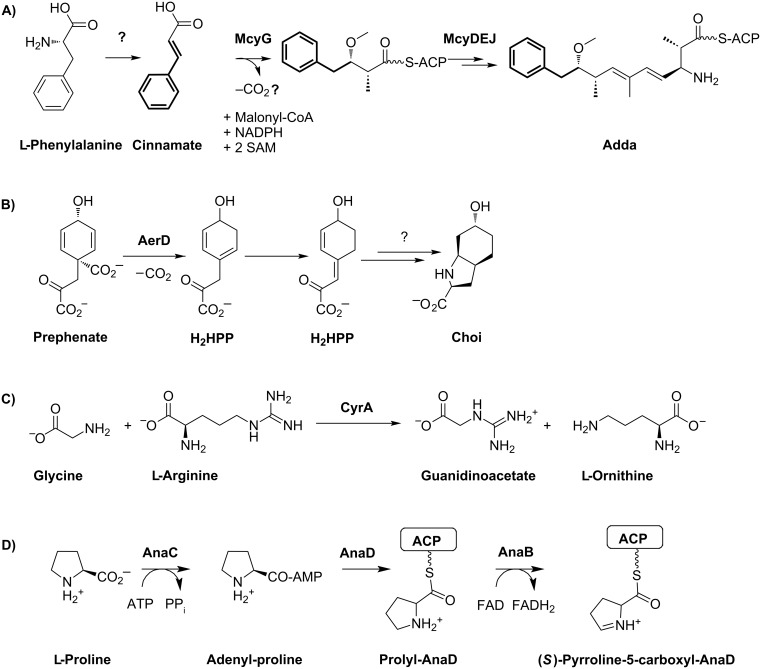
A) Synthesis of the Adda ((2S,3S,8S,9S)-3-amino-9-methoxy-2,6,8-trimethyl-10-phenyl-4,6-decadienoic acid) moiety of microcystin (1) starting with cinnamate. The mechanism of α-carbon decarboxylation has to be elucidated. B) Synthesis of the Choi moiety of the aeruginosin 3. H2HPP: Dihydro-4-hydroxyphenylpyruvate. C) Formation of the guanidinoacetate starter unit for the subsequent PKS assembly line of cylindrospermopsin (4). D) Formation of the (S)-pyrroline-5-carboxylate starter unit from proline in anatoxin-a (6) synthesis. ACP: Acyl carrier protein.
Figure 5
Figure 5
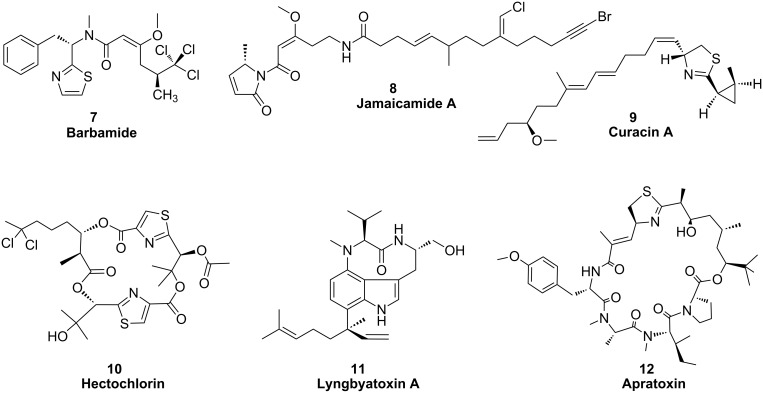
Structures of NRPS and PKS products in marine cyanobacteria.
Figure 6
Figure 6
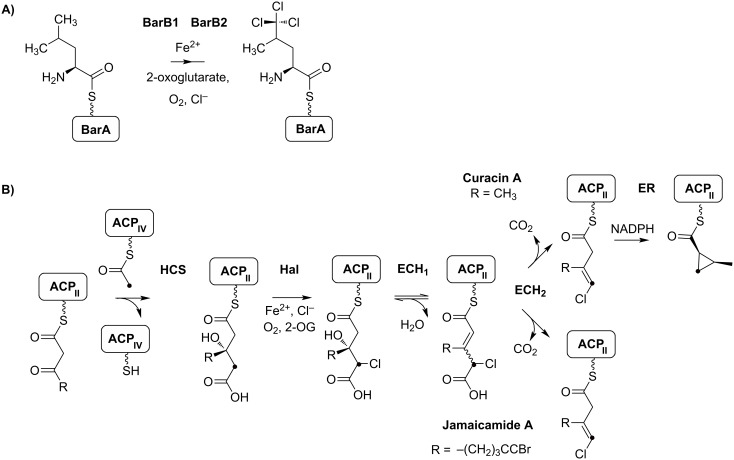
A) Formation of the trichloroleucyl starter unit of barbamide (7) synthesis through the non-heme iron(II)-dependent halogenases BarB1 and BarB2. B) Formation of cyclopropane and vinyl chloride functional groups in curacin A (9) and jamaicamide A (8) biosynthesis, respectively. The halogenated carbon is highlighted with a black dot. ACP: Acyl carrier protein; HCS: HMG-CoA synthase-like enzyme; Hal: Halogenase; ECH1: Dehydratase; ECH2: Decarboxylase; ER: Enoyl reductase.
Figure 7
Figure 7
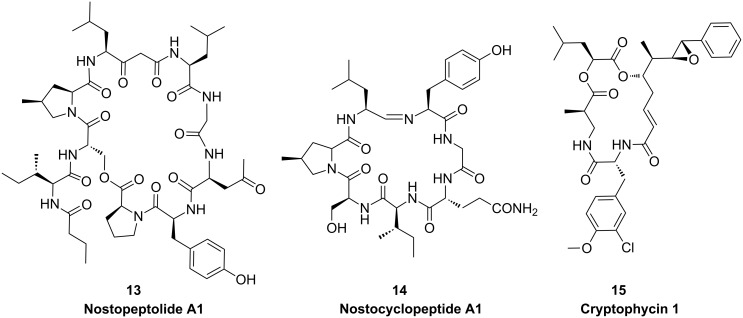
Structures of NRPS and PKS products in terrestrial cyanobacteria.
Figure 8
Figure 8
Synthesis of the (2S,4S)-4-methylproline moiety of nostopeptolides A (13).
Figure 9
Figure 9
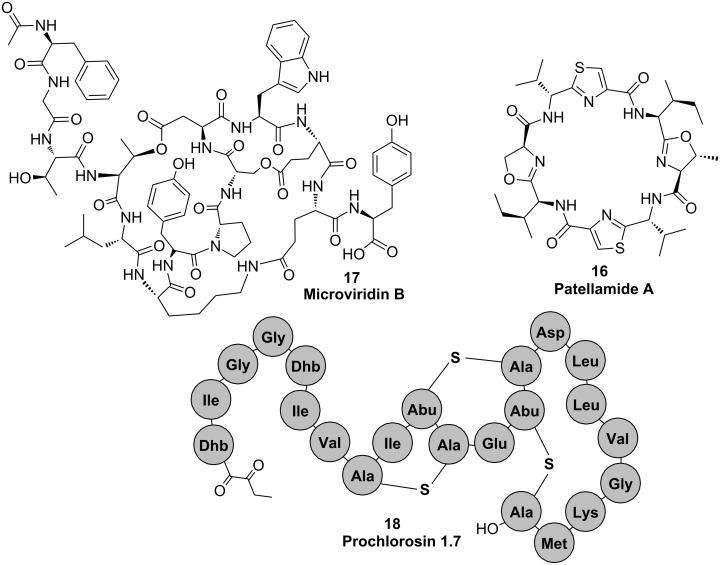
Structures of cyanobacterial peptides that are synthesized ribosomally and post-translationally modified.
Figure 10
Figure 10
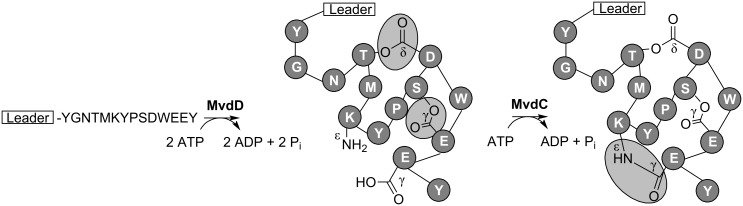
Formation of ester linkages and ω-amide linkage in microviridins 17 by the ATP grasp ligases MvdD and MvdC, respectively.
Figure 11
Figure 11
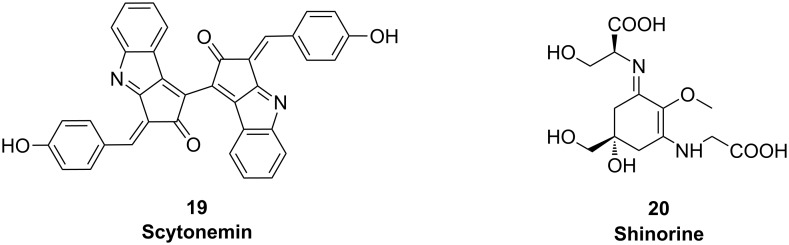
Structures of cyanobacterial sunscreen compounds.

References

    1. Rippka R. Methods Enzymol. 1988;167:3–27. doi: 10.1016/0076-6879(88)67004-2. - DOI - PubMed
    1. Rai A N, Söderbäck E, Bergman B. New Phytol. 2000;147:449–481. doi: 10.1046/j.1469-8137.2000.00720.x. - DOI - PubMed
    1. Paerl H W, Fulton R S, III, Moisander P H, Dyble J. TheScientificWorldJOURNAL. 2001;1:76–113. doi: 10.1100/tsw.2001.16. - DOI - PMC - PubMed
    1. Dittmann E, Wiegand C. Mol Nutr Food Res. 2006;50:7–17. doi: 10.1002/mnfr.200500162. - DOI - PubMed
    1. Patterson G M L, Larsen L K, Moore R E J. Appl Phycol. 1994;6:151–157. doi: 10.1007/BF02186069. - DOI

LinkOut - more resources