


A randomized controlled trial of adjunctive family therapy and treatment as usual following inpatient treatment for anorexia nervosa adolescents
- PMID: 22238574
- PMCID: PMC3251571
- DOI: 10.1371/journal.pone.0028249
A randomized controlled trial of adjunctive family therapy and treatment as usual following inpatient treatment for anorexia nervosa adolescents
Abstract
Research on treatments in anorexia nervosa (AN) is scarce. Although most of the therapeutic programs used in 'real world practice' in AN treatment resort to multidisciplinary approaches, they have rarely been evaluated.
Objective: To compare two multidimensional post-hospitalization outpatients treatment programs for adolescents with severe AN: Treatment as Usual (TAU) versus this treatment plus family therapy (TAU+FT).
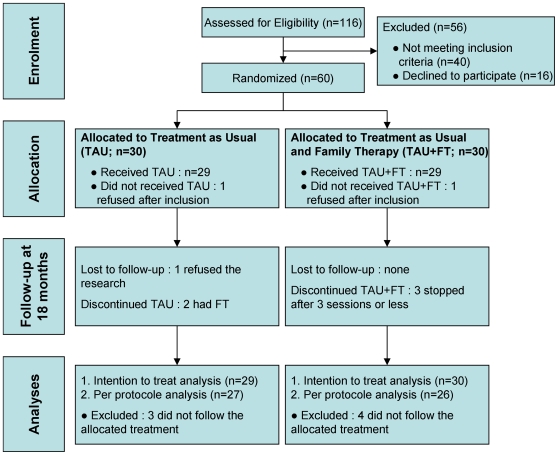
Method: Sixty female AN adolescents, aged 13 to 19 years, were included in a randomized parallel controlled trial conducted from 1999 to 2002 for the recruitment, and until 2004 for the 18 months follow-up. Allocation to one of the two treatment groups (30 in each arm) was randomised. The TAU program included sessions for the patient alone as well as sessions with a psychiatrist for the patient and her parents. The TAU+FT program was identical to the usual one but also included family therapy sessions targeting intra-familial dynamics, but not eating disorder symptoms. The main Outcome Measure was the Morgan and Russell outcome category (Good or Intermediate versus Poor outcome). Secondary outcome indicators included AN symptoms or their consequences (eating symptoms, body mass index, amenorrhea, number of hospitalizations in the course of follow-up, social adjustment). The evaluators, but not participants, were blind to randomization.
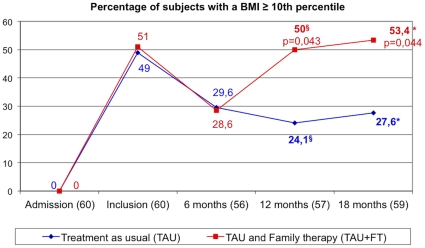
Results: At 18 months follow-up, we found a significant group effect for the Morgan and Russell outcome category in favor of the program with family therapy (Intention-to-treat: TAU+FT :12/30 (40%); TAU : 5/29 (17.2%) p = 0.05; Per Protocol analysis: respectively 12/26 (46.2%); 4/27 (14.8%), p = 0.01). Similar group effects were observed in terms of achievement of a healthy weight (i.e., BMI≥10(th) percentile) and menstrual status.
Conclusions: Adding family therapy sessions, focusing on intra-familial dynamics rather than eating symptomatology, to a multidimensional program improves treatment effectiveness in girls with severe AN.
Trial registration: Controlled-trials.com ISRCTN71142875.
Conflict of interest statement
Figures
References
-
- Hoek HW, van Hoeken D. Review of the prevalence and incidence of eating disorders. Int J Eat Disord. 2003;34:383–396. - PubMed
-
- Keski-Rahkonen A, Hoek HW, Susser ES, Linna MS, Sihvola E, et al. Epidemiology and course of anorexia nervosa in the community. Am J Psychiatry. 2007;164:1259–1265. - PubMed
-
- Flament MF, Godart NT, Fermanian J, Jeammet P. Predictive factors of social disability in patients with eating disorders. Eat Weight Disord. 2001;6:99–106. - PubMed
-
- Godart NT, Perdereau F, Curt F, Lang F, Venisse JL, et al. Predictive factors of social disability in anorexic and bulimic patients. Eat Weight Disord. 2004;9:249–257. - PubMed
Publication types
MeSH terms
Associated data
LinkOut - more resources
Full Text Sources
