doi: 10.1038/embor.2011.259.
Neutrophils--the unexpected helpers of B-cell activation
Affiliations
- PMID: 22240972
- PMCID: PMC3271345
- DOI: 10.1038/embor.2011.259
Item in Clipboard
Neutrophils--the unexpected helpers of B-cell activation
EMBO Rep.
.
No abstract available
Figures
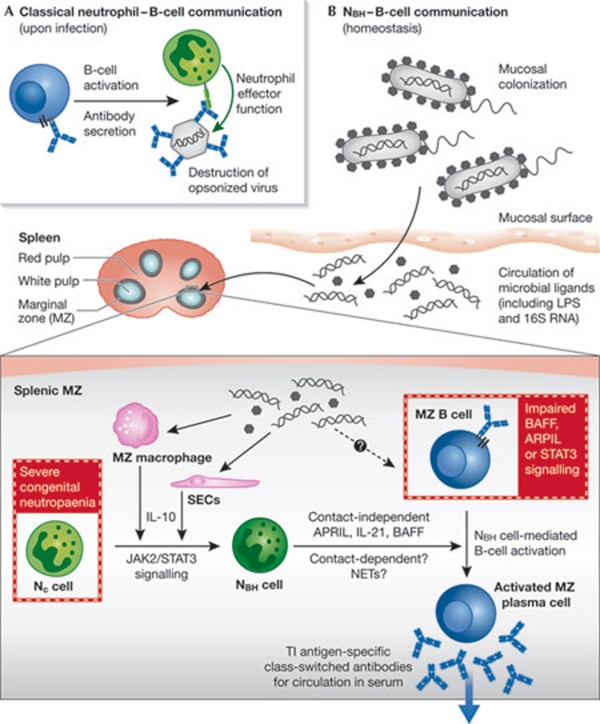
Cross-talk between neutrophils and B cells. (A) In response to infection, neutrophils (green) have been traditionally thought to opsonize pathogens that are coated with antibodies secreted by B cells (blue). (B) The newly identified B-helper neutrophil population (NBH, dark green) in the splenic marginal zone (MZ, grey) can activate MZ B cells (dark blue) to secrete antibodies against TI antigens. This probably occurs through the secretion of APRIL, BAFF and IL-21 in a contact-independent mechanism, although contact-dependent and/or neutrophil extracellular traps (NETs) might also play a role. Secreted antibodies are often class-switched and might enter the general circulation to provide basal innate immunity against microbial pathogens. NBH cells probably arise from circulatory neutrophils (Nc) as a result of JAK2 and STAT3 signalling, in response to IL-10 secretion by sinusoidal endothelial cells (SECs) and/or macrophages. This might be triggered by microbial ligands present in the general circulation that are translocated across mucosal surfaces after bacterial colonization. Patients with severe congenital neutropenia have reduced levels of antibodies against TI antigen, and patients with altered signalling in response to BAFF, APRIL and IL-21 have impaired MZ B-cell development (both highlighted in red boxes). LPS, lipopolysaccharide; TI, T-cell-independent.
References
MeSH terms
Substances
Grants and funding
LinkOut - more resources
Full Text Sources