. 2011 Oct 20:10:93.
doi: 10.1186/1475-925X-10-93.

Neonatal non-contact respiratory monitoring based on real-time infrared thermography

Affiliations

Neonatal non-contact respiratory monitoring based on real-time infrared thermography

Abbas K Abbas et al. Biomed Eng Online. .

Abstract

Background: Monitoring of vital parameters is an important topic in neonatal daily care. Progress in computational intelligence and medical sensors has facilitated the development of smart bedside monitors that can integrate multiple parameters into a single monitoring system. This paper describes non-contact monitoring of neonatal vital signals based on infrared thermography as a new biomedical engineering application. One signal of clinical interest is the spontaneous respiration rate of the neonate. It will be shown that the respiration rate of neonates can be monitored based on analysis of the anterior naris (nostrils) temperature profile associated with the inspiration and expiration phases successively.

Objective: The aim of this study is to develop and investigate a new non-contact respiration monitoring modality for neonatal intensive care unit (NICU) using infrared thermography imaging. This development includes subsequent image processing (region of interest (ROI) detection) and optimization. Moreover, it includes further optimization of this non-contact respiration monitoring to be considered as physiological measurement inside NICU wards.

Results: Continuous wavelet transformation based on Debauches wavelet function was applied to detect the breathing signal within an image stream. Respiration was successfully monitored based on a 0.3°C to 0.5°C temperature difference between the inspiration and expiration phases.

Conclusions: Although this method has been applied to adults before, this is the first time it was used in a newborn infant population inside the neonatal intensive care unit (NICU). The promising results suggest to include this technology into advanced NICU monitors.


Figures
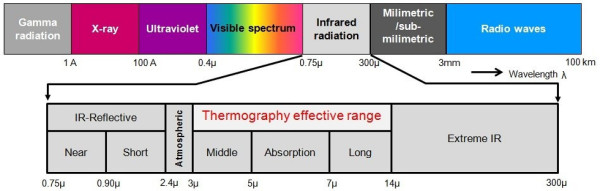
Figure 1
Figure 1
The electromagnetic spectrum. The electromagnetic spectrum showing the infrared radiation classification and corresponding wavelengths, (© MedIT, 2011).
Figure 2
Figure 2
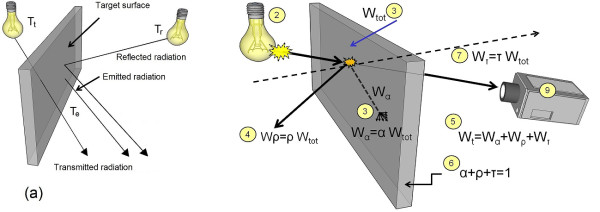
Heat radiation mechanism. Heat radiation mechanism (a) The radiative heat flow mechanism, where total exitance or radiosity equal to the sum of reflected radiation Wr=ε.σ.Tr4, transmitted radiation Wt=ε.σ.Tt4 and emitted radiation We=ε.σ.Te4, (b) The concept of impinging the process of radiation on a target surface, where (1) is the total radiant energy, (2) heat source,(3) absorbed energy, (4) reflected energy, (5) transmitted energy, (6) total detected energy and (7) total surface properties (© MedIT, 2011).
Figure 3
Figure 3
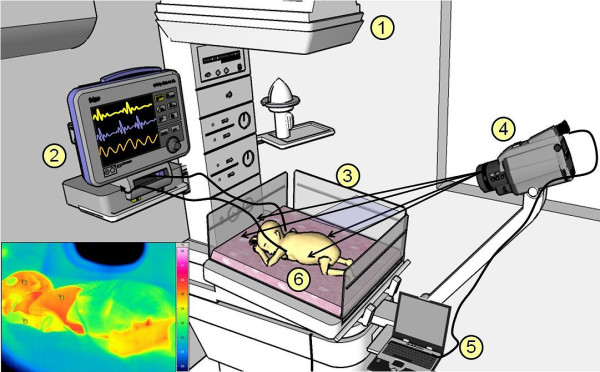
IRTR clinical imaging setup. Schematic of the experimental setup used for the neonatal infrared respiration monitoring technique. The IR camera is located 70 - 80 cm from the neonate and is connected to the IR acquisition/analysis workstation. The infant's nostrils have to be in direct optical contact and visible, the overall setting consist of (1) radiant warmer bed,(2) bedside monitor,(3) camera field of view (FOV),(4) IR thermal camera, (5) analysis workstation and (6) infant under NIRT imaging (© MedIT, 2011).
Figure 4
Figure 4
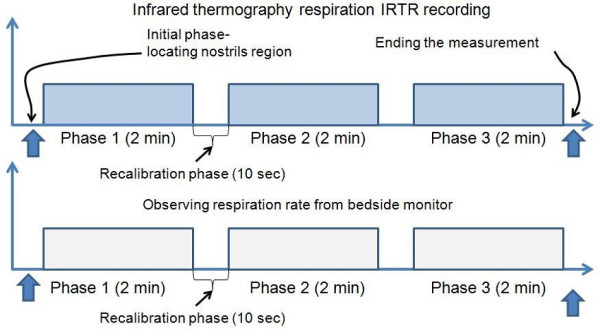
IRTR measurement protocol. The IRTR signal measurement protocol which include three phases and in between a recalibration phase to compensate any non-uniformities within infrared thermography imaging.
Figure 5
Figure 5
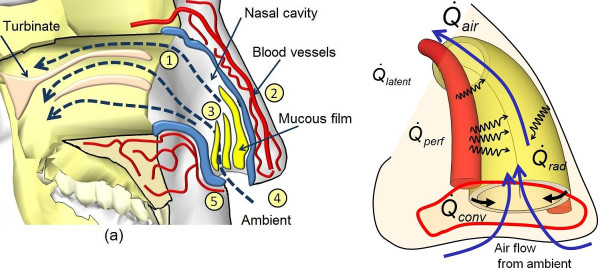
Physiology of heat transfer processes inside nasal cavity. (a) Anatomical section through the nasal cavity, showing the mechanism of heat exchange between the internal tissue lining and the flowing air inside the nasal cavity (inspiration-expiration phase) which consist of the following: (1) convective air flow inside nasal cavity, (2) perfusion heat transfer inside nasal blood vessels, (3) convective heat loss over mucosal film, (4) conductive heat loss of mucosal film on nostrils inner lining and (5) radiative heat loss from nostrils tissue, (b) schematic representation of heat transfer processes inside the nasal cavity, (© MedIT, 2011).
Figure 6
Figure 6
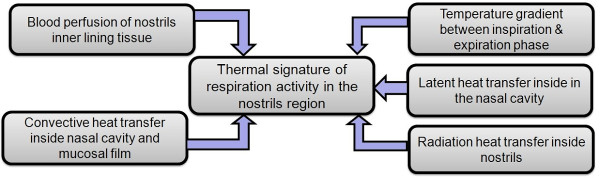
Physical parameter interaction in respiration thermal signature. Interaction of the physical parameters that contribute to the detection of the respiration thermal signature (©MedIT, 2011).
Figure 7
Figure 7
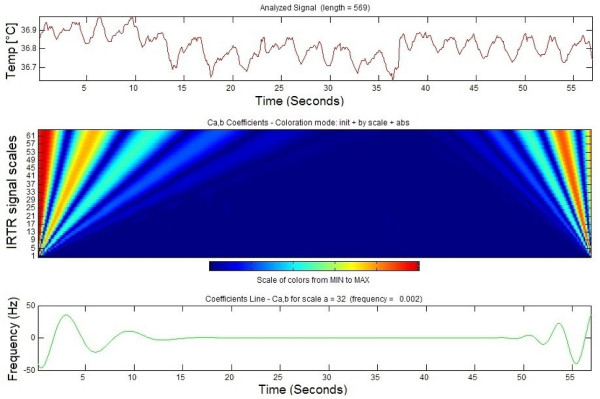
IRTR signal wavelet analysis. Wavelet analysis of the IRTR signal extracted from the region of the nostrils of a neonate during a one-minute interval.
Figure 8
Figure 8
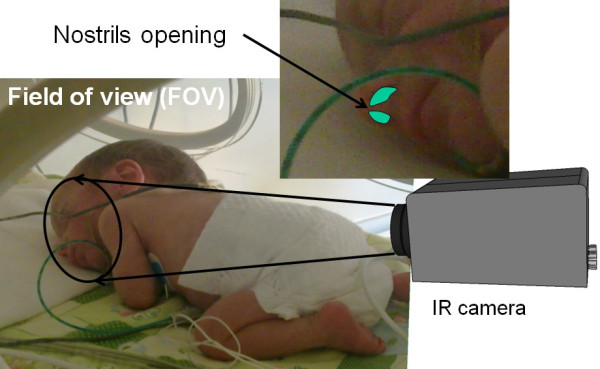
IRTR camera setting with field of view (FOV) and region of interest (ROI) over neonate's nostrils. Infrared camera setting for detection of neonatal respiration activity, showing the region of interest around the neonate's nostrils.
Figure 9
Figure 9
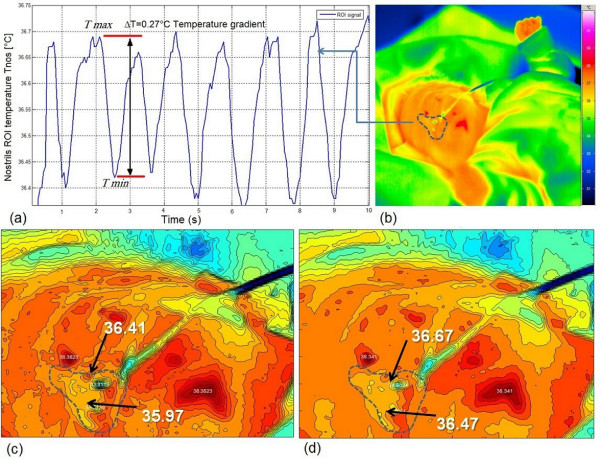
IRTR image over neonate's nostrils. Top: Neonatal infrared thermographic image with (a) IRTR signal with δT = 0.27°C between inspiration and expiration (b) ROI located over the nostrils from which signal in (a) derived. Bottom: Thermal contour plot of the thermography clearly showing the thermal signature over this region at (c) inspiration phase starting and (d) at the expiration phase starting.
Figure 10
Figure 10
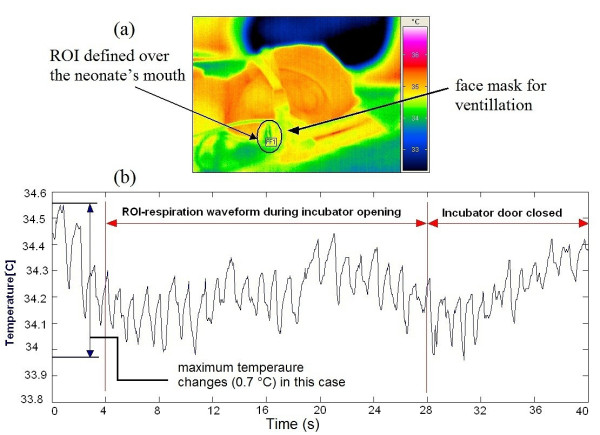
IRTR signal of defined ROI temperature trend over neonate's mouth. (a) Neonatal infrared thermographic imaging inside a neonatal incubator with the ROI around the mouth opening, (b) Fluctuating temperature trend of the neonate during normal activities of daily care.
Figure 11
Figure 11
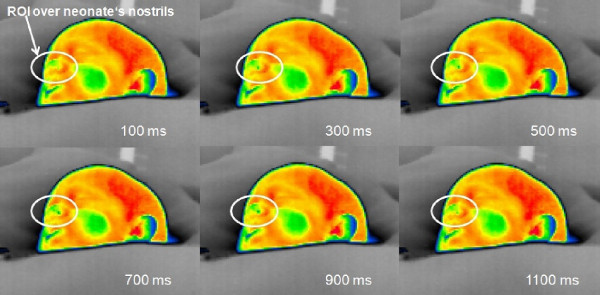
Series of IRTR image during open care procedure. Images of the IRTR signal detection process in the neonate. The sequence indicates tracking of one respiration cycle for 1100 ms; this interval is not fixed over the measurement period of time, but varies according to the physiological and clinical status of the neonate.
Figure 12
Figure 12
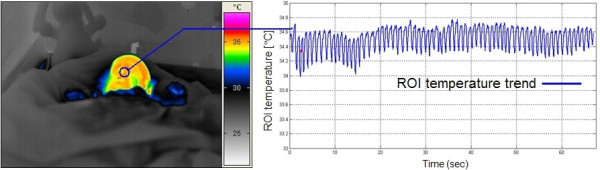
IRTR signal of neonate under open therapy (IR radiant warmer). (Left) Neonatal respiration monitoring acquired from a newborn infant under the intensive open-care system, indicating that the respiration thermal signature is difficult to detect unless there is a good calibration and image zooming functions to identify temperature variation during the inspiration-expiration phases. (Right) Time graph of the ROI temperature profile over the nasal region, extracted and recorded for about 60 seconds.

References

    1. Murthy JN, van Jaarsveld J, Fei J, Pavlidis I, Harrykissoon R, Lucke. Thermal infrared imaging: A novel method to monitor airflow during polysomnography. SLEEP. 2009;32:15211527. - PMC - PubMed
    1. Wang JQ, Wang HB, Jin XJ, Yang GS, Yang B, Dong XZ, Qiu LJ. The study on non-contact detection of breathing and heartbeat based on radar principles. Fourth Medical Military conference. 2001;25:132–135. - PubMed
    1. de Chazal P, O'Hare E, Fox N, Heneghan C. Assessment of sleep/wake patterns using a non-contact biomotion sensor. In Conf Proc IEEE Eng Med Biol Soc. 2008;33:514–517. IEEE. - PubMed
    1. Matthews G, Sudduth B, Burrow M. A non-contact vital signs monitor. Crit Rev Biomed Eng. 2000;28(1-2):173–178. - PubMed
    1. Droitcour AD, Seto TB, Park BK, Yamada S, Vergara A, Hourani CE, Shing T, Yuen A, Lubecke VM, Boric-Lubecke O. Non-contact respiratory rate measurement validation for hospitalized patients. Conf Proc IEEE Eng Med Biol Soc 2009. 2009;24:4812–4815. - PMC - PubMed

LinkOut - more resources