


Comment
doi: 10.1016/j.neuron.2011.12.017.
Adaptive switches in midbrain circuits
Affiliations
- PMID: 22243742
- PMCID: PMC3402024
- DOI: 10.1016/j.neuron.2011.12.017
Item in Clipboard
Comment
Adaptive switches in midbrain circuits
Neuron.
.
Abstract
In this issue of Neuron, Mysore and Knudsen (2012) describe a simple, anatomically supported circuit that can categorize stimuli into "strongest" and "others," regardless of their absolute strength. Such flexible categorization cannot be achieved by lateral inhibition alone but also requires that the inhibitory neurons reciprocally inhibit each other.
Copyright © 2012 Elsevier Inc. All rights reserved.
Figures

The circuit diagram is shown on the left. Input and output neurons are marked with circles; diamonds mark inhibitory neurons. Right: the responses of output 1 are plotted as a function of “competitor” input 2, for different values of input 1 (corresponding to the stimulus strength within the receptive field). The switch between high and low values of output 1 occurs for the same value of competitor input 2, regardless of input 1. Input and output strength are in arbitrary units.
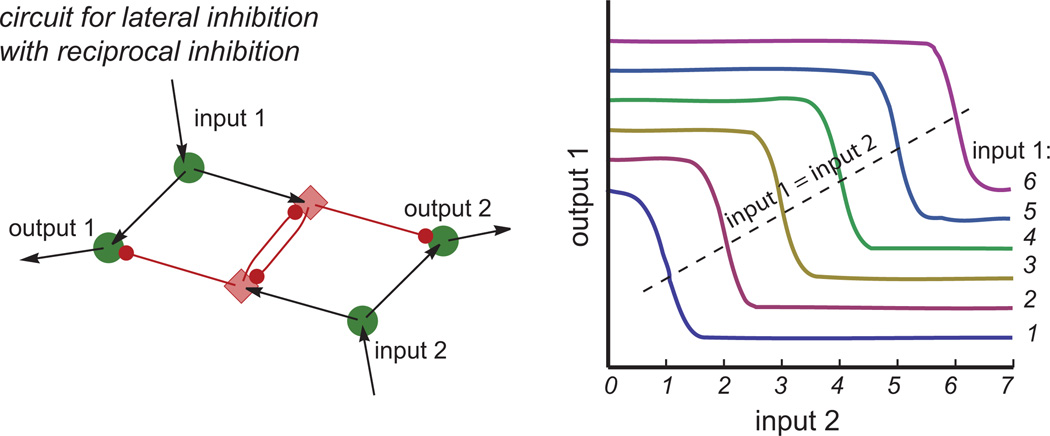
Notations are as in Figure 1. The main difference is the switch from low to high level in output 1 occurs when “competitor” input 2 exceeds the “main” input 1.
Comment on
-
Reciprocal inhibition of inhibition: a circuit motif for flexible categorization in stimulus selection.Neuron. 2012 Jan 12;73(1):193-205. doi: 10.1016/j.neuron.2011.10.037. Neuron. 2012. PMID: 22243757 Free PMC article.
References
-
- Berry MJ, 2nd, Brivanlou IH, Jordan TA, Meister M. Nature. 1999;398:334–338. - PubMed
-
- Lettvin JY, Maturana HR, McCulloch WS, Pitts WH. What the frog’s eye tells the frog’s brain. Proc. IRE. 1959;47:1940–1951.
Publication types
MeSH terms
Grants and funding
LinkOut - more resources
Full Text Sources
