. 2012 Apr;101(2):288-96.
doi: 10.1016/j.pbb.2011.12.018. Epub 2011 Dec 31.

The cystine-glutamate transporter enhancer N-acetyl-L-cysteine attenuates cocaine-induced changes in striatal dopamine but not self-administration in squirrel monkeys

Affiliations

The cystine-glutamate transporter enhancer N-acetyl-L-cysteine attenuates cocaine-induced changes in striatal dopamine but not self-administration in squirrel monkeys

Rayna M Bauzo et al. Pharmacol Biochem Behav. 2012 Apr.

Abstract

Extrasynaptic glutamate has been shown to regulate dopamine function in the mesocorticolimbic pathway, which plays an important role in the behavioral pharmacology of psychostimulants. Basal levels of glutamate are primarily regulated by the cystine-glutamate transporter and provide glutamatergic tone on extrasynaptic glutamate receptors. The present study examined the effects of a cystine-glutamate transporter enhancer on the neurochemical and behavioral effects of cocaine and amphetamine in nonhuman primates. It was hypothesized that augmenting extrasynaptic glutamate release with N-acetyl-L-cysteine (NAC), a cystine prodrug, would attenuate cocaine- or amphetamine-induced increases in extracellular dopamine and their corresponding behavioral-stimulant and reinforcing effects. In vivo microdialysis was used to evaluate cocaine-induced changes in extracellular dopamine (DA) in the caudate nucleus (n=3). NAC significantly attenuated cocaine-induced increases in dopamine but had inconsistent effects on amphetamine-induced increases in dopamine (n=4). Separate groups of subjects were either trained on a fixed-interval schedule of stimulus termination (n=6) or on a second-order schedule of self-administration (n=5) to characterize the behavioral-stimulant and reinforcing effects of psychostimulants, respectively. Systemic administration of NAC did not alter the behavioral-stimulant effects of either cocaine or amphetamine. Furthermore, cocaine self-administration and reinstatement of previously extinguished cocaine self-administration were not altered by pretreatment with NAC. Hence, drug interactions on caudate neurochemistry in vivo were not reflected in behavioral measures in squirrel monkeys. The present results in nonhuman primates do not support the use of NAC as a pharmacotherapy for cocaine abuse, although rodent and clinical studies suggest otherwise.


Conflict of interest statement

DISCLOSURE STATEMENT None of the authors have any actual or potential conflict of interest including any financial, personal or other relationships with other people or organizations within three years of beginning the work submitted that could inappropriately influence our work.

Figures

Figure 1
Figure 1
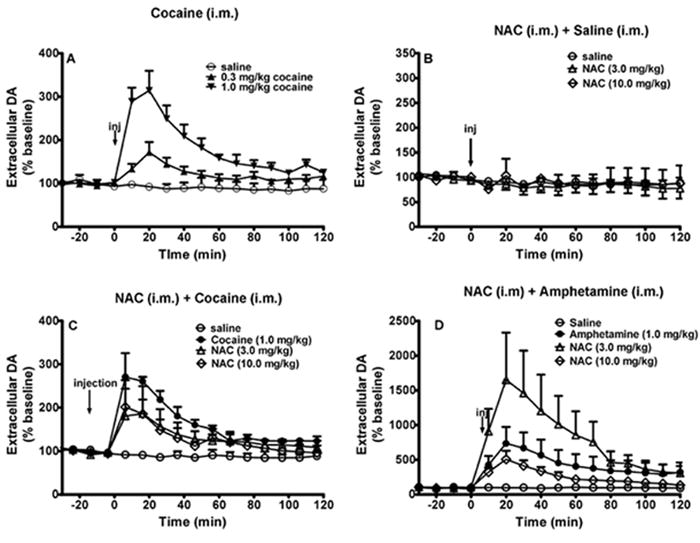
Cocaine administration (0.3 and 1.0 mg/kg, i.m.) dose-dependently increased extracellular dopamine in the caudate (A) of three squirrel monkeys. Neither administration of saline (i.m.) nor of NAC (i.m.) significantly altered extracellular dopamine when administered as a pretreatment to saline (B). However, NAC pretreatment significantly attenuated cocaine-induced increases in extracellular dopamine (C). The lower dose of NAC (3.0 mg/kg) tended to enhance amphetamine-induced increases in extracellular dopamine, while a higher dose of NAC (10 mg/kg) slightly attenuated amphetamine-induced increases in extracellular dopamine (D). Arrows indicate the point at which saline or drug was administered. Data points represent mean ± SEM dopamine levels as a percent of values obtained prior to drug administration. Abscissae: time in minutes. Ordinates: extracellular concentrations of dopamine expressed as a percent of baseline control levels.
Figure 2
Figure 2
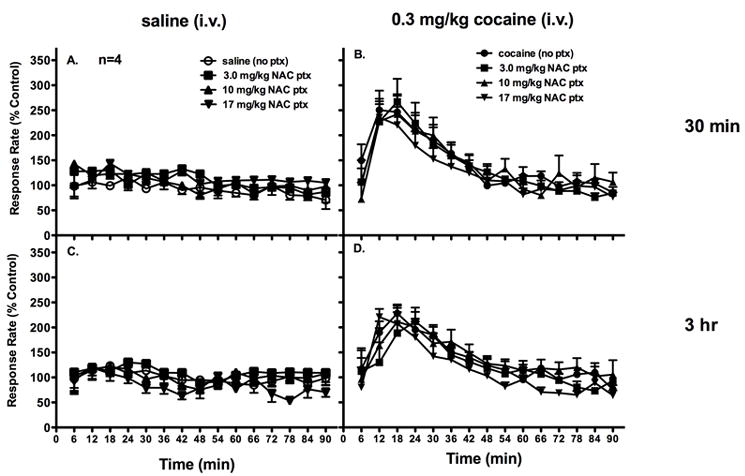
Pretreatment with NAC (i.m.) 30 min or 3 hr prior to i.v. administration of saline did not significantly alter rates of responding under a fixed-interval avoidance schedule (A, C). Pretreatment with NAC (i.m.) 30 min or 3 h prior to cocaine administration did not significantly alter cocaine-induced increases in rates of responding (B, D). Abscissae: time in minutes. Ordinates: rates of responding expressed as a percent of baseline control rates.
Figure 3
Figure 3
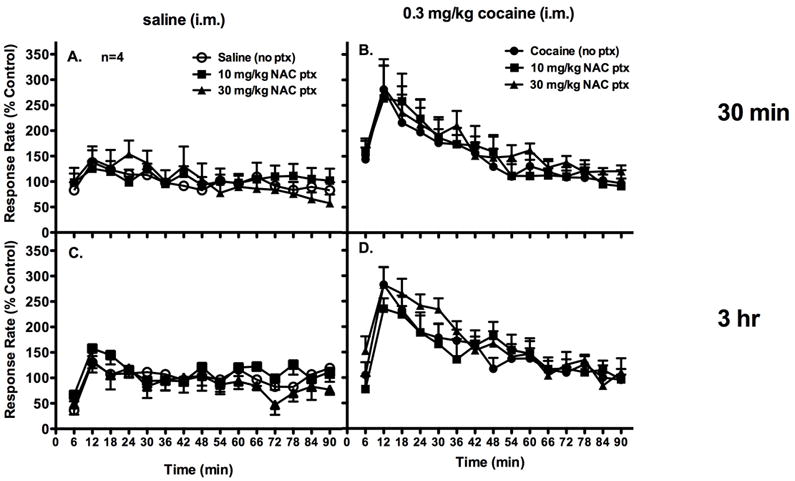
NAC pretreatments (i.m.) did not significantly alter rates of responding under a fixed-interval avoidance schedule when saline was administered i.m. 5 sec prior to the start of the session (A, 30 min ptx; C, 3h ptx). Further, NAC pretreatments did not significantly alter cocaine-induced increases in rates of responding when cocaine (0.3 mg/kg) was administered i.m. 5 sec prior to the start of the session (B, 30 min ptx; D, 3h ptx). Abscissae: time in minutes. Ordinates: rates of responding expressed as a percent of baseline control rates.
Figure 4
Figure 4
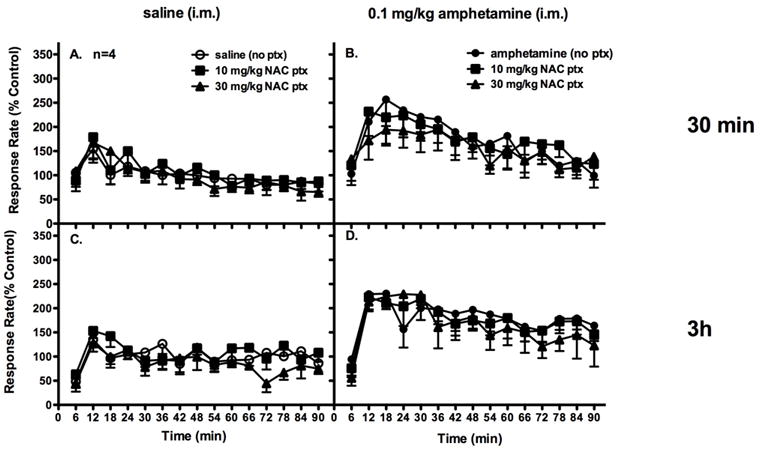
NAC pretreatments (i.m.) did not significantly alter rates of responding under a fixed-interval avoidance schedule when saline was administered i.m. 5 sec prior to the session (A, 30 min ptx; C, 3h ptx). Furthermore, NAC pretreatments did not significantly alter amphetamine-induced increases in rates of responding when amphetamine (0.1 mg/kg) was administered i.m. 5 sec prior to the session (B, 30 min ptx; D, 3h ptx). Abscissae: time in minutes. Ordinates: rates of responding expressed as a percent of baseline control rates.
Figure 5
Figure 5
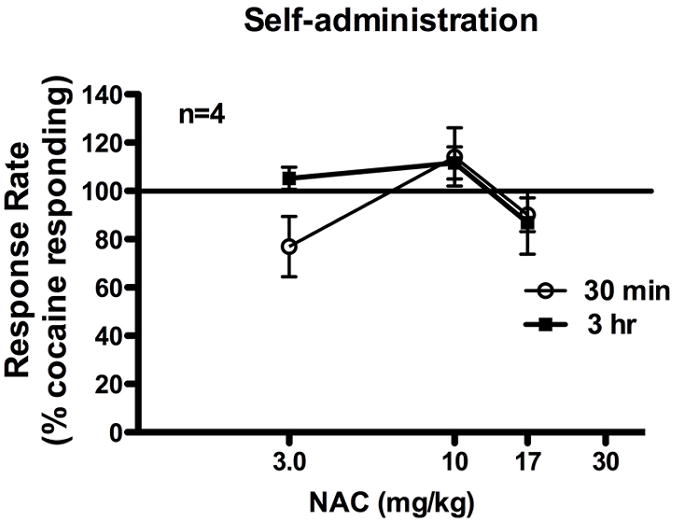
Administration of NAC did not significantly alter rates of responding maintained by a second-order schedule of cocaine self-administration. Each dose of NAC was administered 30 min or 3 hr prior to the start of the self-administration session for three consecutive days. The solid line at 100% represents baseline responding during cocaine self-administration. Abscissae: dose of NAC pretreatment. Ordinates: rates of responding expressed as a percent of baseline control rates.
Figure 6
Figure 6
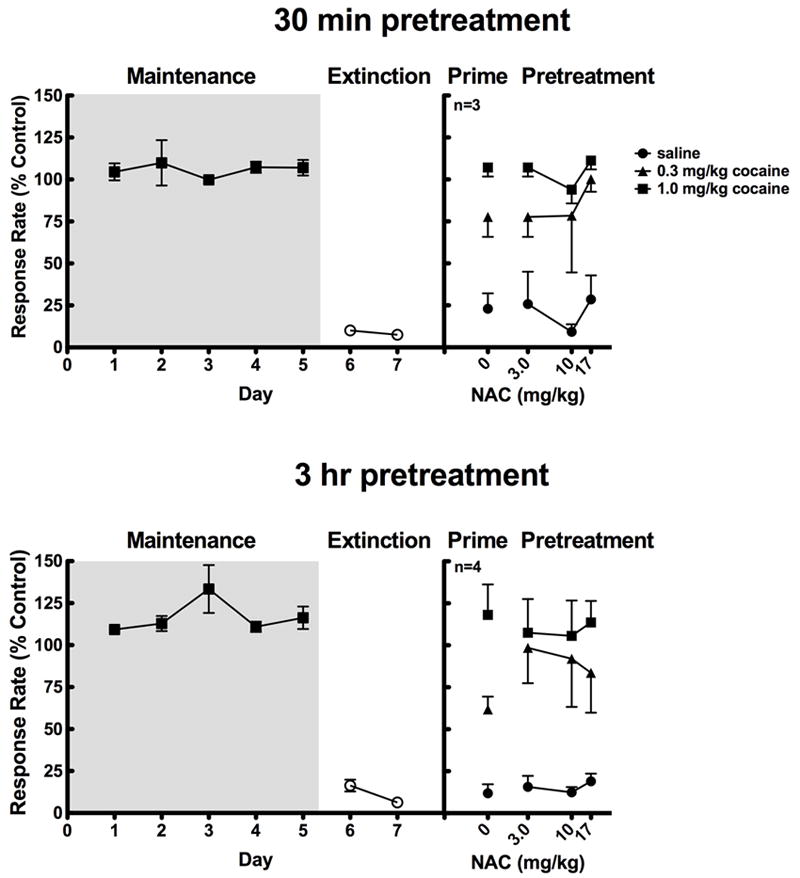
Pretreatment with NAC did not significantly alter reinstatement of previously extinguished cocaine self-administration.Abscissae: day of treatment and pretreatment dose of NAC prior to reinstatement tests. Ordinates: rates of responding expressed as a percent of baseline control rates.

References

    1. Baker DA, McFarland K, Lake RW, Shen H, Tang XC, Toda S, et al. Neuroadaptations in cystine-glutamate exchange underlie cocaine relapse. Nat Neurosci. 2003a;6:743–9. - PubMed
    1. Baker DA, McFarland K, Lake RW, Shen H, Toda S, Kalivas PW. N-acetyl cysteine-induced blockade of cocaine-induced reinstatement. Annals of the New York Academy of Sciences. 2003b;1003:349–51. - PubMed
    1. Baker DA, Shen H, Kalivas PW. Cystine/glutamate exchange serves as the source for extracellular glutamate: Modifications by repeated cocaine administration. Amino Acids. 2002a;23:161–2. - PubMed
    1. Baker DA, Xi ZX, Shen H, Swanson CJ, Kalivas PW. The origin and neuronal function of in vivo nonsynaptic glutamate. J Neurosci. 2002b;22:9134–41. - PMC - PubMed
    1. Bauzo RM, Kimmel HL, Howell LL. Interactions between the mGluR2/3 agonist, LY379268, and cocaine on in vivo neurochemistry and behavior in squirrel monkeys. Pharmacol Biochem Behav. 2009a;94:204–10. - PMC - PubMed

Publication types

MeSH terms