


Factors influencing urologist treatment preference in surgical management of stone disease
- PMID: 22245295
- PMCID: PMC4465295
- DOI: 10.1016/j.urology.2011.11.024
Factors influencing urologist treatment preference in surgical management of stone disease
Abstract
Objective: To assess the surgeon factors influencing the surgical treatment decisions for symptomatic stone disease. The factors influencing the selection of shock wave lithotripsy (SWL), ureteroscopy, or percutaneous nephrolithotomy to treat symptomatic stone disease are not well studied.
Methods: Electronic surveys were sent to urologists with American Medical Association membership. Information on training, practice, and ideal treatment of common stone scenarios was obtained and statistically analyzed.
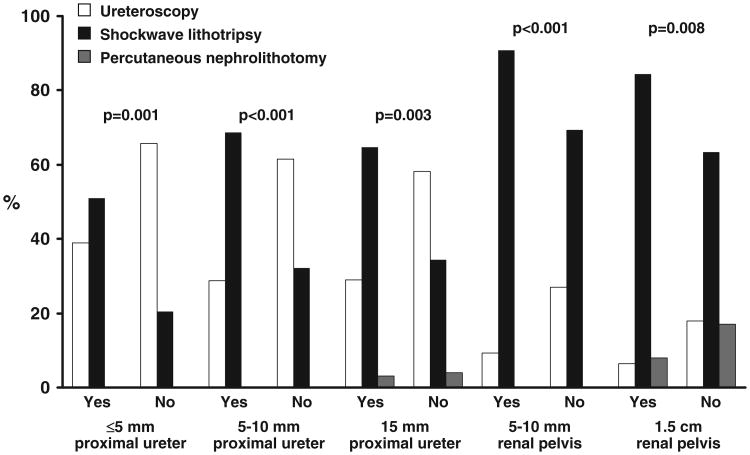
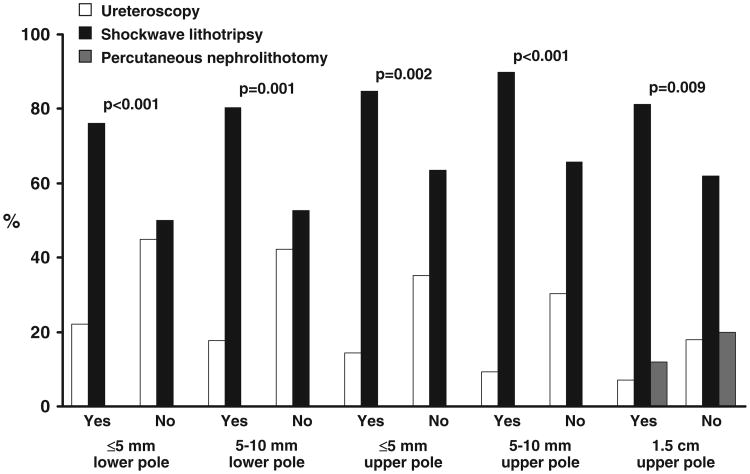
Results: In November 2009, 600 surveys were sent and 180 were completed. High-volume SWL practices (>100 cases annually) were more common in community practice (P < .01), and high-volume ureteroscopy and percutaneous nephrolithotomy practices were more common in academic practice (P = .03). Community practice was associated with SWL selection for proximal urolithiasis and upper pole nephrolithiasis (P < .005). An increasing time since urologic training was associated with SWL selection for proximal urolithiasis and upper pole nephrolithiasis (P < .01). Urologists reporting shock wave lithotriptor ownership were 3-4 times more likely to select SWL for urolithiasis or nephrolithiasis compared with urologists who did not own a lithotripter (P < .01). Routine concern for stent pain and rigid ureteroscope preference (vs flexible) were associated with SWL selection (P < .03).
Conclusion: Surgeon factors significantly affected urolithiasis treatment selection. SWL was associated with community urology practice, increasing time since training, shock wave lithotriptor ownership, concern for stent pain, and ureteroscope preference.
Copyright © 2012 Elsevier Inc. All rights reserved.
Figures
References
-
- Preminger GM, Tiselius HG, Assimos DG, et al. Guideline for the management of ureteral calculi. J Urol. 2007;178:2418–2434. - PubMed
-
- Wignall GR, Canales BK, Denstedt JD, et al. Minimally invasive approaches to upper urinary tract urolithiasis. Urol Clin North Am. 2008;35:441–454. viii. - PubMed
-
- Bandi G, Best SL, Nakada SY. Current practice patterns in the management of upper urinary tract calculi in the north central United States. J Endourol. 2008;22:631–636. - PubMed
-
- Matlaga BR American Board of Urology. Contemporary surgical management of upper urinary tract calculi. J Urol. 2009;181:2152–2156. - PubMed
-
- Pearle MS, Calhoun EA, Curhan GC, et al. Urologic diseases in America project: urolithiasis. J Urol. 2005;173:848–857. - PubMed
Publication types
MeSH terms
Grants and funding
LinkOut - more resources
Full Text Sources
