


FMRI group analysis combining effect estimates and their variances
- PMID: 22245637
- PMCID: PMC3404516
- DOI: 10.1016/j.neuroimage.2011.12.060
FMRI group analysis combining effect estimates and their variances
Abstract
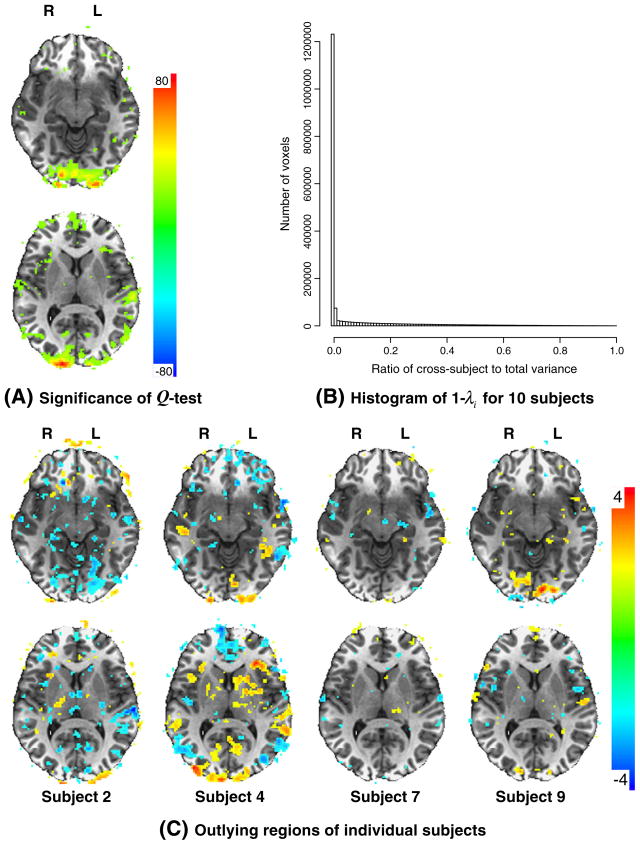
Conventional functional magnetic resonance imaging (FMRI) group analysis makes two key assumptions that are not always justified. First, the data from each subject is condensed into a single number per voxel, under the assumption that within-subject variance for the effect of interest is the same across all subjects or is negligible relative to the cross-subject variance. Second, it is assumed that all data values are drawn from the same Gaussian distribution with no outliers. We propose an approach that does not make such strong assumptions, and present a computationally efficient frequentist approach to FMRI group analysis, which we term mixed-effects multilevel analysis (MEMA), that incorporates both the variability across subjects and the precision estimate of each effect of interest from individual subject analyses. On average, the more accurate tests result in higher statistical power, especially when conventional variance assumptions do not hold, or in the presence of outliers. In addition, various heterogeneity measures are available with MEMA that may assist the investigator in further improving the modeling. Our method allows group effect t-tests and comparisons among conditions and among groups. In addition, it has the capability to incorporate subject-specific covariates such as age, IQ, or behavioral data. Simulations were performed to illustrate power comparisons and the capability of controlling type I errors among various significance testing methods, and the results indicated that the testing statistic we adopted struck a good balance between power gain and type I error control. Our approach is instantiated in an open-source, freely distributed program that may be used on any dataset stored in the universal neuroimaging file transfer (NIfTI) format. To date, the main impediment for more accurate testing that incorporates both within- and cross-subject variability has been the high computational cost. Our efficient implementation makes this approach practical. We recommend its use in lieu of the less accurate approach in the conventional group analysis.
Published by Elsevier Inc.
Figures



References
-
- Baker R, Jackson D. A new approach to outliers in meta-analysis. Health Care Manage Sci. 2008;11:121–131. - PubMed
-
- Beckmann C, Jenkinson M, Smith S. General multilevel linear modelling for group analysis in FMRI. NeuroImage. 2003;20:1052–1063. - PubMed
-
- Cohen MS. Parametric analysis of fMRI data using linear systems methods. Neuro Image. 1997;6:93–103. - PubMed
Publication types
MeSH terms
Grants and funding
LinkOut - more resources
Full Text Sources
Medical
