


Multi-isotope imaging mass spectrometry reveals slow protein turnover in hair-cell stereocilia
- PMID: 22246323
- PMCID: PMC3267870
- DOI: 10.1038/nature10745
Multi-isotope imaging mass spectrometry reveals slow protein turnover in hair-cell stereocilia
Abstract
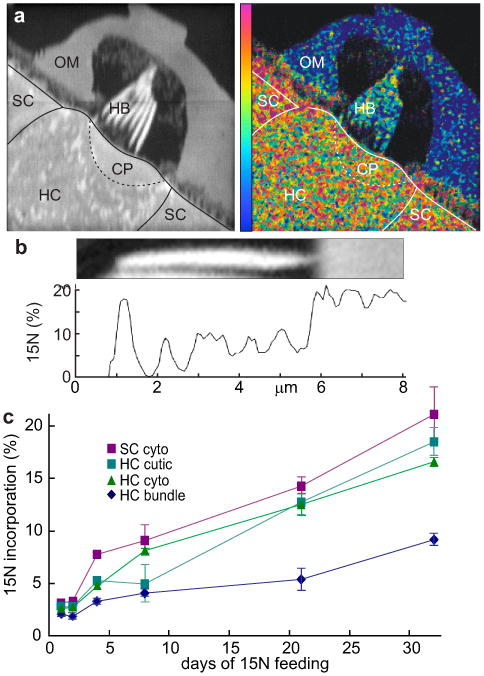
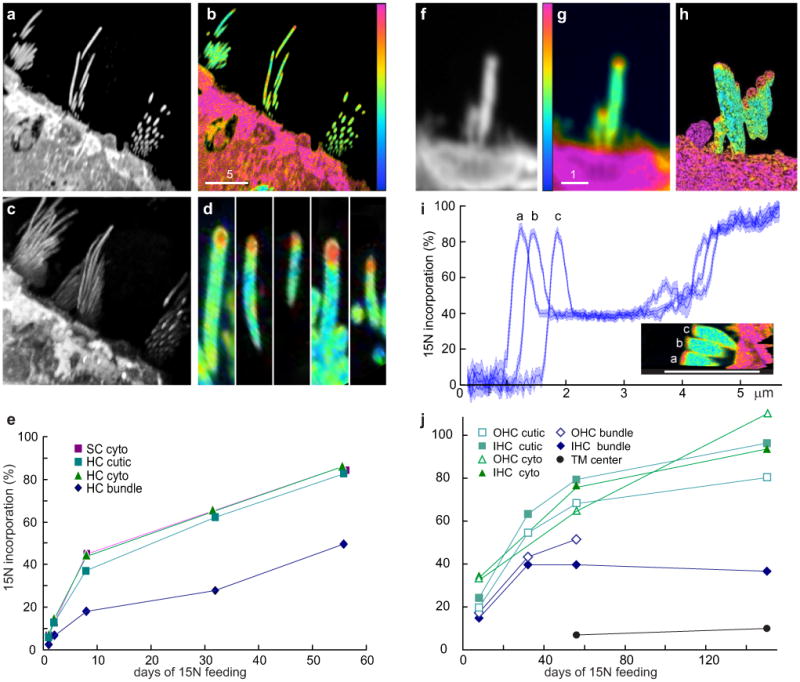
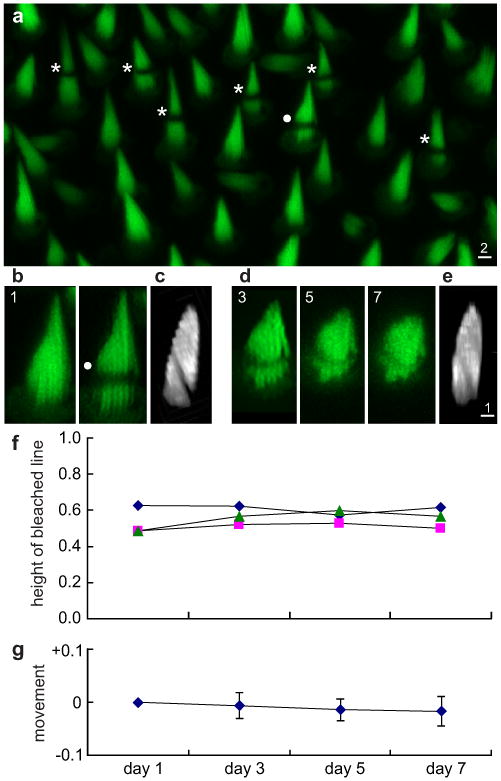
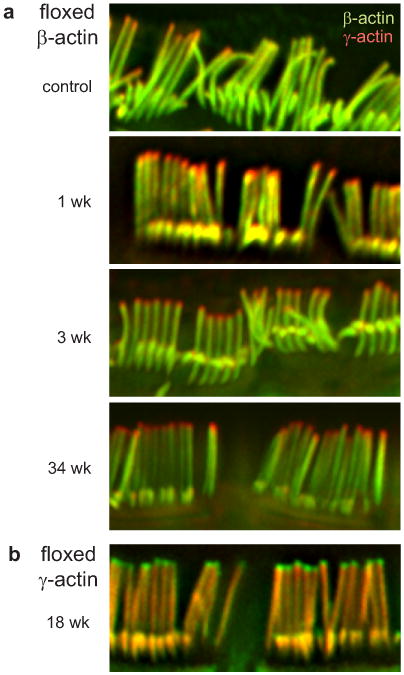
Hair cells of the inner ear are not normally replaced during an animal's life, and must continually renew components of their various organelles. Among these are the stereocilia, each with a core of several hundred actin filaments that arise from their apical surfaces and that bear the mechanotransduction apparatus at their tips. Actin turnover in stereocilia has previously been studied by transfecting neonatal rat hair cells in culture with a β-actin-GFP fusion, and evidence was found that actin is replaced, from the top down, in 2-3 days. Overexpression of the actin-binding protein espin causes elongation of stereocilia within 12-24 hours, also suggesting rapid regulation of stereocilia lengths. Similarly, the mechanosensory 'tip links' are replaced in 5-10 hours after cleavage in chicken and mammalian hair cells. In contrast, turnover in chick stereocilia in vivo is much slower. It might be that only certain components of stereocilia turn over quickly, that rapid turnover occurs only in neonatal animals, only in culture, or only in response to a challenge like breakage or actin overexpression. Here we quantify protein turnover by feeding animals with a (15)N-labelled precursor amino acid and using multi-isotope imaging mass spectrometry to measure appearance of new protein. Surprisingly, in adult frogs and mice and in neonatal mice, in vivo and in vitro, the stereocilia were remarkably stable, incorporating newly synthesized protein at <10% per day. Only stereocilia tips had rapid turnover and no treadmilling was observed. Other methods confirmed this: in hair cells expressing β-actin-GFP we bleached fiducial lines across hair bundles, but they did not move in 6 days. When we stopped expression of β- or γ-actin with tamoxifen-inducible recombination, neither actin isoform left the stereocilia, except at the tips. Thus, rapid turnover in stereocilia occurs only at the tips and not by a treadmilling process.
Figures
Comment in
-
Technology: A deeper peek into living organisms.Nature. 2012 Jan 25;481(7382):454. doi: 10.1038/481454a. Nature. 2012. PMID: 22281592 No abstract available.
References
-
- Schoenheimer R. The Dynamic State of Body Constituents. Harvard University Press; Cambridge, MA: 1942.
-
- Rzadzinska A, Schneider M, Noben-Trauth K, Bartles JR, et al. Balanced levels of espin are critical for stereociliary growth and length maintenance. Cell Motil Cytoskeleton. 2005;62:157–165. - PubMed
Publication types
MeSH terms
Substances
Grants and funding
- R01AR049899/AR/NIAMS NIH HHS/United States
- R01DC03463/DC/NIDCD NIH HHS/United States
- P41EB001974/EB/NIBIB NIH HHS/United States
- R01 DC004179/DC/NIDCD NIH HHS/United States
- F32DC009539/DC/NIDCD NIH HHS/United States
- R37DK39773/DK/NIDDK NIH HHS/United States
- P41RR14579/RR/NCRR NIH HHS/United States
- R01 DK058762/DK/NIDDK NIH HHS/United States
- Z01 DC000033/ImNIH/Intramural NIH HHS/United States
- P41 EB001974/EB/NIBIB NIH HHS/United States
- R01 DC000033/DC/NIDCD NIH HHS/United States
- R01GM47214/GM/NIGMS NIH HHS/United States
- R01 EY012963/EY/NEI NIH HHS/United States
- R01 AR042423/AR/NIAMS NIH HHS/United States
- R01 DC002281/DC/NIDCD NIH HHS/United States
- HHMI/Howard Hughes Medical Institute/United States
- R01DC02281/DC/NIDCD NIH HHS/United States
- R01 GM047214/GM/NIGMS NIH HHS/United States
- R01DC00033/DC/NIDCD NIH HHS/United States
- R01EY12963/EY/NEI NIH HHS/United States
- R37 DK039773/DK/NIDDK NIH HHS/United States
- R01 AR049899/AR/NIAMS NIH HHS/United States
- F32 DC009539/DC/NIDCD NIH HHS/United States
- R01DC04179/DC/NIDCD NIH HHS/United States
- WT079643/WT_/Wellcome Trust/United Kingdom
- 2P41RR0112553-12/RR/NCRR NIH HHS/United States
- R01D K58762/PHS HHS/United States
LinkOut - more resources
Full Text Sources
Other Literature Sources
Molecular Biology Databases
