. 2012 Jan 13;335(6065):229-32.
doi: 10.1126/science.1214448.

iRhom2 regulation of TACE controls TNF-mediated protection against Listeria and responses to LPS

Affiliations

iRhom2 regulation of TACE controls TNF-mediated protection against Listeria and responses to LPS

David R McIlwain et al. Science. .

Abstract

Innate immune responses are vital for pathogen defense but can result in septic shock when excessive. A key mediator of septic shock is tumor necrosis factor-α (TNFα), which is shed from the plasma membrane after cleavage by the TNFα convertase (TACE). We report that the rhomboid family member iRhom2 interacted with TACE and regulated TNFα shedding. iRhom2 was critical for TACE maturation and trafficking to the cell surface in hematopoietic cells. Gene-targeted iRhom2-deficient mice showed reduced serum TNFα in response to lipopolysaccharide (LPS) and could survive a lethal LPS dose. Furthermore, iRhom2-deficient mice failed to control the replication of Listeria monocytogenes. Our study has identified iRhom2 as a regulator of innate immunity that may be an important target for modulating sepsis and pathogen defense.


Figures
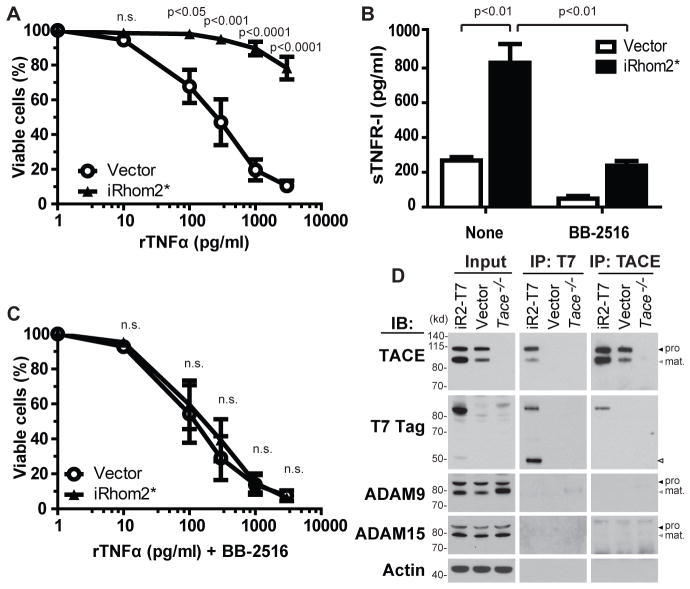
Fig. 1
Fig. 1
iRhom2 confers resistance to TNFα in a MP-dependent manner and interacts with TACE. (A) L929 cells stably overexpressing iRhom2* or control vector were treated with recombinant TNFα (rTNFα) at the indicated concentrations, and percent viability was determined by Annexin-7AAD exclusion (means ± SEM; n = 4 experiments). (B) Untreated cells from (A) were cultured with or without metalloproteinase inhibitor BB-2516 (20 μM) for 24 hours. Soluble TNFR1 in the culture supernatant was measured by enzyme-linked immunosorbent assay (ELISA) (means ± SEM; n = 3 experiments). (C) Cells from (A) were treated for 24 hours with TNFα at the indicated concentrations plus 20 μM BB-2516, and viability was assessed as in (A) (means ± SEM; n = 4 experiments). (D) WT immortalized mouse embryonic fibroblasts (MEFs) stably overexpressing T7-tagged iRhom2 (iR2-T7) or control vector and Adam17−/−(TACE−/−) MEFs (negative control) were immunoprecipitated (IP) by using antibodies against T7 or TACE followed by immunoblotting (IB) to detect T7 or TACE. ADAM9 and ADAM15 were specificity controls; actin, loading control. Black arrowheads indicate immature pro-forms, whereas gray arrowheads indicate mature forms, of TACE and other ADAMs (for all figures). Empty arrowhead is likely a processed form of iRhom2. ConA purification was used to enhance detection of TACE in input lanes (unpurified input appears in fig. S3). Results are representative of three trials.
Fig. 2
Fig. 2
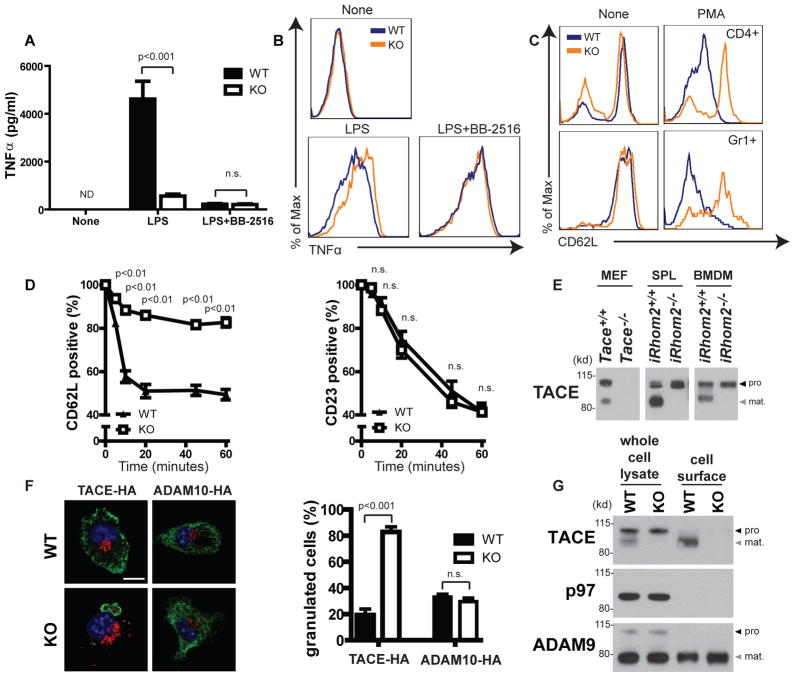
iRhom2 deficiency reduces TACE activity in vitro. (A and B) WT and iRhom2−/− TGEMs were stimulated in vitro with 1 μg/ml LPS, with or without 20 μM BB-2516. (A) TNFα in culture supernatants was determined by ELISA after 24 hours of treatment (means ± SEM of triplicates). (B) Membrane-bound TNFα was assayed by flow cytometry after 3 hours of treatment. Results are representative of three trials. (C) Isolated WT and iRhom2−/− total splenocytes were stimulated in vitro with 25 ng/ml PMA for 3 hours, and CD62L expression on CD4+ T cells and Gr1+ granulocytes was determined by flow cytometry. Results are representative of three trials. (D) WT and iRhom2−/− total splenocytes were stimulated with 2 mM BzATP for the indicated times, and surface levels of CD62L and CD23 (ADAM10 substrate) on B220+CD3 B cells were determined by flow cytometry (means ± SEM; n = 3 mice per group). (E) ConA-purified lysates of control and iRhom2−/− splenocytes (SPL) or BMDMs were immunoblotted to detect pro- (black arrowhead) and mature (gray arrowhead) TACE. Adam17−/−(TACE−/−) MEFs, negative control. Additional controls appear in fig. S6A. Results are representative of three trials. (F) (Top) Control and iRhom2−/− BMDMs were transfected with vectors expressing TACE-HA or ADAM10-HA (green), stimulated with LPS, and visualized by confocal immunofluorescence microscopy. Giantin (red) and 4′,6′-diamidino-2-phenylindole (DAPI) stain (blue). Scale bar, 10 μm. (Bottom) Percentages of control and iRhom2−/− BMDMs that exhibited granulated vesicular appearance of TACE or ADAM10 localization (means ± SEM; n = 4 to 6 experiments). (G) (Top) Immunoblot to detect pro- (black arrowhead) and mature (gray arrowhead) TACE in whole-cell lysates and purified cell surface fractions of control and iRhom2−/− BMDMs. (Middle) P97, intracellular protein (negative control). (Bottom) Pro- (black arrowhead) and mature (gray arrowhead) ADAM9 (positive control). Results are representative of three trials.
Fig. 3
Fig. 3
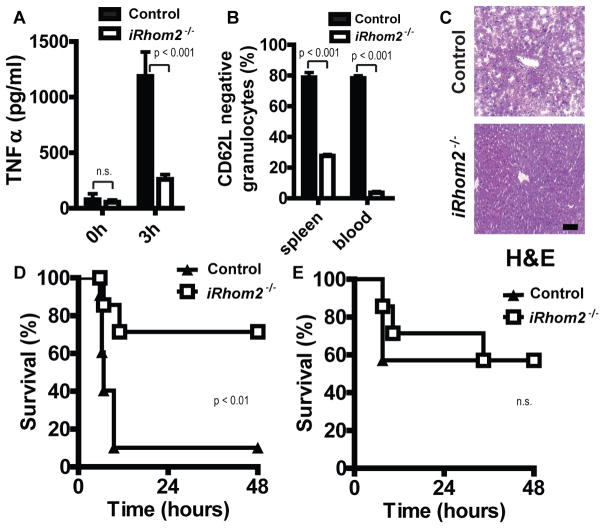
iRhom2 deficiency prevents LPS-induced liver pathology by inhibiting TNFα shedding. (A and B) Control and iRhom2−/− mice (n = 4 per group) were intravenously injected with 0.14 mg per mouse LPS O111:B4. Serum TNFα (A) and CD62LGr1+CD11b+ cells in spleen and blood (B) were measured 3 hours after injection by ELISA or flow cytometry, respectively. (C) Control (n = 7) and iRhom2−/−(n = 8) mice were intraperitoneally injected with 10 mg GalN, followed 20 min later by intravenous injection of 0.05 mg LPS O111:B4. Livers were snap-frozen 6 hours after injection and sections stained with hematoxylin and eosin (H&E). Control panel is representative for six out of seven samples. iRhom2−/− panel is representative for five out of eight samples. Scale bar, 100 μm. (D) Control and iRhom2−/− mice (n = 10 to 11 per group) were injected with GalN and LPS as for (C), and survival was monitored for 48 hours. (E) Control and iRhom2−/− mice (n = 7 per group) were intraperitoneally injected with 10 mg GalN, followed 20 min later by intravenous injection of 0.15 μg rTNFα. Survival was monitored for 48 hours.
Fig. 4
Fig. 4
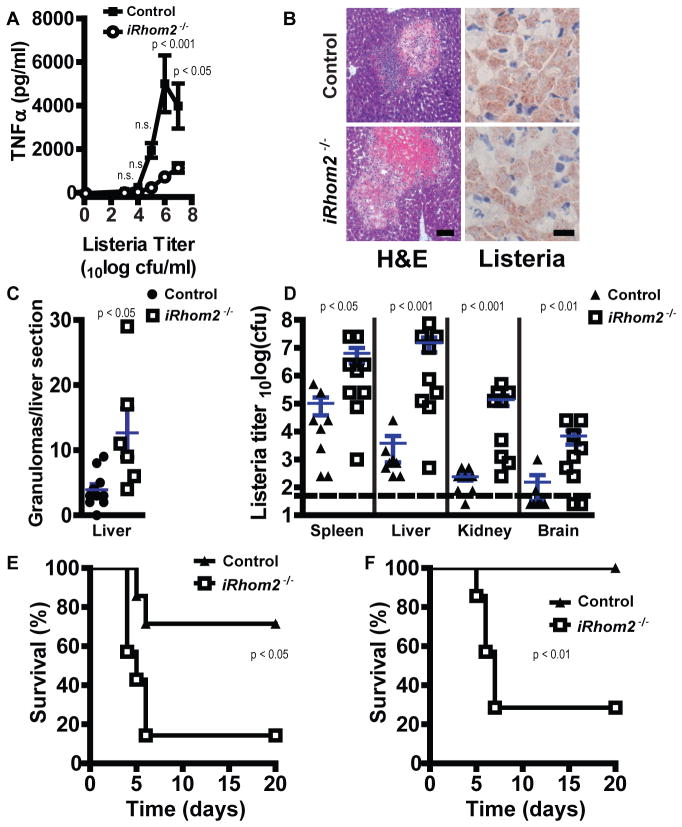
iRhom2 is crucial for control of L. monocytogenes. (A) TGEMs (105) isolated from control or iRhom2−/− mice (n = 5 to 8 per group) were exposed to the indicated titers of L. monocytogenes for 24 hours. TNFα in culture supernatants was determined by ELISA (means ± SEM). (B) Control and iRhom2−/− mice (n = 6 to 10 per group) were infected with 104 colony-forming units (cfu) L. monocytogenes. Livers were isolated on day 4 after infection, sectioned, and stained with H&E (left) or with antibody against Listeria (right). Scale bars: left, 100 μm; right, 20 μm. (C) Granulomas were counted in F4/80-stained liver sections (not shown) from the mice in (B). Data points are granulomas or liver of individual mice. Blue lines, means ± SEM (n = 6 to 10 per group). (D) Control and iRhom2−/− mice (n = 8 to 9 mice per group) were infected with 105 cfu L. monocytogenes, and bacterial titers were determined in spleen, liver, kidney, and brain on day 4 after infection. Data points are titers of individual mice. Dashed line, limit of detection. Blue lines, means ± SEM. (E and F) Control and iRhom2−/− mice (n = 7 per group) were infected with 5 × 10⁴ cfu (E) or 5 × 10³ cfu (F) L. monocytogenes, and mouse survival was monitored for 20 days.

Comment in

  • Cell biology. Sheddase gets guidance.
    Lichtenthaler SF. Lichtenthaler SF. Science. 2012 Jan 13;335(6065):179-80. doi: 10.1126/science.1216815. Science. 2012. PMID: 22246765 No abstract available.

References

    1. Scott DL, Kingsley GH. Tumor necrosis factor inhibitors for rheumatoid arthritis. N Engl J Med. 2006;355:704. doi: 10.1056/NEJMct055183. - DOI - PubMed
    1. Palladino MA, Bahjat FR, Theodorakis EA, Moldawer LL. Anti-TNF-alpha therapies: The next generation. Nat Rev Drug Discov. 2003;2:736. doi: 10.1038/nrd1175. - DOI - PubMed
    1. Feldmann M. Development of anti-TNF therapy for rheumatoid arthritis. Nat Rev Immunol. 2002;2:364. doi: 10.1038/nri802. - DOI - PubMed
    1. Pfeffer K, et al. Mice deficient for the 55 kd tumor necrosis factor receptor are resistant to endotoxic shock, yet succumb to L. monocytogenes infection. Cell. 1993;73:457. doi: 10.1016/0092-8674(93)90134-C. - DOI - PubMed
    1. Bhattacharya D, Logue EC, Bakkour S, DeGregori J, Sha WC. Identification of gene function by cyclical packaging rescue of retroviral cDNA libraries. Proc Natl Acad Sci USA. 2002;99:8838. doi: 10.1073/pnas.132274799. - DOI - PMC - PubMed

Publication types

MeSH terms