


Criteria for selection of surrogates used to study the fate and control of pathogens in the environment
- PMID: 22247166
- PMCID: PMC3298155
- DOI: 10.1128/AEM.06582-11
Criteria for selection of surrogates used to study the fate and control of pathogens in the environment
Abstract
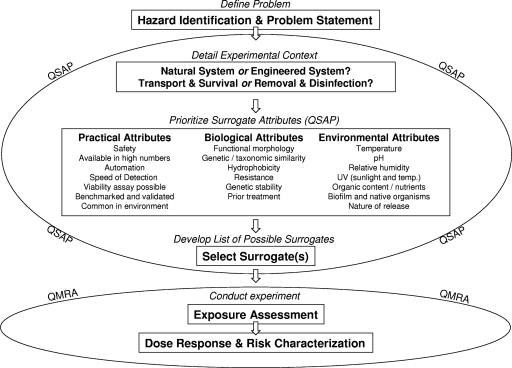
This article defines the term surrogate as an organism, particle, or substance used to study the fate of a pathogen in a specific environment. Pathogenic organisms, nonpathogenic organisms, and innocuous particles have been used as surrogates for a variety of purposes, including studies on survival and transport as well as for method development and as "indicators" of certain conditions. This article develops a qualitative surrogate attribute prioritization process and allows investigators to select a surrogate by systematically detailing the experimental process and prioritizing attributes. The results are described through the use of case studies of various laboratories that have used this process. This article also discusses the history of surrogate and microbial indicator use and outlines the method by which surrogates can be used when conducting a quantitative microbial risk assessment. The ultimate goal of selecting a sufficiently representative surrogate is to improve public health through a health-based risk assessment framework. Under- or overestimating the resistance, inactivation, or movement may negatively impact risk assessments that, in turn, will impact health assessments and estimated safety levels. Reducing uncertainty in a risk assessment is one of the objectives of using surrogates and the ultimate motive for any experiment investigating potential exposure of a pathogen.
Figures
References
-
- Abbaszadegan M, et al. 1997. The disinfection efficacy of a point-of-use water treatment system against bacterial, viral and protozoan waterborne pathogens. Water Res. 31:574–582
-
- Ashbolt N, Grabow W, Snozzi M. 2001. Indicators of microbial water quality, p 289–316 In Fewtrell L, Bartram J. (ed), Water quality: guidelines, standards and health. IWA Publishing, London, United Kingdom
-
- Bitton G. 2005. Wastewater microbiology, 3rd ed, p 23 Wiley-Liss, John Wiley & Sons, Hoboken, NJ
Publication types
MeSH terms
LinkOut - more resources
Full Text Sources
Other Literature Sources
