. 2012 Jan 17;109(3):E111-8.
doi: 10.1073/pnas.1110740109. Epub 2012 Jan 12.

Production of amorphadiene in yeast, and its conversion to dihydroartemisinic acid, precursor to the antimalarial agent artemisinin

Affiliations

Production of amorphadiene in yeast, and its conversion to dihydroartemisinic acid, precursor to the antimalarial agent artemisinin

Patrick J Westfall et al. Proc Natl Acad Sci U S A. .

Abstract

Malaria, caused by Plasmodium sp, results in almost one million deaths and over 200 million new infections annually. The World Health Organization has recommended that artemisinin-based combination therapies be used for treatment of malaria. Artemisinin is a sesquiterpene lactone isolated from the plant Artemisia annua. However, the supply and price of artemisinin fluctuate greatly, and an alternative production method would be valuable to increase availability. We describe progress toward the goal of developing a supply of semisynthetic artemisinin based on production of the artemisinin precursor amorpha-4,11-diene by fermentation from engineered Saccharomyces cerevisiae, and its chemical conversion to dihydroartemisinic acid, which can be subsequently converted to artemisinin. Previous efforts to produce artemisinin precursors used S. cerevisiae S288C overexpressing selected genes of the mevalonate pathway [Ro et al. (2006) Nature 440:940-943]. We have now overexpressed every enzyme of the mevalonate pathway to ERG20 in S. cerevisiae CEN.PK2, and compared production to CEN.PK2 engineered identically to the previously engineered S288C strain. Overexpressing every enzyme of the mevalonate pathway doubled artemisinic acid production, however, amorpha-4,11-diene production was 10-fold higher than artemisinic acid. We therefore focused on amorpha-4,11-diene production. Development of fermentation processes for the reengineered CEN.PK2 amorpha-4,11-diene strain led to production of > 40 g/L product. A chemical process was developed to convert amorpha-4,11-diene to dihydroartemisinic acid, which could subsequently be converted to artemisinin. The strains and procedures described represent a complete process for production of semisynthetic artemisinin.


Conflict of interest statement

Conflict of interest statement: All authors hold stock options or shares in Amyris, Inc.

Figures
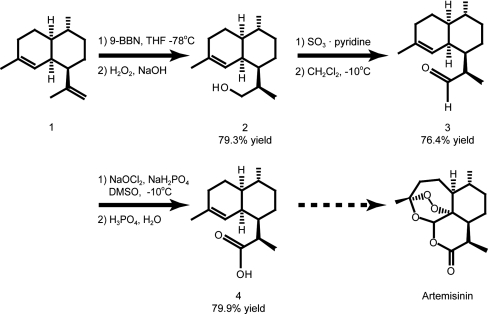
Fig. 5.
Fig. 5.
Synthesis of dihydroartemisinic acid from amorpha-4,11-diene. Only the R isomer is shown.
Fig. 1.
Fig. 1.
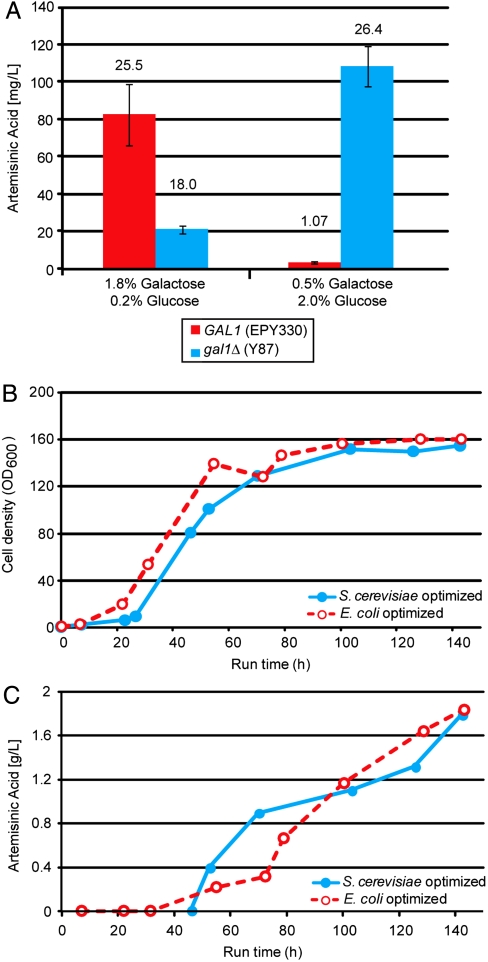
Production of artemisinic acid in Gen 1.0 yeast strains. (A) Production of artemisinic acid in shake-flask cultures of EPY330 (GAL1) and Y87 (gal1Δ) in defined media containing either low or high concentrations of glucose (± 1 SD of three flasks). Numbers above the bars show specific production (mg/L/OD600). (B) Growth and (C) artemisinic acid production in fed-batch glucose-limited fermentors of Y87 containing a high-copy plasmid expressing E. coli-optimized ADS/CYP71AV1/AaCPR and Y137 containing pAM322, expressing S. cerevisiae-optimized ADS/CYP71AV1/AaCPR.
Fig. 2.
Fig. 2.
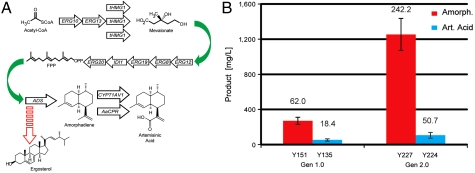
Construction of CEN.PK2 Gen 2.0 and comparison of production by Gen 1.0 and 2.0 strains. (A) Schematic of the mevalonate pathway showing genes overexpressed in Gen 2.0 strains from GAL1 or GAL10 promoters in block arrows. Dashed arrow represents the ergosterol pathway transcriptionally restricted at ERG9. (B) Production of amorpha-4,11-diene by Y151 (Gen 1.0) and Y227 (Gen 2.0), and artemisinic acid by Y135 (Gen 1.0) and Y224 (Gen 2.0) after 72 h growth in shake-flasks. Error bars show ± 1 SD of three flasks. Numbers above the bars show specific production (mg/L/OD600).
Fig. 3.
Fig. 3.
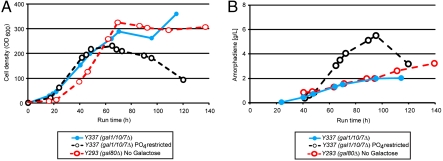
Development of fed-batch glucose-limited fermentations for the production of amorpha-4,11-diene. (A) Growth and (B) amorpha-4,11-diene production by Y337 in glucose-limited fermentations with and without phosphate limitation, and Y293 in glucose-limited fermentation. Production of amorpha-4,11-diene was induced in Y337 fermentations by addition of galactose (see SI Materials and Methods).
Fig. 4.
Fig. 4.
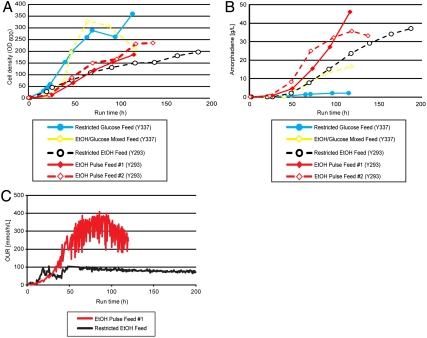
Development of fed-batch glucose/ethanol and ethanol feed fermentations. (A) Growth and (B) amorpha-4,11-diene production by Y337 with restricted glucose feed and mixed glucose and ethanol feed, and Y293 with ethanol pulse feed (replicate fermentations) and restricted ethanol feed. (C) Oxygen uptake rate of Y293 ethanol pulse feed and restricted ethanol feed fermentors.
Fig. P1.
Fig. P1.
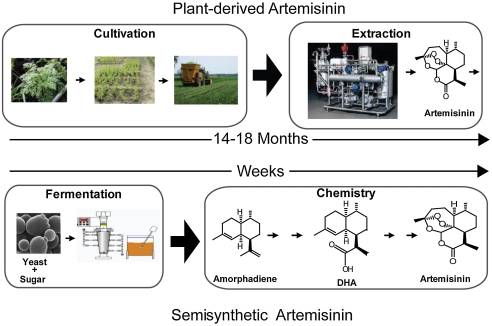
Production of plant-derived artemisinin compared to semisynthetic artemisinin. Production of plant-derived artemisinin takes from 14 to 18 months from planting to production. Plant-derived artemisinin requires cultivation of A. annua, followed by extraction of artemisinin from the leaves and conversion to artemisinin derivatives for incorporation into antimalarial ACT medication. Semisynthetic artemisinin, by contrast, uses engineered yeast to produce amorphadiene in fermentations. The amorphadiene extracted from the fermentor is chemically converted to dihydroartemisinic acid and then to artemisinin derivatives for incorporation into ACT drugs. The entire process could be accomplished in weeks.

References

    1. Korenromp E, Miller J, Nahlen B, Wardlaw T, Young M. World Malaria Report 2005. Geneva: World Health Organization; 2005.
    1. Bloland PB. Drug Resistance in Malaria. Geneva: World Health Organization; 2001.
    1. Olumese P. Guidelines for the Treatment of Malaria. Geneva: World Health Organization; 2006.
    1. Cohen J, Singh I, O’Brien M. Predicting global fund grant disbursements for procurement of artemisinin-based combination therapies. Malar J. 2008;7:200. - PMC - PubMed
    1. Aregawi M, Cibulskis R, Otten M, Williams R, Dye C. World Malaria Report 2008. Geneva: World Health Organization; 2008.

Publication types