. 2012 Jan 1;37(1):30-40.
doi: 10.1016/j.jtherbio.2011.10.004.

Robust thermoregulatory overcompensation, rather than tolerance, develops with serial administrations of 70% nitrous oxide to rats

Affiliations

Robust thermoregulatory overcompensation, rather than tolerance, develops with serial administrations of 70% nitrous oxide to rats

Karl J Kaiyala et al. J Therm Biol. .

Abstract

Changes in typical whole-animal dependent variables following drug administration represent an integral of the drug's pharmacological effect, the individual's autonomic and behavioral responses to the resulting disturbance, and many other influences. An archetypical example is core temperature (T(c)), long used for quantifying initial drug sensitivity and tolerance acquisition over repeated drug administrations. Our previous work suggested that rats differing in initial sensitivity to nitrous oxide (N(2)O)-induced hypothermia would exhibit different patterns of tolerance development across N(2)O administrations. Specifically, we hypothesized that rats with an initially insensitive phenotype would subsequently develop regulatory overcompensation that would mediate an allostatic hyperthermic state, whereas rats with an initially sensitive phenotype would subsequently compensate to a homeostatic normothermic state. To preclude confounding due to handling and invasive procedures, a valid test of this prediction required non-invasive thermal measurements via implanted telemetric temperature sensors, combined direct and indirect calorimetry, and automated drug delivery to enable repeatable steady-state dosing. We screened 237 adult rats for initial sensitivity to 70% N(2)O-induced hypothermia. Thirty highly sensitive rats that exhibited marked hypothermia when screened and 30 highly insensitive rats that initially exhibited minimal hypothermia were randomized to three groups (n=10 each/group) that received: 1) twelve 90-min exposures to 70% N(2)O using a classical conditioning procedure, 2) twelve 90-min exposures to 70% N(2)O using a random control procedure for conditioning, or 3) a no-drug control group that received custom-made air. Metabolic heat production (via indirect calorimetry), body heat loss (via direct calorimetry) and T(c) (via telemetry) were simultaneously quantified during N(2)O and control gas administrations. Initially insensitive rats rapidly acquired (3(rd) administration) a significant allostatic hyperthermic phenotype during N(2)O administration whereas initially sensitive rats exhibited classical tolerance (normothermia) during N(2)O inhalation in the 4(th) and 5(th) sessions. However, the sensitive rats subsequently acquired the hyperthermic phenotype and became indistinguishable from initially insensitive rats during the 11(th) and 12th N(2)O administrations. The major mechanism for hyperthermia was a brisk increase in metabolic heat production. However, we obtained no evidence for classical conditioning of thermal responses. We conclude that the degree of initial sensitivity to N(2)O-induced hypothermia predicts the temporal pattern of thermal adaptation over repeated N(2)O administrations, but that initially insensitive and sensitive animals eventually converge to similar (and substantial) magnitudes of within-administration hyperthermia mediated by hyper-compensatory heat production.


Figures

Figure 1
Figure 1. Experimental design
(A) We categorized rats as being initially sensitive or initially insensitive to N2O-induced hypothermia based on Z-scores for magnitudes of hypothermia and within-session recovery of Tc during initial 70% N2O administration. (B) Group Tc values during screening (mean ± 95% confidence interval); black bar on X-axis indicates drug exposure period. (C) Selected rats were randomized to one of three chronic exposure groups such that each group consisted of n=10 initially sensitive and n=10 initially insensitive rats: 1) a control-gas control group that received custom-made air (white bars with and without circles) in lieu of 70% N2O, 2) a conditioning group in which N2O exposure was reliably paired with a lights and clicks (L&C) stimulus (black bars with white circles denotes the persistent L&C stimulus), and 3) a random control group in which N2O exposure was not reliably paired with the L&C stimulus (note the occurrence of the L&C stimulus denoted by circles during control gas exposures). Rats that received N2O experienced interlineated exposures to control gas, with all exposures in these groups involving an initial 1.4-min administration of 70% N2O to avert the possibility that N2O onset might become a conditioned stimulus. Selected rats were given 25 exposure sessions (plus a 26th exposure involving 70% N2O for control gas control rats). The boxes surrounding sessions 1, 6, and 24 indicate that all rats within a given group received the same protocol during those sessions to permit planned comparisons among groups. In sessions 1–24, the conditioning group received 12 exposures to 70% N2O that were always paired with the persistent L&C stimulus that commenced 1.4 min after N2O onset, whereas the other 12 exposures entailed only a brief (1.4-min) N2O onset period followed by 88.6-min of control gas inhalation. The intent was for the rats to learn that N2O continued only if the L&C stimulus occurred following the initial period of N2O administration. In the conditioning group, the sessions involving the brief 1.4-min N2O exposure that were followed by control-gas administration, and the prolonged N2O exposures that were accompanied by the L&C stimulus, were randomly sorted during sessions 2–5 and 7–23 (schematic gives one example of sorting). In sessions 1–24 in the random control group, neither the L&C stimulus nor the initial N2O onset period were reliably paired with the 12 extended 70% N2O administrations such that neither drug onset nor L&C reliably predicted prolonged N2O inhalation. The brief N2O-L&C trials, and the N2O only trials were randomly sorted during sessions 2–5 and 7–23 (schematic gives one example). In sessions 1–24, the control gas control group inhaled only custom-blended air. The L&C stimulus occurred during 12 of these control gas administrations, and the order of L&C trials and blank trials were randomly sorted during sessions 2–5 and 7–23 (one example is shown). In session 25, the L&C stimulus was presented to all groups during control gas administration. Evidence for conditioning would be reliable changes only in the conditioning group of one or more thermal outcomes (Tc, heat production, heat loss) in session 25 compared to these outcomes in session 24.
Figure 2
Figure 2
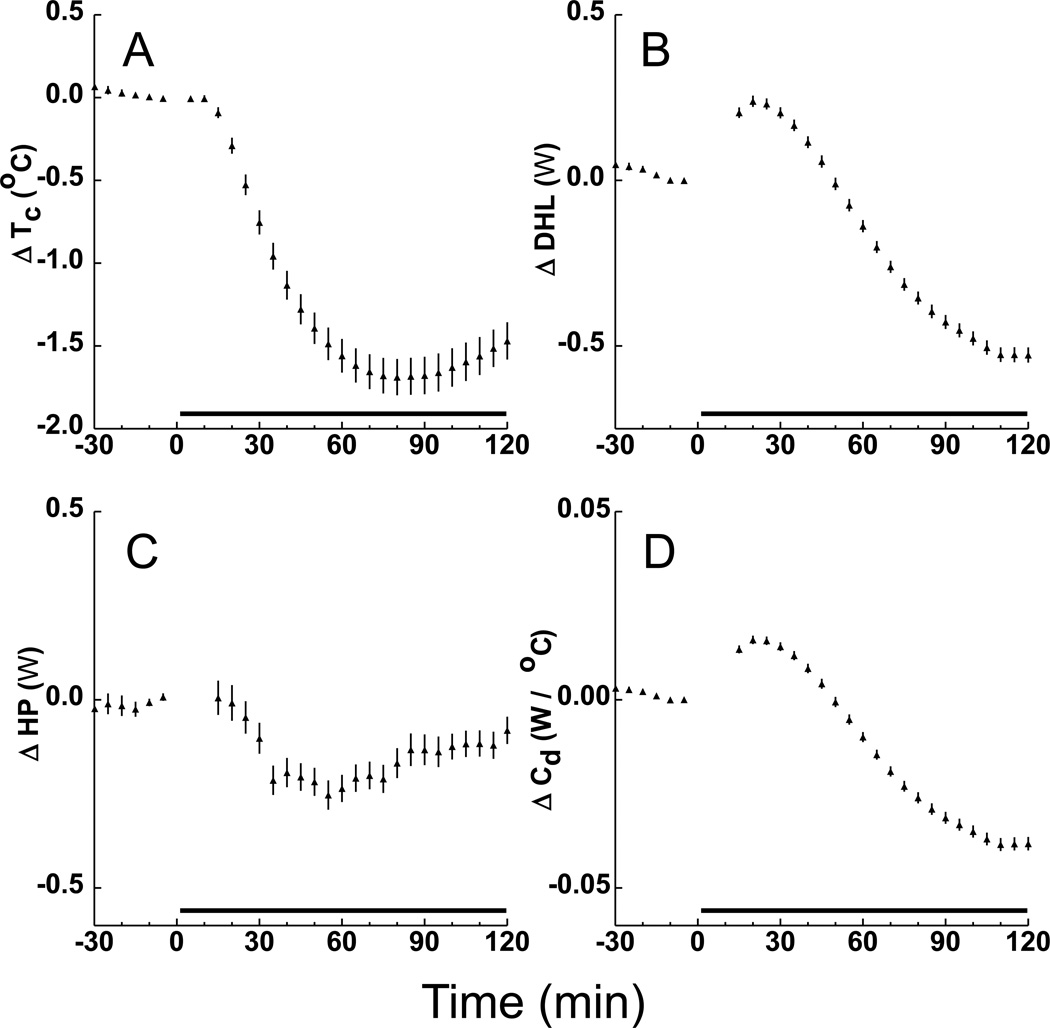
Overall mean ± 95% confidence interval values for thermal outcomes expressed as the change (Δ) from baseline during screening (n=237). Black bars on X-axis shows period of 70% N2O administration. The hypothermic core temperature (Tc) profile in panel A is congruent with the initial increase of dry heat loss (DHL) in B and the decrease of heat production (HP) in C. Panel D shows conductance (Cd) defined as DHL per degree of the core-to-ambient temperature gradient, considered a measure of how readily heat flows from the animal. Data for first two 5-min bins not shown in C–D.
Figure 3
Figure 3
Thermal adaptations in core temperature (Tc), dry heat loss (DHL) and heat production (HP) during repeated 70% N2O administrations in rats selected to represent extremes of initial sensitivity to hypothermia in the screening (S) administration. Uncertainty bars are 95% confidence intervals. Control rats received control gas (custom-blended air) during exposures. Panels on the left show changes in thermal values averaged across 90-minute (Tc) and 77.5 minutes (DHL and HP) periods of drug administration (for DHL and HP, the first 12.5 minutes of data were excluded owing to potential for artifactual values therein). Panels on the right show early changes averaged over the second and third 5-min bins following drug onset. The 12 drug exposures following screening were each separated by 1–2 day intervals in which no N2O administrations occurred. Panels A and B show that the initial hypothermia during N2O yielded to a state of tolerance (i.e., no change of Tc from baseline) but then subsequently inverted to significant hyperthermia during drug administration. The smooth lines represent elementary first order exponential growth curve fits to the mean data of the form Y = b0 + b1(1-exp(b3 X)). Key points: Initially insensitive rats exhibited Tc tolerance on the 1st post-screening administration and developed a hyperthermic intra-administration phenotype more rapidly than sensitive rats based on when 95% confidence intervals exclude zero. We note that the fitted exponential rate constants (b3) for insensitive vs. sensitive rats were 0.44±0.13 vs. 0.34±0.04, respectively. The hyperthermic sign reversal is highly congruent with the robust intersessional increases of HP during N2O administration (E and F). The increase of average DHL across sessions reflects the increase of HP, a major driver of HL. Early differences in HP and DHL may be especially important in determining Tc phenotypes during N2O administration. *p<0.05 for insensitive vs. sensitive by independent samples Student’s t-test. Baseline-adjusted p-values are reported in Results.
Figure 4
Figure 4
Temporal profiles of core temperature (Tc), dry heat loss (DHL) and heat production (HP) in initially sensitive and insensitive rats as defined by Tc excursions during screening. Numbers by lines indicate exposures 1, 3, 6, 9 and 12. Black bars show period of drug administration. Data are not shown for DHL and HP during the initial period of N2O administration owing to potential for artifactual changes. Key points: rats appear to develop hypothermic tolerance and the subsequent hyperthermic sign reversal via a HP response that is especially brisk in the first 30 minutes of drug administration.
Figure 5
Figure 5
Changes of dry conductance (Cd) with repeated N2O administration. Uncertainty bars are 95% confidence intervals. Key points: Early changes of Cd, a measure of the ease with which heat flows from the body, distinguish the sensitivity groups in earlier but not later exposures. * p<0.05 for initially insensitive vs. sensitive rats.

References

    1. Bessiere B, Richebe P, Laboureyras E, Laulin JP, Contarino A, Simonnet G. Nitrous oxide (N2O) prevents latent pain sensitization and long-term anxiety-like behavior in pain and opioid-experienced rats. Neuropharmacology. 2007;53:733–740. - PubMed
    1. Bligh J. Mammalian homeothermy: an integrative thesis. J. Therm. Biol. 1998;23:143–258.
    1. Bligh J. A theoretical consideration of the means whereby the mammalian core temperature is defended at a null zone. J Appl Physiol. 2006;100:1332–1337. - PubMed
    1. Csete ME, Doyle JC. Reverse engineering of biological complexity. Science. 2002;295:1664–1669. - PubMed
    1. Dworkin BR. Learning and physiological regulation. Chicago: The University of Chicago Press; 1993.

LinkOut - more resources