


Advances in SAW gas sensors based on the condensate-adsorption effect
- PMID: 22247697
- PMCID: PMC3252014
- DOI: 10.3390/s111211871
Advances in SAW gas sensors based on the condensate-adsorption effect
Abstract
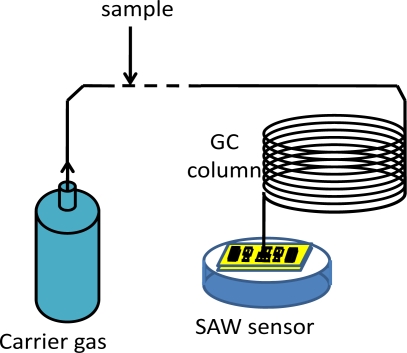
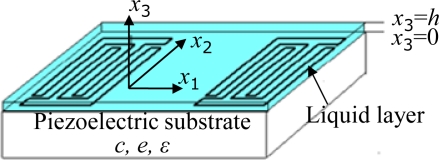
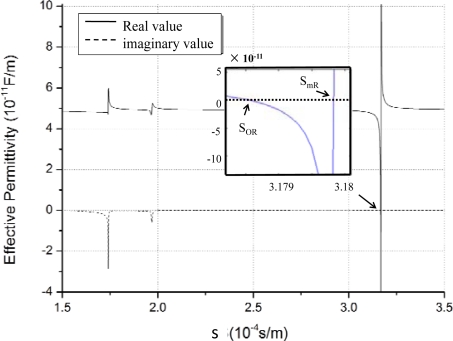
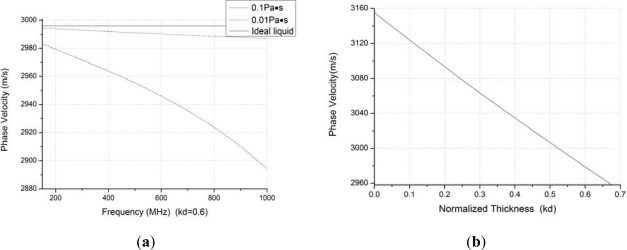
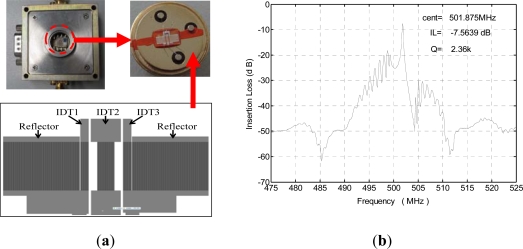
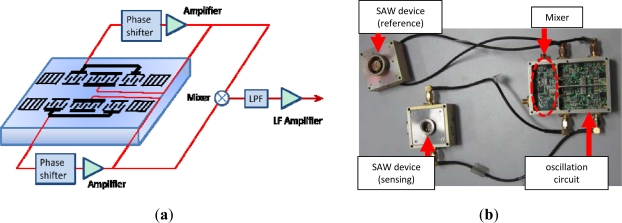
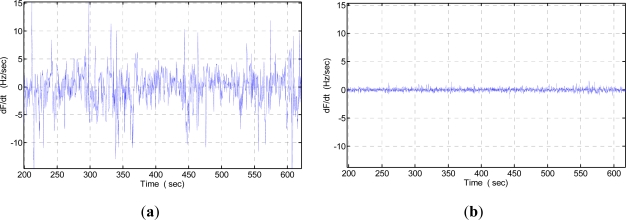
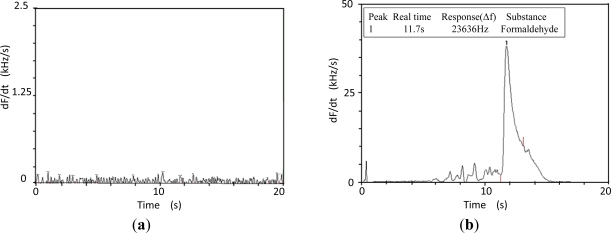
A surface-acoustic-wave (SAW) gas sensor with a low detection limit and fast response for volatile organic compounds (VOCs) based on the condensate-adsorption effect detection is developed. In this sensor a gas chromatography (GC) column acts as the separator element and a dual-resonator oscillator acts as the detector element. Regarding the surface effective permittivity method, the response mechanism analysis, which relates the condensate-adsorption effect, is performed, leading to the sensor performance prediction prior to fabrication. New designs of SAW resonators, which act as feedback of the oscillator, are devised in order to decrease the insertion loss and to achieve single-mode control, resulting in superior frequency stability of the oscillator. Based on the new phase modulation approach, excellent short-term frequency stability (±3 Hz/s) is achieved with the SAW oscillator by using the 500 MHz dual-port resonator as feedback element. In a sensor experiment investigating formaldehyde detection, the implemented SAW gas sensor exhibits an excellent threshold detection limit as low as 0.38 pg.
Keywords: gas chromatography (GC); gas sensor; surface acoustic wave (SAW); threshold detection limit.
Figures
References
-
- Bryant A., Lee D.F., Vetelino J.F. A surface acoustic wave gas detector. Proceedings of the 36th Annual Symposium on Frequency Control; Philadelphia, PA, USA. 2–4 June 1982; pp. 171–174.
-
- Wohltjen H., Snow A.W., Barger W.R. Trace chemical vapor detection using SAW delay line oscillator. IEEE Trans. Soni. Ultr. 1987;34:172–178. - PubMed
-
- Mcgill R.A., Nguyen V.K., Chung R. The ‘NRL-SAWRHINO’: A nose for toxic gases. Sens. Actuat. B. 2000;65:10–13.
-
- Sadek A.Z., Wlodarski W., Shin K., Kaner R.B., Kalantar-zadeh K. A Polyaniline/WO3 nanofiber composite based ZnO/64° YX LiNbO3 SAW hydrogen gas sensor. Synth. Metals. 2008;158:29–32.
Publication types
MeSH terms
Substances
LinkOut - more resources
Full Text Sources
Miscellaneous
