


doi: 10.1007/s12195-011-0208-5.
Synergistic Regulation of Angiogenic Sprouting by Biochemical Factors and Wall Shear Stress
Affiliations
- PMID: 22247741
- PMCID: PMC3254182
- DOI: 10.1007/s12195-011-0208-5
Item in Clipboard
Synergistic Regulation of Angiogenic Sprouting by Biochemical Factors and Wall Shear Stress
Cell Mol Bioeng.
2011 Dec.
Abstract
The process of sprouting angiogenesis involves activating endothelial cells in a quiescent monolayer of an existing vessel to degrade and migrate into the underlying matrix to form new blood vessels. While the roles of biochemical factors in angiogenic sprouting have been well characterized, the roles of fluid forces have received much less attention. This review summarizes results that support a role for wall shear stress in post-capillary venules as a mechanical factor capable of synergizing with biochemical factors to stimulate pro-angiogenic signaling in endothelial cells and promote sprout formation.
Figures
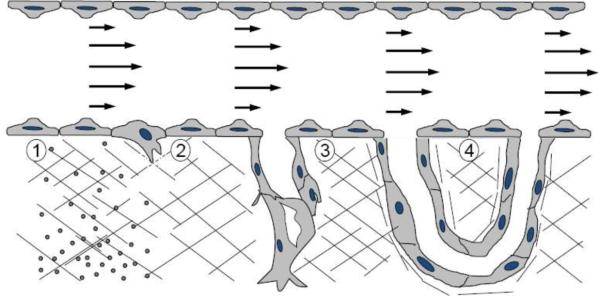
The process of angiogenesis occurs as an orderly series of events. 1) Fluid WSS and a chemotactic concentration gradient of biochemical agonists synergistically activate ECs lining a pre-existing blood vessel. 2) Activated ECs begin to cleave the underlying extracellular matrix through enzymatic proteolysis and migrate into newly-formed passages. 3) A lumen forms while additional ECs migrate and proliferate behind the tip cell to form the stalk. 4) Sprouts join at their tips, anastomosing with existing vessels, to form a new path for blood flow.
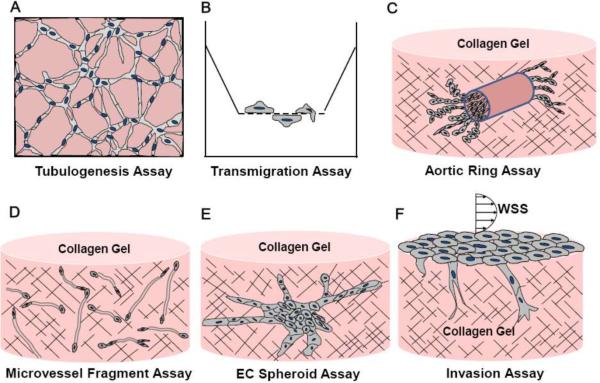
Experimental models for studying angiogenic events.
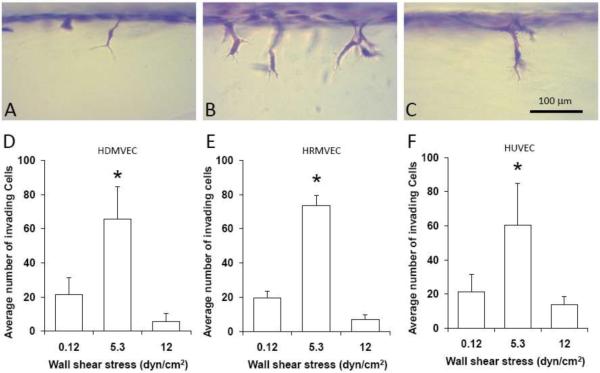
EC invasion depends on the magnitude of WSS. Human dermal microvascular ECs (HDMVECs) on 3-D collagen matrices containing 1μM S1P were subjected to 24h of 0.12 (A), 5.3 (B) and 12 dyn/cm2 WSS (C). The cultures were fixed and stained with toluidine blue to identify invading cells. Scale bar, 100μm. Quantification of HDMVECs (D), human retinal MVECs (E) and HUVECs (F) invasion into 3-D collagen matrices containing 1μM S1P subjected to 22h of WSS ranging from 0.12 to 12 dyn/cm2. Cultures were fixed, stained with toluidine blue for morphometric analysis and analyzed for invasion density. The density of invading ECs are plotted as a function of WSS magnitude (mean ±SD). * indicates the invasion density at 5.3 dyn/cm2 is significantly different from the values at the other WSS magnitudes (ANOVA followed by Student-Newman-Keuls post-hoc test; P<0.01).
References
-
- Anand-Apte B, Pepper MS, Voest E, Montesano R, Olsen B, Murphy G, Apte SS, Zetter B. Inhibition of angiogenesis by tissue inhibitor of metalloproteinase-3. Invest Ophthalmol Vis Sci. 1997;38:817–823. - PubMed
-
- Augustin-Voss HG, Pauli BU. Quantitative analysis of autocrine-regulated, matrix-induced, and tumor cell-stimulated endothelial cell migration using a silicon template compartmentalization technique. Exp Cell Res. 1992;198:221–227. - PubMed
-
- Balligand JL, Feron O, Dessy C. eNOS activation by physical forces: from short-term regulation of contraction to chronic remodeling of cardiovascular tissues. Physiol Rev. 2009;89:481–534. - PubMed
-
- Bayless KJ, Davis GE. Sphingosine-1-phosphate markedly induces matrix metalloproteinase and integrin-dependent human endothelial cell invasion and lumen formation in three-dimensional collagen and fibrin matrices. Biochem Biophys Res Commun. 2003;312:903–913. - PubMed
Grants and funding
LinkOut - more resources
Full Text Sources
