


Social features of online networks: the strength of intermediary ties in online social media
- PMID: 22247773
- PMCID: PMC3256152
- DOI: 10.1371/journal.pone.0029358
Social features of online networks: the strength of intermediary ties in online social media
Abstract
An increasing fraction of today's social interactions occur using online social media as communication channels. Recent worldwide events, such as social movements in Spain or revolts in the Middle East, highlight their capacity to boost people's coordination. Online networks display in general a rich internal structure where users can choose among different types and intensity of interactions. Despite this, there are still open questions regarding the social value of online interactions. For example, the existence of users with millions of online friends sheds doubts on the relevance of these relations. In this work, we focus on Twitter, one of the most popular online social networks, and find that the network formed by the basic type of connections is organized in groups. The activity of the users conforms to the landscape determined by such groups. Furthermore, Twitter's distinction between different types of interactions allows us to establish a parallelism between online and offline social networks: personal interactions are more likely to occur on internal links to the groups (the weakness of strong ties); events transmitting new information go preferentially through links connecting different groups (the strength of weak ties) or even more through links connecting to users belonging to several groups that act as brokers (the strength of intermediary ties).
Conflict of interest statement
Figures
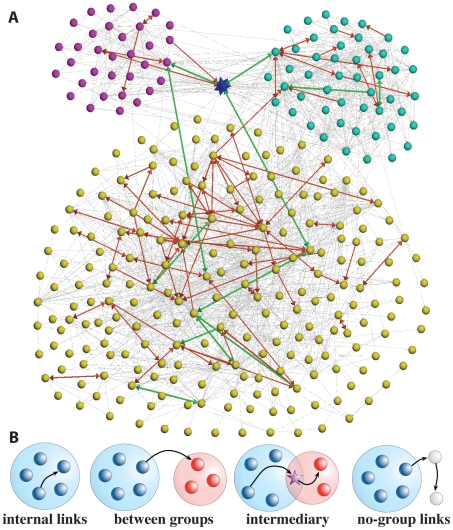
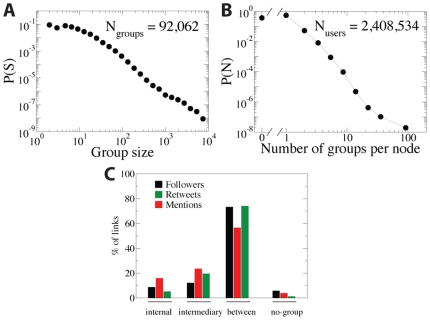
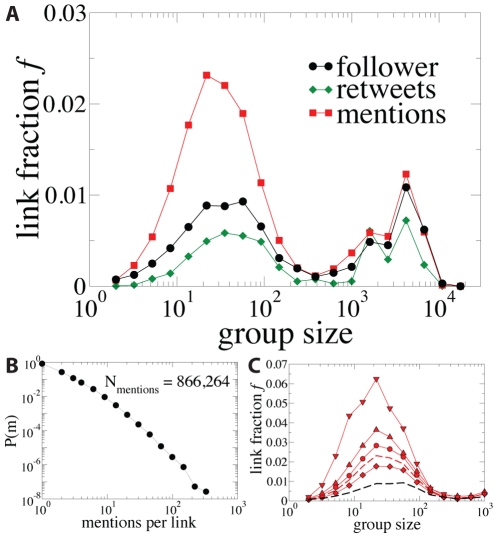
 of internal links as a function of the group size in number of users. The curve for the follower network acts as baseline for mentions and retweets. Note that if mentions/retweets were randomly appearing over follower links then the red/green curve should match the black curve. (B) Distribution of the number of mentions per link. (C) Fraction of links with mentions as a function of their intensity. The dashed curves are the total for the follower network (black) and for the links with mentions (red). While the other curves correspond (from bottom to top) to fractions of links with: 1 non-reciprocated mention (diamonds), 3 mentions (circles), 6 mentions (triangle up) and more than 6 reciprocated mentions (triangle down).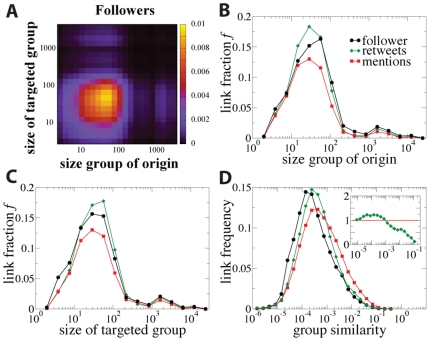
 of links of the different types (follower, with mentions and with retweets) as a function of the size of the group at the link origin, and (C) at the targeted group. (D) Frequency of between-group links as a function of the group-group similarity for the different type of links. In the inset, ratio between the frequency of links with retweets and with mentions.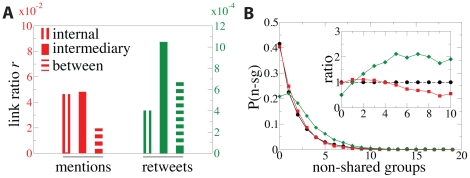
 between the number of links with mentions or retweets and number of follower links. (B) Distribution of the links in the follower network (black curve), those with mentions (red curve) and retweets (green curve) as a function of the number of non-shared groups of the users connected by the link. Inset, ratios between these distributions and the follower network.
References
-
- Cummings JN, Butler B, Kraut R. The quality of online social relationships. Comm ACM. 2002;45:103–108.
-
- van Dijk JAGM. The network society: social aspects of new media. London: Sage Publications Ltd (second edition); 2006.
-
- Avnit A. The Million Followers Fallacy. 2009. Internet Draft, Pravda Media. Available: http://tinyurl.com/nshcjg. Accessed July 15 2011.
-
- Watts DJ. A twenty-first century science. Nature. 2007;445:489. - PubMed
-
- Vespignani A. Predicting the behavior of techno-social systems. Science. 2009;325:425–428. - PubMed
Publication types
MeSH terms
LinkOut - more resources
Full Text Sources
Other Literature Sources
Medical
