Review
. 2011;16(3-4):163-97.
doi: 10.1615/critrevoncog.v16.i3-4.30.

The oncogenic role of Yin Yang 1

Affiliations
Review

The oncogenic role of Yin Yang 1

Qiang Zhang et al. Crit Rev Oncog. 2011.

Abstract

Yin Yang 1 (YY1) is a transcription factor with diverse and complex biological functions. YY1 either activates or represses gene transcription, depending on the stimuli received by the cells and its association with other cellular factors. Since its discovery, a biological role for YY1 in tumor development and progression has been suggested because of its regulatory activities toward multiple cancer-related proteins and signaling pathways and its overexpression in most cancers. In this review, we primarily focus on YY1 studies in cancer research, including the regulation of YY1 as a transcription factor, its activities independent of its DNA binding ability, the functions of its associated proteins, and mechanisms regulating YY1 expression and activities. We also discuss the correlation of YY1 expression with clinical outcomes of cancer patients and its target potential in cancer therapy. Although there is not a complete consensus about the role of YY1 in cancers based on its activities of regulating oncogene and tumor suppressor expression, most of the currently available evidence supports a proliferative or oncogenic role of YY1 in tumorigenesis.


Figures
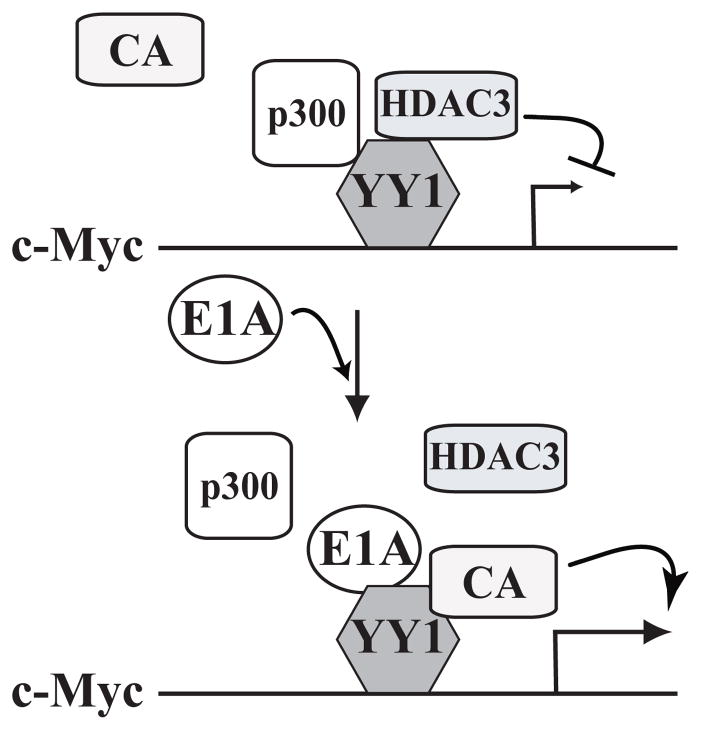
FIGURE 1
FIGURE 1
Schematic model for the stimulatory effect of E1A on Yin Yang 1 (YY1) -mediated c-Myc gene activation. YY1 forms a ternary complex with corepressors p300 and histone deacetylase (HDAC) 3, which represses c-Myc gene expression, probably in normal or resting cells. In transformed cells, the introduction of the viral oncogene E1A disrupts the YY1-p300-HDAC3 complex and leads to c-Myc gene activation, likely through recruiting a coactivator (CA) to promote histone acetylation. The stimulatory effects of E1A on YY1-mediated c-Fos gene activation and ORF50 promoter activation, the hepatitis C virus core protein on YY1-mediated B23 gene activation, and B23 on YY1-mediated proliferating cellular nuclear antigen (PCNA) gene activation, employ the same model, although the YY1-recruited cofactors are different.
FIGURE 2
FIGURE 2
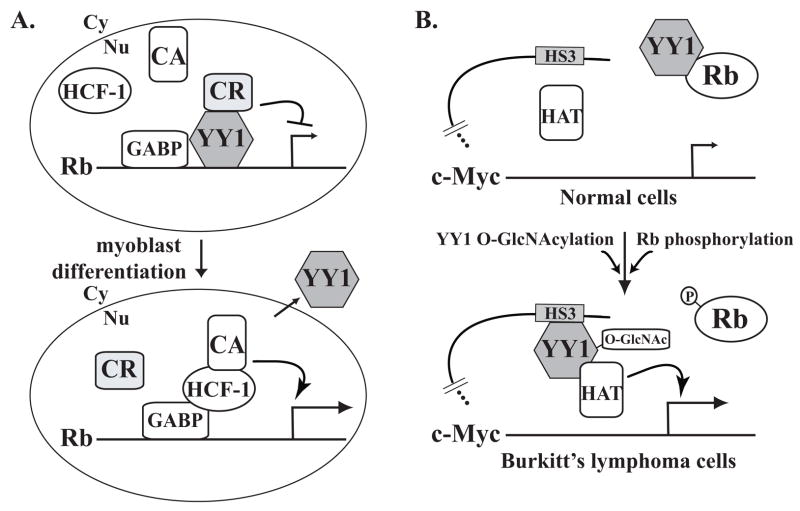
Schematic model of the interplay between Yin Yang 1 (YY1) and retinoblastoma (Rb). A, YY1 negatively regulates Rb gene transcription. YY1 and GA binding protein (GABP) cooperatively repress Rb gene expression, likely through recruiting a co-repressor (CR). During myoblast differentiation, YY1 is translocated from nucleus (Nu) to cytoplasm (Cy). This leads to the recruitment of host cell factor (HCF)–1 and probably a co-activator (CA), and Rb gene activation. B, Rb negatively regulates YY1-activated c-Myc gene expression. In human Burkitt lymphoma cells, a translocated c-Myc allele is regulated by the immunoglobulin heavy-chain gene HS3 enhancer. In resting or normal cells, hypophosphorylated Rb binds YY1 and prevents its association with HS3. In Burkitt lymphoma cells, YY1 disassociates with Rb, binds to the HS3 enhancer, and recruits a histone acetyltransferase (HAT) to mediate the acetylation of the c-Myc promoter, which leads to c-Myc gene activation. Phosphorylation of Rb causes its disassociation with YY1. The O-GlcNAcylation of YY1 both disrupts the Rb-YY1 association and increases the DNA binding affinity of YY1.,,
FIGURE 3
FIGURE 3
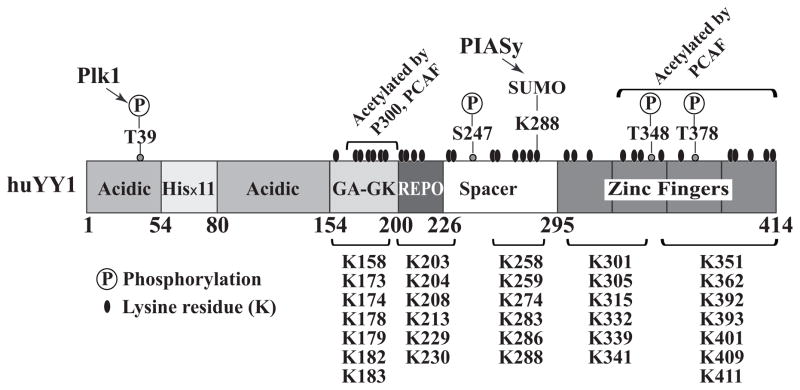
Domain structure of human Yin Yang 1 (YY1) protein with indicated posttranslational modification sites or regions. Polo-like kinase 1 (Plk1) phosphorylates T39, while protein inhibitor of activated STAT Y (PIASy) stimulates the sumoylation at K288. p300 and PCAF mediate the acetylation of residues 171–200, while P300/CBP associated factor (PCAF) also acetylates the C-terminal. Phosphorylation of Thr348 and Thr378, but not Ser247, reduces the DNA binding affinity of YY1. The regions of the 32 lysine residues are indicated. The sequence of YY1 protein is based on the NCBI access number NM_003403.3. The figure is adapted from Sui with permission.

References

    1. Shi Y, Seto E, Chang LS, Shenk T. Transcriptional repression by YY1, a human GLI-Kruppel-related protein, and relief of repression by adenovirus E1A protein. Cell. 1991;67(2):377–88. - PubMed
    1. Seto E, Shi Y, Shenk T. YY1 is an initiator sequence-binding protein that directs and activates transcription in vitro. Nature. 1991;354(6350):241–5. - PubMed
    1. Park K, Atchison ML. Isolation of a candidate repressor/activator, NF-E1 (YY-1, delta), that binds to the immunoglobulin kappa 3′ enhancer and the immunoglobulin heavy-chain mu E1 site. Proc Natl Acad Sci U S A. 1991;88(21):9804–8. - PMC - PubMed
    1. Hariharan N, Kelley DE, Perry RP. Delta, a transcription factor that binds to downstream elements in several polymerase II promoters, is a functionally versatile zinc finger protein. Proc Natl Acad Sci U S A. 1991;88(21):9799–803. - PMC - PubMed
    1. Flanagan JR, Becker KG, Ennist DL, Gleason SL, Driggers PH, Levi BZ, et al. Cloning of a negative transcription factor that binds to the upstream conserved region of Moloney murine leukemia virus. Mol Cell Biol. 1992;12(1):38–44. - PMC - PubMed

Publication types

MeSH terms

Substances