


Real-time prescription surveillance and its application to monitoring seasonal influenza activity in Japan
- PMID: 22249906
- PMCID: PMC3846340
- DOI: 10.2196/jmir.1881
Real-time prescription surveillance and its application to monitoring seasonal influenza activity in Japan
Abstract
Background: Real-time surveillance is fundamental for effective control of disease outbreaks, but the official sentinel surveillance in Japan collects information related to disease activity only weekly and updates it with a 1-week time lag.
Objective: To report on a prescription surveillance system using electronic records related to prescription drugs that was started in 2008 in Japan, and to evaluate the surveillance system for monitoring influenza activity during the 2009-2010 and 2010-2011 influenza seasons.
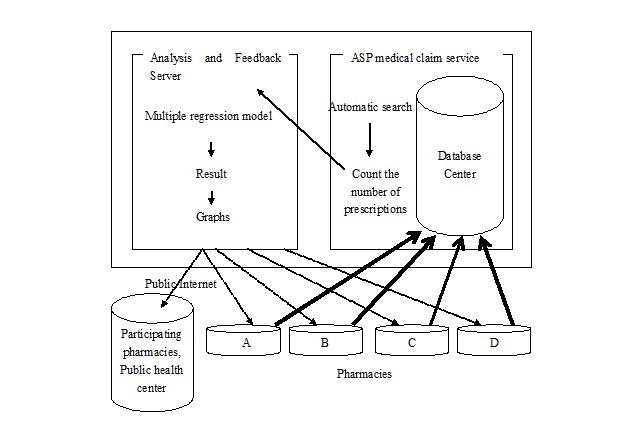
Methods: We developed an automatic surveillance system using electronic records of prescription drug purchases collected from 5275 pharmacies through the application service provider's medical claims service. We then applied the system to monitoring influenza activity during the 2009-2010 and 2010-2011 influenza seasons. The surveillance system collected information related to drugs and patients directly and automatically from the electronic prescription record system, and estimated the number of influenza cases based on the number of prescriptions of anti-influenza virus medication. Then it shared the information related to influenza activity through the Internet with the public on a daily basis.
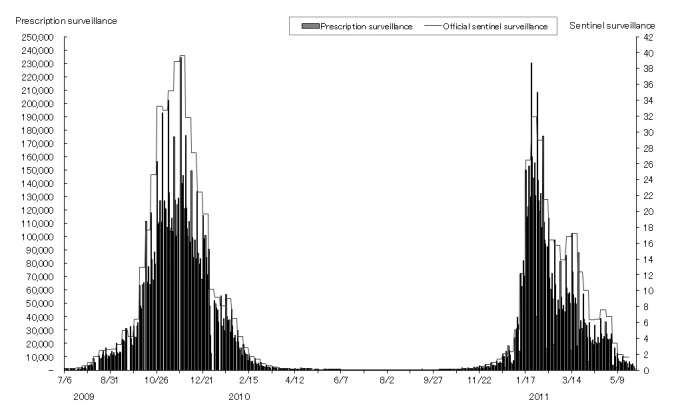
Results: During the 2009-2010 influenza season, the number of influenza patients estimated by the prescription surveillance system between the 28th week of 2009 and the 12th week of 2010 was 9,234,289. In the 2010-2011 influenza season, the number of influenza patients between the 36th week of 2010 and the 12th week of 2011 was 7,153,437. The estimated number of influenza cases was highly correlated with that predicted by the official sentinel surveillance (r = .992, P < .001 for 2009-2010; r = .972, P < .001 for 2010-2011), indicating that the prescription surveillance system produced a good approximation of activity patterns.
Conclusions: Our prescription surveillance system presents great potential for monitoring influenza activity and for providing early detection of infectious disease outbreaks.
Conflict of interest statement
Conflicts of Interest: None declared.
Figures
References
-
- Shimada T, Gu Y, Kamiya H, Komiya N, Odaira F, Sunagawa T, Takahashi H, Toyokawa T, Tsuchihashi Y, Yasui Y, Tada Y, Okabe N. Epidemiology of influenza A(H1N1)v virus infection in Japan, May-June 2009. Euro Surveill. 2009 Jun 18;14(24) http://www.eurosurveillance.org/ViewArticle.aspx?ArticleId=19244 - PubMed
-
- National Institute of Infectious Diseases. 2011. [2011-06-30]. Infectious Diseases Weekly Report: Trend Graph [in Japanese] http://idsc.nih.go.jp/idwr/index.html.
-
- Buehler JW, Sonricker A, Paladini M, Sope P, Mostashar F. Syndromic surveillance practice in the United States: findings from a survey of state, territorial, and selected local health departments. Adv Dis Surveill. 2008;6(3)
-
- Taniguchi K, Hashimoto S, Kawado M, Murakami Y, Izumida M, Ohta A, Tada Y, Shigematsu M, Yasui Y, Nagai M. Overview of infectious disease surveillance system in Japan, 1999-2005. J Epidemiol. 2007 Dec;17 Suppl:S3–13. http://joi.jlc.jst.go.jp/JST.JSTAGE/jea/17.S3?from=PubMed - PMC - PubMed
-
- Olson DR, Heffernan RT, Paladini M, Konty K, Weiss D, Mostashari F. Monitoring the impact of influenza by age: emergency department fever and respiratory complaint surveillance in New York City. PLoS Med. 2007 Aug;4(8):e247. doi: 10.1371/journal.pmed.0040247. http://dx.plos.org/10.1371/journal.pmed.0040247 - DOI - PMC - PubMed
Publication types
MeSH terms
LinkOut - more resources
Full Text Sources
Medical
