


Distinct HIV discordancy patterns by epidemic size in stable sexual partnerships in sub-Saharan Africa
- PMID: 22250180
- PMCID: PMC3261749
- DOI: 10.1136/sextrans-2011-050114
Distinct HIV discordancy patterns by epidemic size in stable sexual partnerships in sub-Saharan Africa
Abstract
Objective: To describe patterns of HIV infection among stable sexual partnerships across sub-Saharan Africa (SSA).
Methods: The authors defined measures of HIV discordancy and conducted a comprehensive quantitative assessment of discordancy among stable partnerships in 20 countries in SSA through an analysis of the Demographic and Health Survey data.
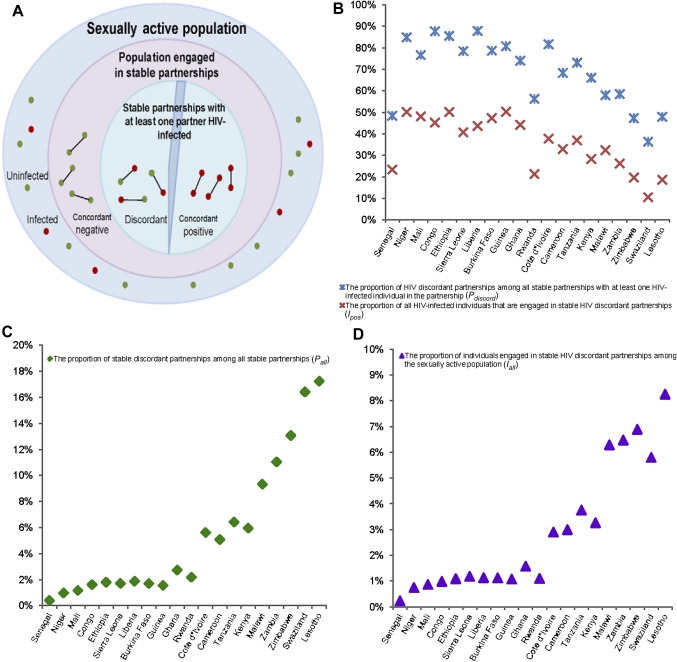
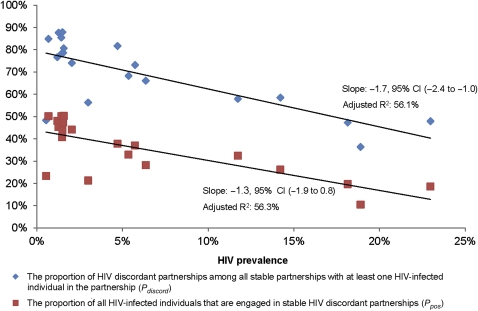
Results: HIV prevalence explained at least 50% of the variation in HIV discordancy, with two distinct patterns of discordancy emerging based on HIV prevalence being roughly smaller or larger than 10%. In low-prevalence countries, approximately 75% of partnerships affected by HIV are discordant, while only about half of these are discordant in high-prevalence countries. Out of each 10 HIV infected persons, two to five are engaged in discordant partnerships in low-prevalence countries compared with one to three in high-prevalence countries. Among every 100 partnerships in the population, one to nine are affected by HIV and zero to six are discordant in low-prevalence countries compared with 16-45 and 9-17, respectively, in high-prevalence countries. Finally, zero to four of every 100 sexually active adults are engaged in a discordant partnership in low-prevalence countries compared with six to eight in high-prevalence countries.
Conclusions: In high-prevalence countries, a large fraction of stable partnerships were affected by HIV and half were discordant, whereas in low-prevalence countries, fewer stable partnerships were affected by HIV but a higher proportion of them were discordant. The findings provide a global view of HIV infection among stable partnerships in SSA but imply complex considerations for rolling out prevention interventions targeting discordant partnerships.
Conflict of interest statement
Figures
References
-
- UNAIDS UNAIDS Report on the Global AIDS Epidemic. http://www.unaids.org/globalreport/Global_report.htm, 2010
-
- Guthrie BL, De Bruyn G, Farquhar C. HIV-1-discordant couples in sub-Saharan Africa: explanations and implications for high rates of discordancy. Curr HIV Res 2007;5:416–29 - PubMed
-
- Dunkle K, Stephenson R, Karita E, et al. New heterosexually transmitted HIV infections in married or cohabiting couples in urban Zambia and Rwanda: an analysis of survey and clinical data. Lancet 2008;371:2183–91 - PubMed
-
- Matovu JK. Preventing HIV transmission in married and cohabiting HIV-discordant couples in sub-Saharan Africa through combination prevention. Curr HIV Res 2010;8:430–40 - PubMed
Publication types
MeSH terms
Grants and funding
LinkOut - more resources
Full Text Sources
Medical
Research Materials
