. 2012 Mar;26(2):251-265.
doi: 10.1037/a0026712. Epub 2012 Jan 16.

Age group and sex differences in performance on a computerized neurocognitive battery in children age 8-21

Affiliations

Age group and sex differences in performance on a computerized neurocognitive battery in children age 8-21

Ruben C Gur et al. Neuropsychology. 2012 Mar.

Abstract

Objective: Examine age group effects and sex differences by applying a comprehensive computerized battery of identical behavioral measures linked to brain systems in youths that were already genotyped. Such information is needed to incorporate behavioral data as neuropsychological "biomarkers" in large-scale genomic studies.

Method: We developed and applied a brief computerized neurocognitive battery that provides measures of performance accuracy and response time for executive-control, episodic memory, complex cognition, social cognition, and sensorimotor speed domains. We tested a population-based sample of 3,500 genotyped youths ages 8-21 years.

Results: Substantial improvement with age occurred for both accuracy and speed, but the rates varied by domain. The most pronounced improvement was noted in executive control functions, specifically attention, and in motor speed, with some effect sizes exceeding 1.8 standard deviation units. The least pronounced age group effect was in memory, where only face memory showed a large effect size on improved accuracy. Sex differences had much smaller effect sizes but were evident, with females outperforming males on attention, word and face memory, reasoning speed, and all social cognition tests and males outperforming females in spatial processing and sensorimotor and motor speed. These sex differences in most domains were seen already at the youngest age groups, and age group × sex interactions indicated divergence at the oldest groups with females becoming faster but less accurate than males.

Conclusions: The results indicate that cognitive performance improves substantially in this age span, with large effect sizes that differ by domain. The more pronounced improvement for executive and reasoning domains than for memory suggests that memory capacities have reached their apex before age 8. Performance was sexually modulated and most sex differences were apparent by early adolescence.


Figures
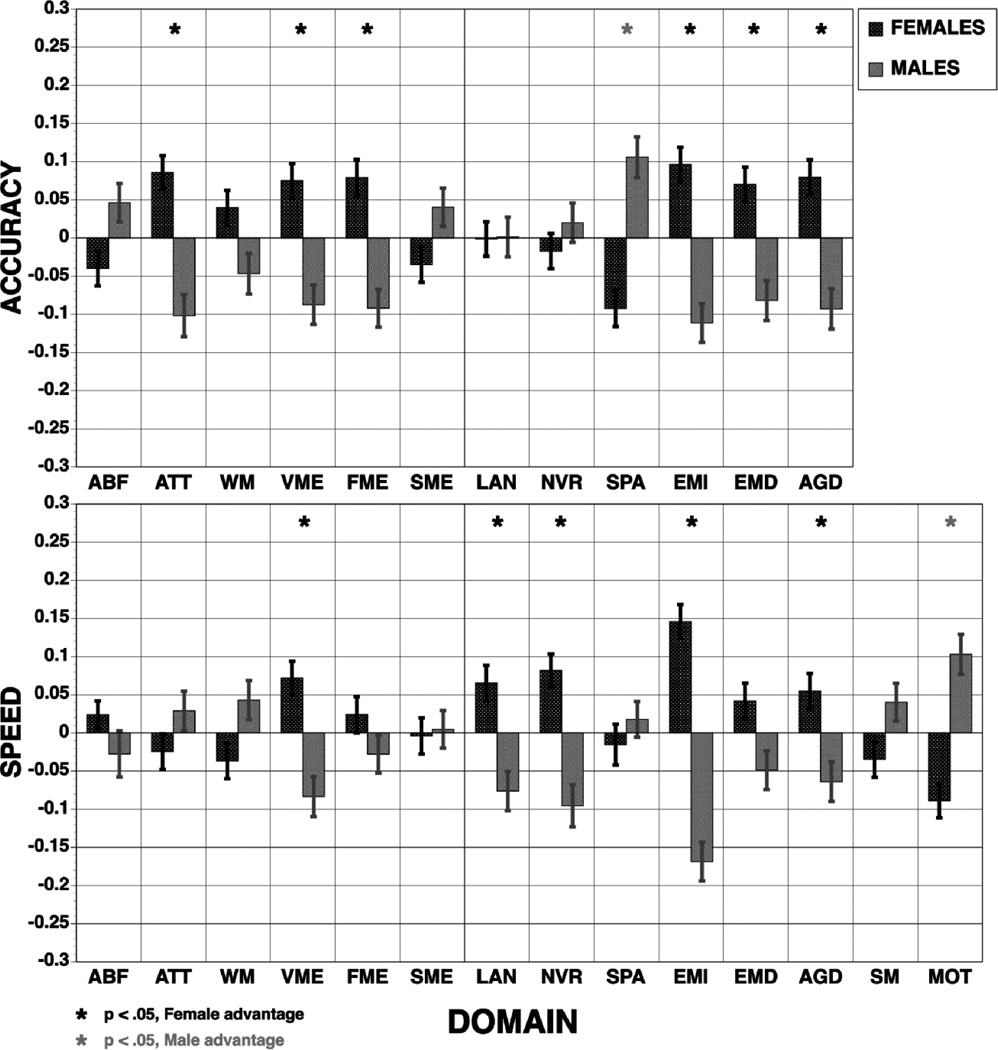
Figure 1
Figure 1
Means (±SE) of z-scores for accuracy (top panel) and speed (bottom panel) for females (red bars) and males (blue bars) across the sample on each behavioral domain. ABF=Abstraction and Mental Flexibility; ATT=Attention; WM=Working Memory; VME=Verbal Memory; FME=Face Memory; SME=Spatial Memory; LAN= Language Reasoning; NVR=Nonverbal Reasoning; SPA=Spatial Processing; EMI= Emotion Identification; EMD=Emotion Differentiation; AGD=Age Differentiation; SM=Sensorimotor Speed; MOT=Motor Speed. Stars indicate significant (p<.05) sex differences, red stars indicate better performance in females, blue stars better performance in males.
Figure 2
Figure 2
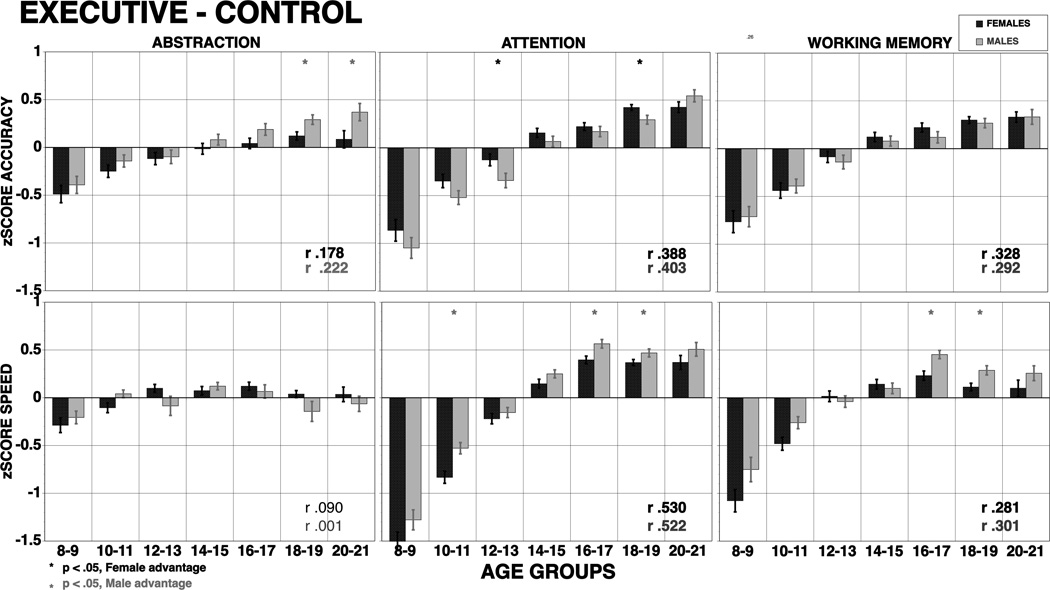
Means (±SE) of z-scores for accuracy (top panel) and speed (bottom panel) for females (red bars) and males (blue bars) on executive-control functions. The results are shown by age groups and correlations with age are provided by sex (bold correlations are significant at p<.001). Stars indicate significant (p<.05) sex differences, red stars indicate better performance in females, blue stars better performance in males.
Figure 3
Figure 3
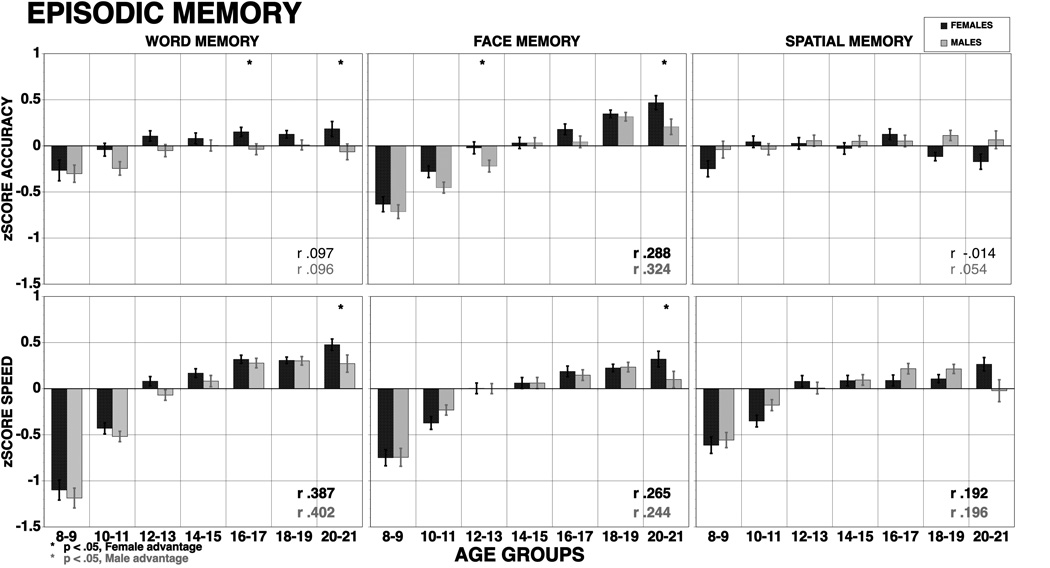
Means (±SE) of z-scores for accuracy (top panel) and speed (bottom panel) for females (red bars) and males (blue bars) on memory functions. The results are shown by age groups and correlations with age are provided by sex (bold correlations are significant at p<.001). Stars indicate significant (p<.05) sex differences, red stars indicate better performance in females, blue stars better performance in males.
Figure 4
Figure 4
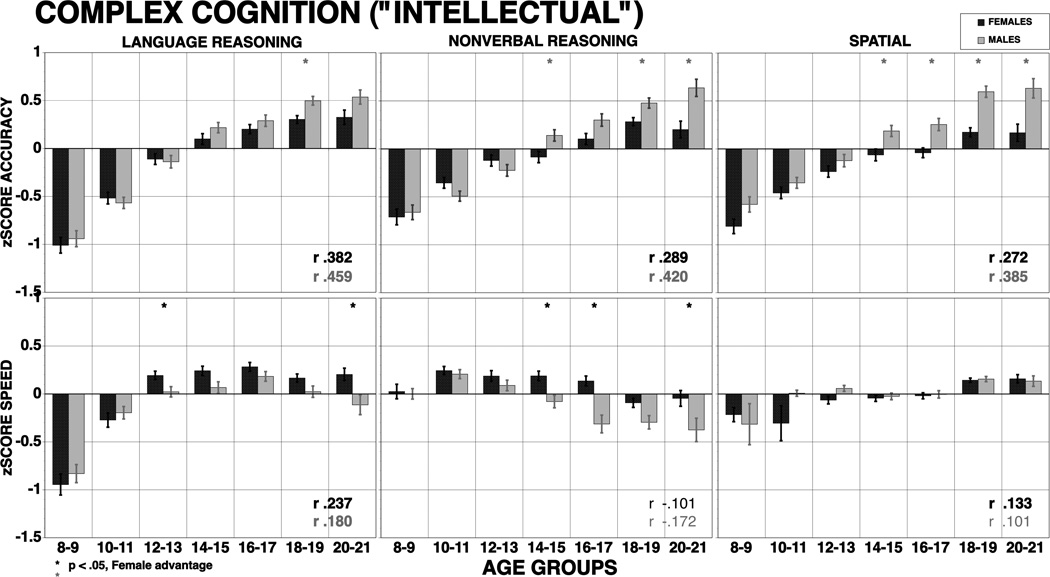
Means (±SE) of z-scores for accuracy (top panel) and speed (bottom panel) for females (red bars) and males (blue bars) on complex cognitive tasks. The results are shown by age groups and correlations with age are provided by sex (bold correlations are significant at p<.001). Stars indicate significant (p<.05) sex differences, red stars indicate better performance in females, blue stars better performance in males.
Figure 5
Figure 5
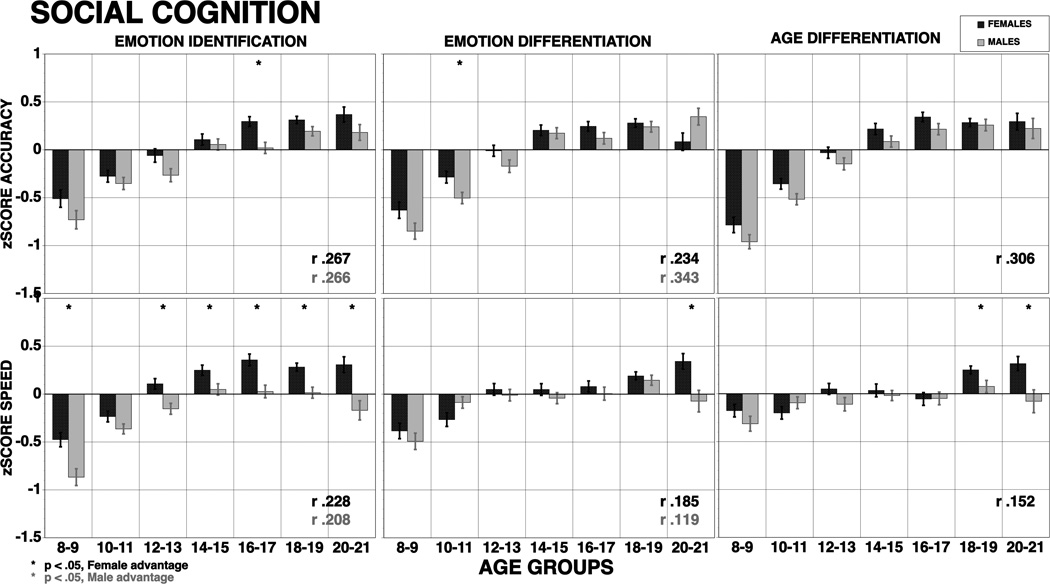
Means (±SE) of z-scores for accuracy (top panel) and speed (bottom panel) for females (red bars) and males (blue bars) on social cognition. The results are shown by age groups and correlations with age are provided by sex (bold correlations are significant at p<.001). Stars indicate significant (p<.05) sex differences, red stars indicate better performance in females, blue stars better performance in males.
Figure 6
Figure 6
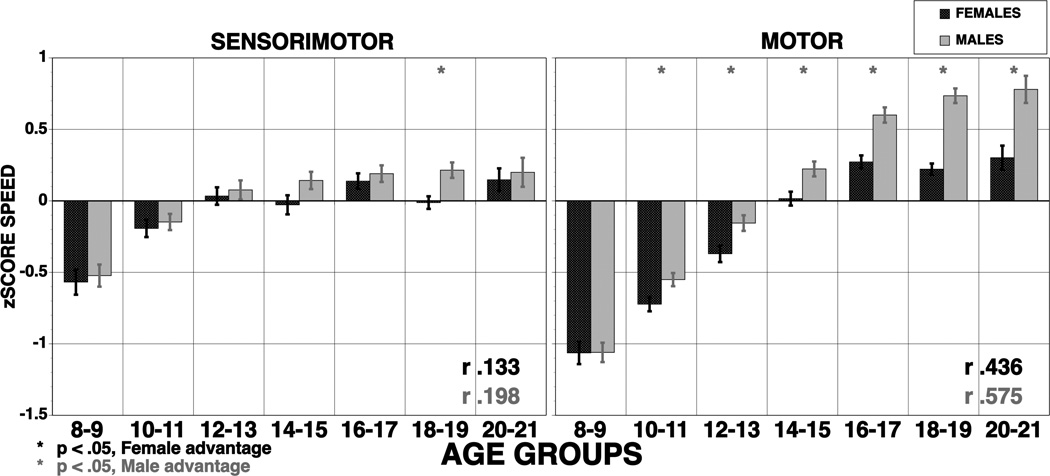
Means (±SE) of z-scores for sensorimotor processing and motor speed for females (red bars) and males (blue bars). The results are shown by age groups and correlations with age are provided by sex (bold correlations are significant at p<.001). Stars indicate significant (p<.05) sex differences, red stars indicate better performance in females, blue stars better performance in males.

References

    1. Ang SY, Lee K. Central executive involvement in children's spatial memory. Memory. 2008;16:918–933. - PubMed
    1. Ang SY, Lee K. Exploring developmental differences in visual short-term memory and working memory. Developmental Psychology. 2010;46:279–285. - PubMed
    1. Bramen JE, Hranilovich JA, Dahl RE, Forbes EE, Chen J, Toga AW, Dinov ID, Worthman CM, Sowell ER. Puberty influences medial temporal lobe and cortical gray matter maturation differently in boys than girls matched for sexual maturity. Cerebral Cortex. 2011;21:636–646. - PMC - PubMed
    1. Burnett S, Sebastian C, Cohen Kadosh K, Blakemore SJ. The social brain in adolescence: Evidence from functional magnetic resonance imaging and behavioural studies. [2010 Oct 29];Neuroscience Biobehavioral Review. 2011 [Epub ahead of print] - PMC - PubMed
    1. Carter CS, Barch DM, Gur RC, Gur RE, Pinkham A, Ochsner K. CNTRICS Final Task Selection: Social Cognitive and Affective Neuroscience-Based Measures. Schizophrenia Bulletin. 2008;35:153–162. - PMC - PubMed

Publication types