


Ecology of the microbiome of the infected root canal system: a comparison between apical and coronal root segments
- PMID: 22251411
- PMCID: PMC4986919
- DOI: 10.1111/j.1365-2591.2011.02006.x
Ecology of the microbiome of the infected root canal system: a comparison between apical and coronal root segments
Abstract
Aim: To evaluate the microbial ecology of the coronal and apical segments of infected root canal systems using a complete sampling technique and next-generation sequencing.
Methodology: The roots of 23 extracted teeth with apical periodontitis were sectioned in half, horizontally, and cryo-pulverized. Bacterial communities were profiled using tagged 454 pyrosequencing of the 16S rDNA hypervariable V5-V6 region.
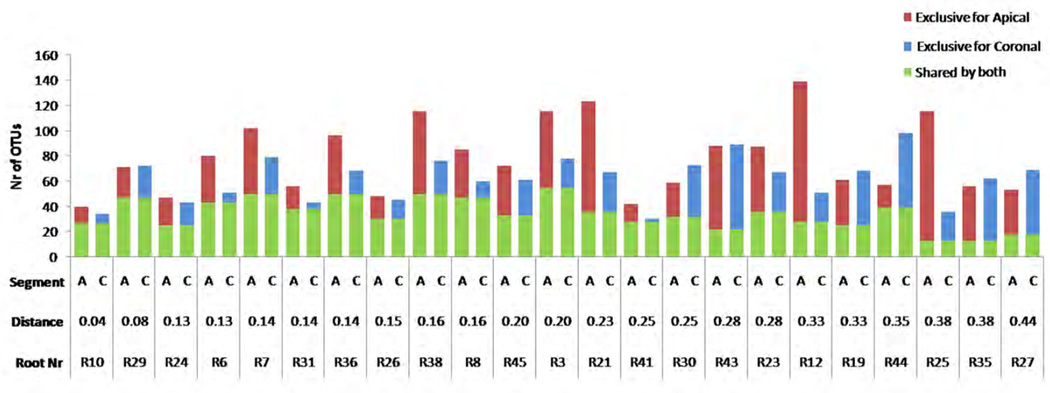
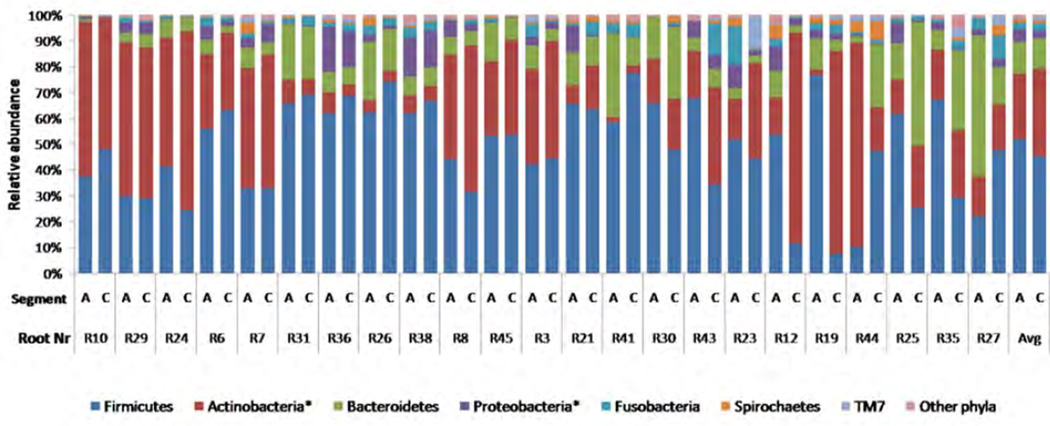
Results: The sequences were classified into 606 taxa (species or higher taxon), representing 24 bacterial phyla or candidate divisions and one archaeal phylum. Proteobacteria were more abundant in the apical samples (P < 0.05), whilst Actinobacteria were in significantly higher proportions in the coronal samples. The apical samples harboured statistically significantly more taxa than the coronal samples (P = 0.01) and showed a higher microbial diversity. Several taxa belonging to fastidious obligate anaerobes were significantly more abundant in the apical segments of the roots compared with their coronal counterparts.
Conclusions: Endodontic infections are more complex than reported previously. The apical part of the root canal system drives the selection of a more diverse and more anaerobic community than the coronal part. The presence of a distinct ecological niche in the apical region explains the difficulty of eradication of the infection and emphasizes the need for new treatment approaches to be developed.
© 2012 International Endodontic Journal.
Figures

References
-
- Adib V, Spratt D, Ng Y-l, Gulabivala K. Cultivable microbial flora associated with persistent periapical disease and coronal leakage after root canal treatment: a preliminary study. International Endodontic Journal. 2004;37:542–551. - PubMed
-
- Akpata E. Effect of endodontic procedures on the population of viable microorganisms in the infected root canal. Journal of Endodontics. 1976;2:369–373. - PubMed
-
- Alves FR, Siqueira JFJ, Carmo FL, et al. Bacterial community profiling of cryogenically ground samples from the apical and coronal root segments of teeth with apical periodontitis. Journal of Endodontics. 2009;35:486–492. - PubMed
-
- Baumgartner JC, Watts CM, Xia T. Occurrence of Candida albicans in infections of endodontic origin. Journal of Endodontics. 2000;26:695–698. - PubMed
-
- Brundin M, Figdor D, Roth C, Davies JK, Sundqvist G, Sjögren U. Persistence of dead-cell bacterial DNA in ex vivo root canals and influence of nucleases on DNA decay in vitro. Oral Surgery, Oral Medicine, Oral Pathology, Oral Radiology, and Endodontology. 2010;110:789–794. - PubMed
Publication types
MeSH terms
Substances
Grants and funding
LinkOut - more resources
Full Text Sources
