


Wild boar: an increasing concern for Aujeszky's disease control in pigs?
- PMID: 22251441
- PMCID: PMC3274458
- DOI: 10.1186/1746-6148-8-7
Wild boar: an increasing concern for Aujeszky's disease control in pigs?
Abstract
Background: The goal of this study was describing the temporal evolution of Aujeszky's disease virus (ADV) contact prevalence among Eurasian wild boar (Sus scrofa) populations under different management regimes and contact likelihoods with domestic pigs. Given the recent increase in wild boar abundance throughout Europe, we hypothesized that wild boar contact with ADV would remain stable in time even after significant reduction of ADV prevalence in domestic pigs.
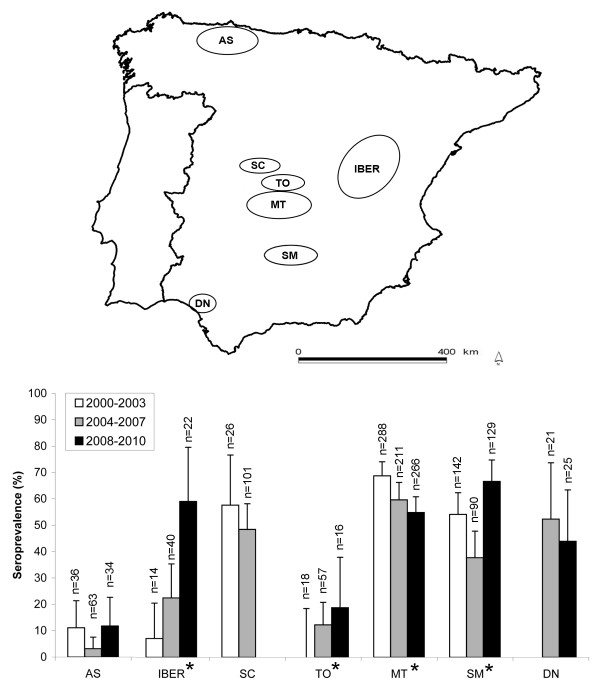
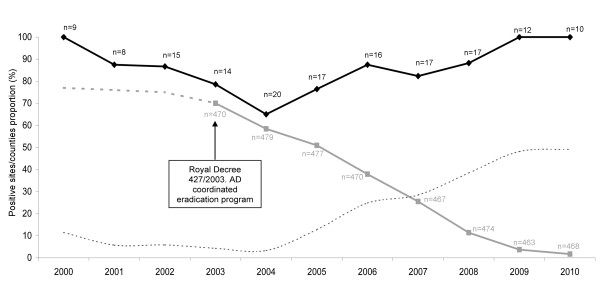
Results: Sera from 1659 wild boar were collected from 2000 to 2010 within 6 areas of the Iberian Peninsula and tested for the presence of antibodies against ADV by ELISA. According to sampling date, wild boar were grouped into three time periods. ADV prevalence was compared through period both globally and by geographic area. Overall seroprevalence for the ten-year study period was 49.6 ± 2.4%. The highest seroprevalence was recorded in areas with intense wild boar management. The annual proportion of positive wild boar sampling sites remained stable through the study period, while the percentage of domestic pig AD positive counties decreased from 70% in 2003 to 1.7% in 2010.
Conclusions: Results presented herein confirmed our hypothesis that ADV would remain almost stable in wild boar populations. This evidences the increasing risk wild boar pose in the final stages of ADV eradication in pigs and for wildlife conservation.
Figures
References
-
- Gortazar C, Vicente J, Fierro Y, Leon L, Cubero MJ, Gonzalez M. In: Domestic Animal/Wildlife Interface: Issue for Disease Control, Conservation, Sustainable Food Production, and Emerging Diseases. Gibbs EPJ, Bokma BH, editor. Vol. 969. New York: New York Acad Sciences; 2002. Natural Aujeszky's disease in a Spanish wild boar population; pp. 210–212. - PubMed
-
- Glass CM, McLean RG, Katz JB, Maehr DS, Cropp CB, Kirk LJ, McKeirnan AJ, Evermann JF. Isolation of pseudorabies (Aujeszky's disease) virus from a Florida panther. J Wildl Dis. 1994;30:180–184. - PubMed
-
- Zanin E, Capua I, Casaccia C, Zuin A, Moresco A. Isolation and characterization of Aujeszky's disease virus in captive brown bears from Italy. J Wildl Dis. 1997;33:632–634. - PubMed
Publication types
MeSH terms
LinkOut - more resources
Full Text Sources
