Review
. 2012 Jan;8(1):81-8.
doi: 10.4161/hv.8.1.17623. Epub 2012 Jan 1.

The rationale for quadrivalent influenza vaccines

Affiliations
Review

The rationale for quadrivalent influenza vaccines

Christopher S Ambrose et al. Hum Vaccin Immunother. 2012 Jan.

Abstract

Two antigenically distinct lineages of influenza B viruses have circulated globally since 1985. However, licensed trivalent seasonal influenza vaccines contain antigens from only a single influenza B virus and thus provide limited immunity against circulating influenza B strains of the lineage not present in the vaccine. In recent years, predictions about which B lineage will predominate in an upcoming influenza season have been no better than chance alone, correct in only 5 of the 10 seasons from 2001 to 2011. Consequently, seasonal influenza vaccines could be improved by inclusion of influenza B strains of both lineages. The resulting quadrivalent influenza vaccines would allow influenza vaccination campaigns to respond more effectively to current global influenza epidemiology. Manufacturing capacity for seasonal influenza vaccines has increased sufficiently to supply quadrivalent influenza vaccines, and methods to identify the influenza B strains to include in such vaccines are in place. Multiple manufacturers have initiated clinical studies of quadrivalent influenza vaccines. Data from those studies, taken together with epidemiologic data regarding the burden of disease caused by influenza B infections, will determine the safety, effectiveness, and benefit of utilizing quadrivalent vaccines for the prevention of seasonal influenza disease.


Figures
None
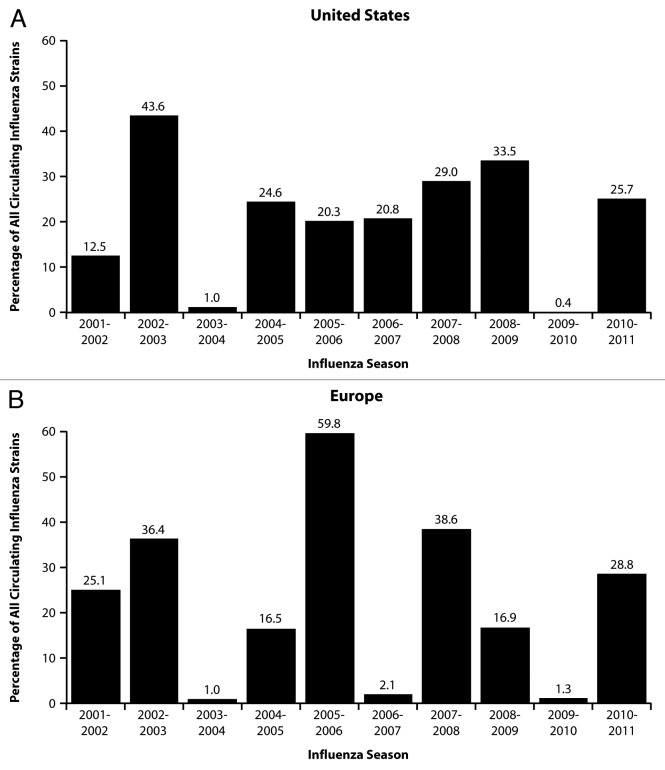
Figure 1. Influenza B circulation as a proportion of circulating influenza strains: US and European data for 2001 to 2011. US data (A) were extracted from cumulative data reported in the final CDC weekly influenza surveillance report for each season (available at www.cdc.gov/flu/weekly/pastreports.htm). Data for 2008–2009 represent cumulative data through April 18, 2009. EU data (B) were extracted from cumulative Euroflu sentinel site data reported in the final weekly influenza surveillance bulletin for each season beginning with the 2003–2004 season (available at www.euroflu.org/cgi-files/bulletin_v2.cgi). Because Euroflu bulletins issued before 2003–2004 do not provide cumulative season data, data presented for the 2001–2002 and 2002–2003 influenza seasons were extracted from the final cumulative European Influenza Surveillance Scheme report issued in 2007 (available at www.euroflu.org/documents/eiss_annual_report_2006-2007.pdf).
None
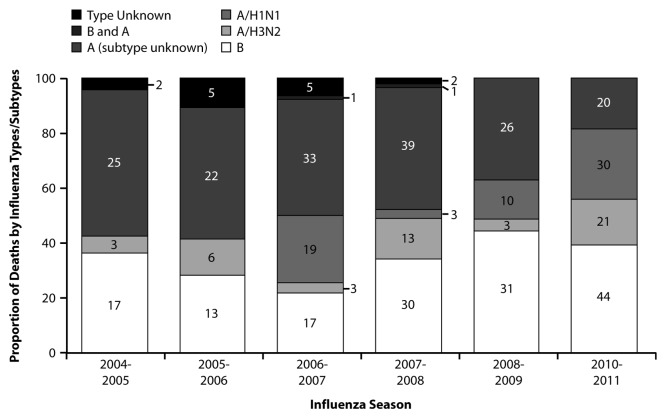
Figure 2. Proportion of US pediatric influenza deaths by viral type (2004 to 2011, excluding 2009–2010 pandemic). Values in columns represent the number of deaths in each category for each season. Data for the 2004–2005 through 2008–2009 seasons were obtained via personal communication with the CDC. Pediatric influenza deaths became reportable in 2004–2005; as a result, comparable data are not available prior to 2004–2005. Data for the 2010–2011 season was obtained from the CDC 2010–2011 Influenza Season Summary (available at www.cdc.gov/flu/weekly/pastreports.htm).
None
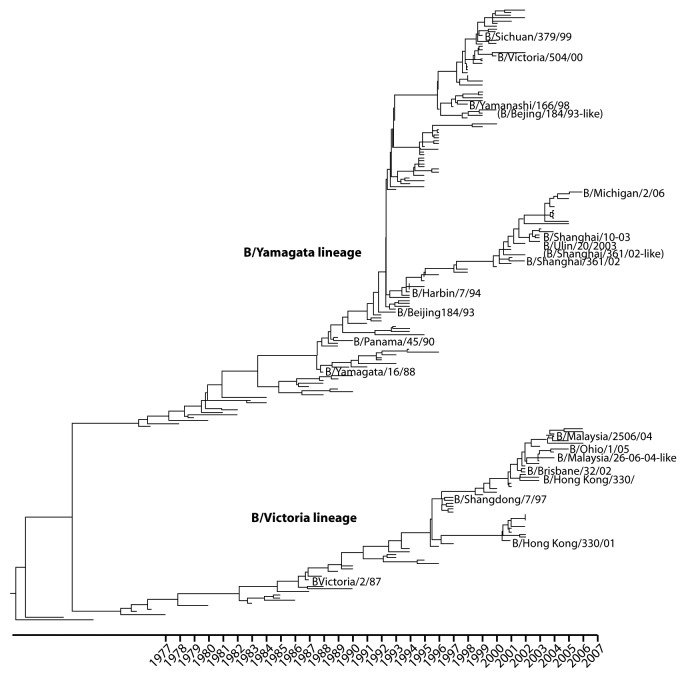
Figure 3. Evolution of two antigenically distinct lineages of influenza B (1970–2006). Phylogenetic tree of the influenza B virus HA1 domain based on 214 sequences sampled annually between 1970 and 2006. Data for the B/Victoria/02/87-like and B/Yamagata/16/88-like lineages are shown. Representative vaccine strains are also shown. Adapted with permission from Chen R. Holmes E.C. The evolutionary dynamics of human influenza B virus.
None
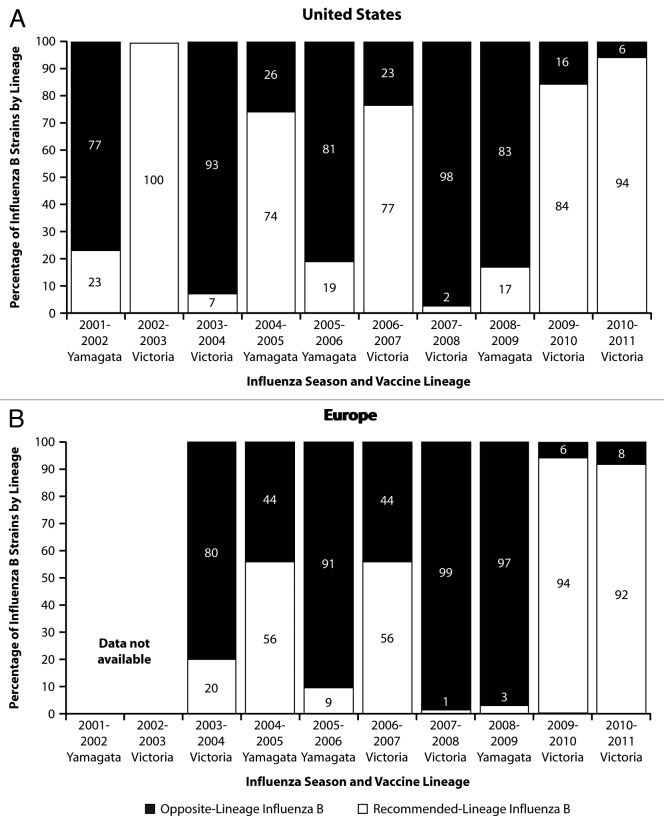
Figure 4. Influenza B circulation by lineage: US and European data for 2001 to 2011. Data were obtained as reported for Figure 1. US data are represented in panel A (A) and European data are represented in panel B (B). The influenza B lineage (Victoria or Yamagata) recommended for inclusion in the trivalent vaccine is shown on the x-axis for each season. EU data regarding the proportion of B viruses by lineage were not available for the 2001–2002 and 2002–2003 influenza seasons.

References

    1. Fiore AE, Uyeki TM, Broder K, Finelli L, Euler GL, Singleton JA, et al. Prevention and control of influenza with vaccines: recommendations of the Advisory Committee on Immunization Practices (ACIP), 2010. MMWR Recomm Rep. 2010;59:1–62. - PubMed
    1. Rota PA, Wallis TR, Harmon MW, Rota JS, Kendal AP, Nerome K. Cocirculation of two distinct evolutionary lineages of influenza type B virus since 1983. Virology. 1990;175:59–68. doi: 10.1016/0042-6822(90)90186-U. - DOI - PubMed
    1. Belshe RB, Coelingh K, Ambrose CS, Woo JC, Wu X. Efficacy of live attenuated influenza vaccine in children against influenza B viruses by lineage and antigenic similarity. Vaccine. 2010;28:2149–56. doi: 10.1016/j.vaccine.2009.11.068. - DOI - PubMed
    1. Couch RB. Background and presentation of possible vaccine options. Presented at: Food and Drug Administration, Center for Biologics Evaluation and Research, Vaccines and Related Biological Products Advisory Committee Meeting; February 27-28, 2007; Washington, DC.
    1. US Centers for Disease Control and Prevention. Seasonal influenza activity surveillance reports: 1999-2000 to 2010-2011 seasons. Available at: http://www.cdc.gov/flu/weekly/pastreports.htm. Accessed November 17, 2011

Publication types

MeSH terms

Substances