


Higher prevalence of obesity among children with asthma
- PMID: 22252049
- PMCID: PMC3348709
- DOI: 10.1038/oby.2012.5
Higher prevalence of obesity among children with asthma
Abstract
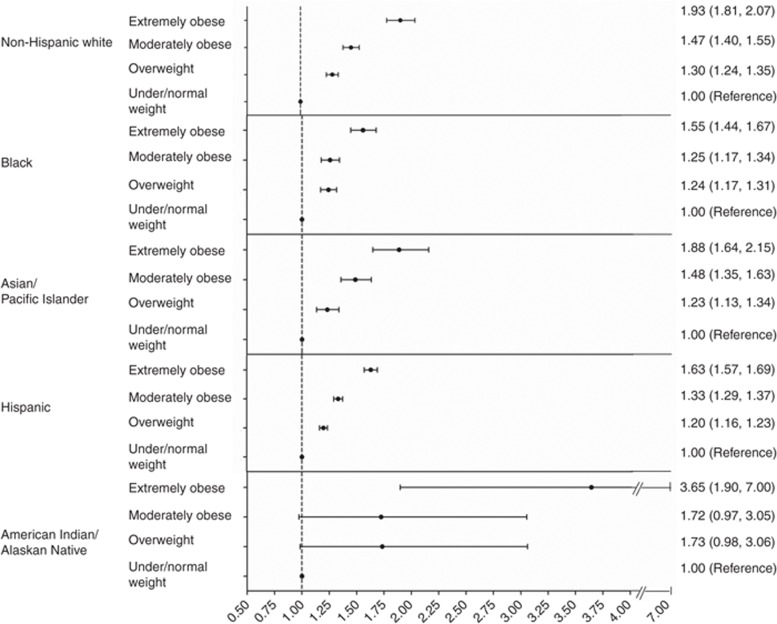
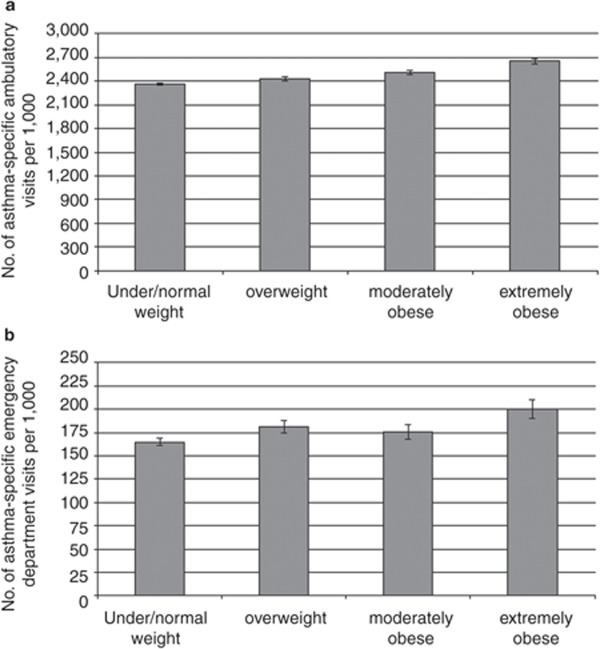
The aim of this study is to investigate the association between childhood obesity and asthma, and whether this relationship varies by race/ethnicity. For this population-based, cross-sectional study, measured weight and height, and asthma diagnoses were extracted from electronic medical records of 681,122 patients aged 6-19 years who were enrolled in an integrated health plan 2007-2009. Weight class was assigned based on BMI-for-age. Overall, 18.4% of youth had a history of asthma and 10.9% had current asthma. Adjusted odds of current asthma for overweight, moderately obese, and extremely obese youth relative to those of normal weight were 1.22 (95% confidence interval (CI): 1.20, 1.24), 1.37 (95% CI: 1.34, 1.40), and 1.68 (95% CI: 1.64, 1.73), respectively (P trend < 0.001). Black youth are nearly twice as likely (adjusted odds ratio (OR) = 1.93, 95% CI: 1.89, 1.99), and Hispanic youth are 25% less likely (adjusted OR = 0.75, 95% CI: 0.74, 0.77), to have current asthma than to non-Hispanic white youth. However, the relationship between BMI and asthma was strongest in Hispanic and weakest in black youth. Among youth with asthma, increasing body mass was associated with more frequent ambulatory and emergency department visits, as well as increased inhaled and oral corticosteroid use. In conclusion, overweight, moderate, and extreme obesity are associated with higher odds of asthma in children and adolescents, although the association varies widely with race/ethnicity. Increasing BMI among youth with asthma is associated with higher consumption of corticosteroids and emergency department visits.
Figures
References
-
- Akinbami LJ, Moorman JE, Garbe PL, Sondik EJ. Status of childhood asthma in the United States, 1980–2007. Pediatrics. 2009;123 Suppl 3:S131–45. - PubMed
-
- Ogden CL, Carroll MD, Curtin LR, Lamb MM, Flegal KM. Prevalence of high body mass index in US children and adolescents, 2007-2008. JAMA. 2010;303:242–249. - PubMed
-
- Brenner JS, Kelly CS, Wenger AD, Brich SM, Morrow AL. Asthma and obesity in adolescents: is there an association. J Asthma. 2001;38:509–515. - PubMed
-
- Rodríguez MA, Winkleby MA, Ahn D, Sundquist J, Kraemer HC. Identification of population subgroups of children and adolescents with high asthma prevalence: findings from the Third National Health and Nutrition Examination Survey. Arch Pediatr Adolesc Med. 2002;156:269–275. - PubMed
Publication types
MeSH terms
Substances
Grants and funding
LinkOut - more resources
Full Text Sources
Medical
