


Randomized, double-blind, placebo-controlled trial of monthly versus bimonthly dihydroartemisinin-piperaquine chemoprevention in adults at high risk of malaria
- PMID: 22252804
- PMCID: PMC3294930
- DOI: 10.1128/AAC.05877-11
Randomized, double-blind, placebo-controlled trial of monthly versus bimonthly dihydroartemisinin-piperaquine chemoprevention in adults at high risk of malaria
Abstract
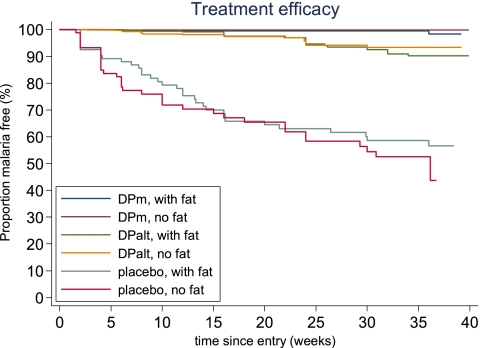
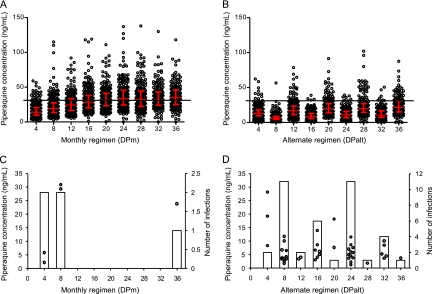
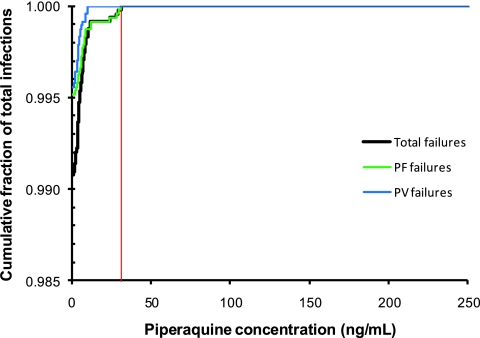
Intermittent preventive treatment (IPT) is increasingly used to reduce malaria morbidity and mortality in children and pregnant women. The efficacy of IPT depends on the pharmacokinetic and pharmacodynamic properties of the antimalarial drugs used. Healthy adult male volunteers whose occupation put them at high risk of malaria on the Northwest border of Thailand were randomized to receive a 3-day-treatment dose of dihydroartemisinin-piperaquine monthly (DPm) or every 2 months (DPalt) or an identical placebo with or without fat (6.4 g/dose) over a 9-month period. All volunteers were monitored weekly. One thousand adults were recruited. Dihydroartemisinin-piperaquine was well tolerated. There were 114 episodes of malaria (49 Plasmodium falciparum, 63 P. vivax, and 2 P. ovale). The protective efficacy against all malaria at 36 weeks was 98% (95% confidence interval [CI], 96% to 99%) in the DPm group and 86% (95% CI, 81% to 90%) in the DPalt group (for both, P < 0.0001 compared to the placebo group). As a result, the placebo group also had lower hematocrits during the study (P < 0.0001). Trough plasma piperaquine concentrations were the main determinant of efficacy; no malaria occurred in participants with a trough concentration above 31 ng/ml. Neither plasma piperaquine concentration nor efficacy was influenced by the coadministration of fat. DPm is safe to use and is effective in the prevention of malaria in adult males living in an area where P. vivax and multidrug-resistant P. falciparum malaria are endemic.
Figures
References
-
- Graham K, et al. 2002. Comparison of three pyrethroid treatments of top-sheets for malaria control in emergencies: entomological and user acceptance studies in an Afghan refugee camp in Pakistan. Med. Vet. Entomol. 16:199–206 - PubMed
-
- Graham K, et al. 2002. Insecticide-treated plastic tarpaulins for control of malaria vectors in refugee camps. Med. Vet. Entomol. 16:404–408 - PubMed
-
- Lindegardh N, Annerberg A, White NJ, Day NP. 2008. Development and validation of a liquid chromatographic-tandem mass spectrometric method for determination of piperaquine in plasma stable isotope labeled internal standard does not always compensate for matrix effects. J. Chromatogr. B Analyt. Technol. Biomed. Life Sci. 862:227–236 - PubMed
Publication types
MeSH terms
Substances
Associated data
Grants and funding
LinkOut - more resources
Full Text Sources
Medical
Research Materials
