


doi: 10.1128/AAC.05395-11.
Epub 2012 Jan 17.
Attenuation-based dual-fluorescent-protein reporter for screening translation inhibitors
Affiliations
- PMID: 22252829
- PMCID: PMC3318315
- DOI: 10.1128/AAC.05395-11
Item in Clipboard
Attenuation-based dual-fluorescent-protein reporter for screening translation inhibitors
Antimicrob Agents Chemother.
2012 Apr.
Abstract
A reporter construct was created on the basis of the transcription attenuator region of the Escherichia coli tryptophan operon. Dual-fluorescent-protein genes for red fluorescent protein and cerulean fluorescent protein were used as a sensor and internal control of gene expression. The sequence of the attenuator was modified to avoid tryptophan sensitivity while preserving sensitivity to ribosome stalling. Antimicrobial compounds which cause translation arrest at the stage of elongation induce the reporter both in liquid culture and on an agar plate. This reporter could be used for high-throughput screening of translation inhibitors.
Figures

(A) Maps of pRFPCER, pRFPCER-TrpL, and pRFPCER-TrpL2A reporter plasmids. UTR, untranslated region; CDF ori, CloDF13-derived CDF replicon; bla, ampicillin resistance gene, T5-1 and T5-2, bacteriophage T5 promoters. Also shown are locations of the trpL leader coding sequence carrying W10A, W11A substitutions (trpL AA), the start of transcription (▶), and the terminator (■). (B) Secondary structure of trpL. Mutated nucleotides are indicated.

Response of Escherichia coli transformed with reporters pRFPCER-TrpL and pRFPCER-TrpL2A to tryptophan in M9 minimal medium. Ratios of CER/RFP fluorescence with standard deviation corridors are shown.
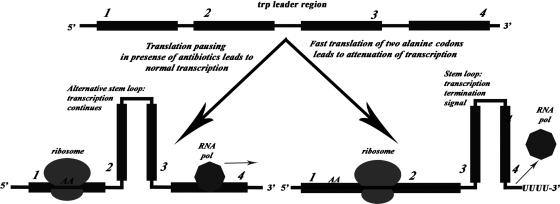
Suggested secondary structures of leader regions preceding CER gene under various conditions. (Left) Secondary structure of the leader region of mRNA transcribed from the pRFPCER-TrpL2A reporter in the presence of translation inhibitors, mimicking the secondary structure of trpL mRNA at low tryptophan concentrations; (right) secondary structure of the leader region of mRNA transcribed from the pRFPCER-TrpL2A reporter without translation inhibitors, mimicking the secondary structure of trpL mRNA at high tryptophan concentrations.

Increase of CER/RFP fluorescence ratio caused by translation inhibitors. (A) Data were normalized to the CER/RFP fluorescence ratio in the absence of any antibiotics. Antibiotics used for induction are shown above the graphs, while their concentrations and MICs are indicated below the graphs. Black bars, pRFPCER-TrpL2A construct; gray bars, control construct pRFPCER devoid of attenuator. (B) The lawn of E. coli transformed with pRFPCER-TrpL2A (left), pRFPCER (center), and pRFPCER-TrpL (right) grown after local spotting of particular antibacterials (indicated): Kan, kanamycin; Cm, chloramphenicol; Ery, erythromycin; Tet, tetracycline.

Induction of CER fluorescence by antibiotics on petri plates. The lawn of E. coli BW25113 or ΔtolC (indicated) transformed with pRFPCER-TrpL2A grown after adding antibiotic disks (indicated). Antibiotics used are erythromycin (Ery), clarithromycin (Cla), roxithromycin (Rox), oleandomycin (Ole), azithromycin (Azi), sulfanilamide (Sul), polymyxin (Pol), rifampin (Rif), chloramphenicol (Cm), kanamycin (Kan), tetracycline (Tet), streptomycin (Sm), vancomycin (Van), linezolid (Linez), lincomycin (Linc), clindomycin (Cli), nalidixic acid (Nal), phosphomycin (Pho), levofloxacin (Lev), norfloxacin (Nor), tobramycin (Tob), and neomycin (Neo).
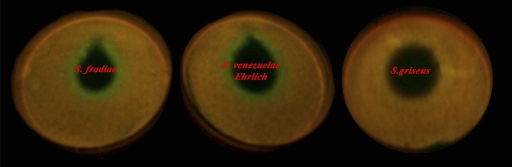
Induction of CER fluorescence by fermentation broths of antibiotic producers. The lawn of E. coli transformed with pRFPCER-TrpL2A grown after local spotting of fermentation broth of antibiotic producer strains S. venezuelae Ehrlich (chloramphenicol producer), S. fradiae (tylosin and neomycin producer), and S. griseus (streptomycin producer).

Screening of natural metabolites produced by a set of soil Actinomyces sp. strains (only a plate with the found inducer is shown). (A) The lawn of E. coli ΔtolC transformed with pRFPCER-TrpL2A grown after adding filters and soaked in fermentation broths of Actinomyces sp. strains. (B) The lawn of E. coli ΔtolC transformed with pRFPCER-TrpL2A grown after local spotting of chloroform-extracted compound produced by strain 428/07 and erythromycin (Ery) at 1 mg/ml. (C) Influence of strain 428/07 and erythromycin on nascent proteome of E. coli ΔtolC. The indicated amounts of antibiotics were added to 1 ml of cell culture, prior to addition of HPG. Cy5 fluorescence shows the amount of newly synthesized proteins after addition of the antibiotic, while the Coomassie blue-stained gel shows the amount of all proteins. (D) Inhibition of in vitro translation of luciferase mRNA by an antibiotic produced by strain 428/07. Shown are dependencies of luciferase activity in million counts per second (cps) over time of protein synthesis. Circles, activity of the luciferase synthesized in the absence of inhibitors; diamonds, activity of the luciferase synthesized in the presence of chloroform-extracted compound produced by strain 428/07 at a 1:50 dilution. Rifampin at a concentration of 4 μg/ml served as a negative control, while erythromycin at a concentration of 0.8 μg/ml served as a positive control of inhibition.
References
-
- Anko ML, Kurittu J, Karp M. 2002. An Escherichia coli biosensor strain for amplified and high throughput detection of antimicrobial agents. J. Biomol. Screen. 7:119–125 - PubMed
-
- Beatty KE, Xie F, Wang Q, Tirrell DA. 2005. Selective dye-labeling of newly synthesized proteins in bacterial cells. J. Am. Chem. Soc. 127:14150–14151 - PubMed
Publication types
MeSH terms
Substances
LinkOut - more resources
Full Text Sources
Other Literature Sources
