Review
doi: 10.1158/0008-5472.CAN-11-1982.
JNK-induced apoptosis, compensatory growth, and cancer stem cells
Affiliations
- PMID: 22253282
- PMCID: PMC3261582
- DOI: 10.1158/0008-5472.CAN-11-1982
Item in Clipboard
Review
JNK-induced apoptosis, compensatory growth, and cancer stem cells
Cancer Res.
.
Abstract
Overwhelming are a set of key stress-responsive kinases that mediate cell apoptosis, which is an important process for tumor suppression. However, JNKs have also been implicated in the malignant transformation and tumorigenesis of cells. This review attempts to reconcile these 2 contradictory functions of JNKs with recent discoveries on the role of JNKs in compensatory growth of neighboring cells and stem cells, which may provide new mechanistic understanding about the role of JNKs in the regulation of cancer stem cells and the pathogenesis of cancers.
Figures
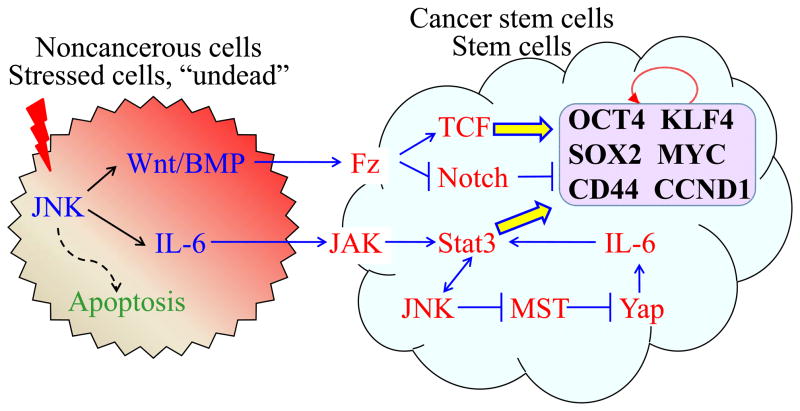
JNK signaling enhances the compensatory proliferation of the neighboring cells, stem cells or cancer stem cells (CSCs). In response to stress signals, activated JNK induces the release of Wnt/BMP and IL-6 from the stressed cells in which an apoptotic response might be initiated but not yet completed, thus inducing a state of “undead” cells. The released Wnt/BMP and IL-6 interact with Fz and JAK complexes, respectively, on the surface of the neighboring cells, stem cells or CSCs, which is followed by the activations of the β-catenin/TCF and Stat3 signaling pathways in these cells. Both β-catenin/TCF and Stat3 are capable of enhancing the expression of the genes such as CCND1, OCT4, Sox2, KLF4, c-Myc, CD44, and others that are important for the cell proliferation and self-renewal of the stem cells or CSCs. There is a reciprocal positive feedback between Stat3 and JNK signaling in the non-stressed neighboring cells or stem cells. Alternatively, JNK can affect Stat3 through the suppression of Hpo/Wts (MST/LATS in mammals) to alleviate Yki (YAP in mammals) that can induce Stat3 through IL-6 signaling. Similarly, in addition to the regulation of the β-catenin/TCF pathway, the Wnt signaling can regulate the cell growth of stem cells by suppressing Notch, a repressor of c-Myc and other cell cycle genes. Circled arrow indicates a group of genes important for the self-renewal of the stem cells or CSCs.
References
-
- Visvader JE. Cells of origin in cancer. Nature. 2011;469(7330):314–322. - PubMed
-
- Chen F, Beezhold K, Castranova V. JNK1, a potential therapeutic target for hepatocellular carcinoma. Biochim Biophys Acta. 2009;1796(2):242–251. - PubMed
-
- Davis RJ. Signal transduction by the JNK group of MAP kinases. Cell. 2000;103(2):239–252. - PubMed
-
- Chang L, Karin M. Mammalian MAP kinase signalling cascades. Nature. 2001;410(6824):37–40. - PubMed
Publication types
MeSH terms
Substances
Grants and funding
LinkOut - more resources
Full Text Sources
Molecular Biology Databases
Research Materials