


An educational and physical program to reduce headache, neck/shoulder pain in a working community: a cluster-randomized controlled trial
- PMID: 22253751
- PMCID: PMC3253792
- DOI: 10.1371/journal.pone.0029637
An educational and physical program to reduce headache, neck/shoulder pain in a working community: a cluster-randomized controlled trial
Abstract
Background: Noninvasive physical management is often prescribed for headache and neck pain. Systematic reviews, however, indicate that the evidence of its efficacy is limited. Our aim was to evaluate the effectiveness of a workplace educational and physical program in reducing headache and neck/shoulder pain.
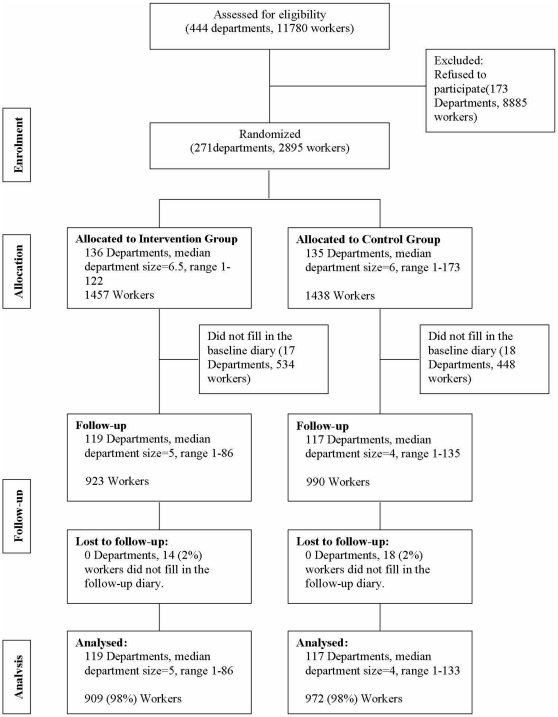
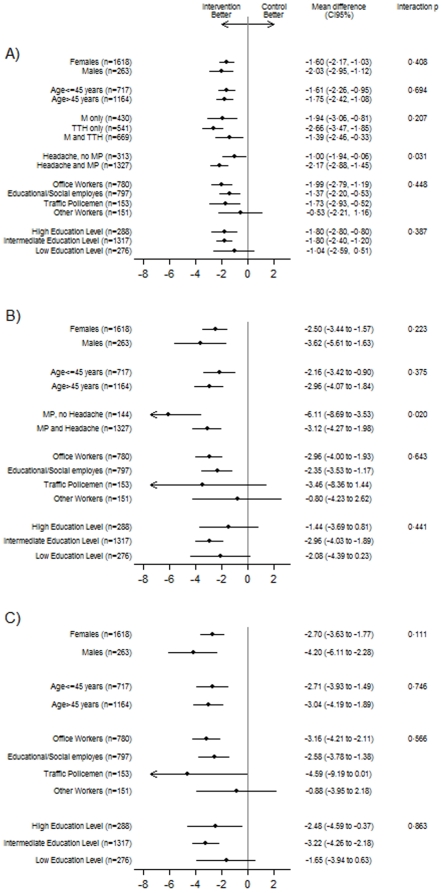
Methodology/principal findings: Cluster-randomized controlled trial. All municipal workers of the City of Turin, Italy, were invited to participate. Those who agreed were randomly assigned, according to their departments, to the intervention group (IG) or to the control group and were given diaries for the daily recording of pain episodes for 1 month (baseline). Subsequently, only the IG (119 departments, 923 workers) began the physical and educational program, whereas the control group (117 departments, 990 workers) did not receive any intervention. All participants were again given diaries for the daily recording of pain episodes after 6 months of intervention. The primary outcome was the change in the frequency of headache (expressed as the proportion of subjects with a ≥50% reduction of frequency; responder rate); among the secondary outcomes there were the absolute reduction of the number of days per month with headache and neck/shoulder pain. Differences between the two groups were evaluated using mixed-effect regression models. The IG showed a higher responder rate [risk ratio, 95% confidence interval (CI)] for headache (1.58; 1.28 to 1.92) and for neck/shoulder pain (1.53; 1.27 to 1.82), and a larger reduction of the days per month (95% CI) with headache (-1.72; -2.40 to -1.04) and with neck/shoulder pain (-2.51; -3.56 to -1.47).
Conclusions: The program effectively reduced headache and neck/shoulder pain in a large working community and appears to be easily transferable to primary-care settings. Further trials are needed to investigate the program effectiveness in a clinical setting, for highly selected patients suffering from specific headache types.
Trial registration: ClinicalTrials.gov NCT00551980.
Conflict of interest statement
Figures
References
-
- Stovner LJ, Zwart JA, Hagen K, Terwindt GM, Pascual J. Epidemiology of headache in Europe. Eur J Neurol. 2006;13:333–345. - PubMed
-
- Wiendels NJ, Knuistingh Neven A, Rosendaal FR, Spinhoven P, Zitman FG, et al. Chronic frequent headache in the general population: prevalence and associated factors. Cephalalgia. 2006;26:1434–1442. - PubMed
-
- Stovner L, Hagen K, Jensen R, Katsarava Z, Lipton R, et al. The global burden of headache: a documentation of headache prevalence and disability worldwide. Cephalalgia. 2007;27:193–210. - PubMed
-
- Steiner TJ. Lifting the burden: The global campaign against headache. Lancet Neurol. 2004;3:204–205. - PubMed
-
- Ghaffari M, Alipour A, Farshad AA, Yensen I, Vingard E. Incidence and recurrence of disabling low back pain and neck-shoulder pain. Spine (Phila Pa 1976) 2006;31:2500–2506. - PubMed
Publication types
MeSH terms
Associated data
LinkOut - more resources
Full Text Sources
Medical
