


Nonclassical vitamin D action
- PMID: 22254030
- PMCID: PMC3257656
- DOI: 10.3390/nu2040408
Nonclassical vitamin D action
Abstract
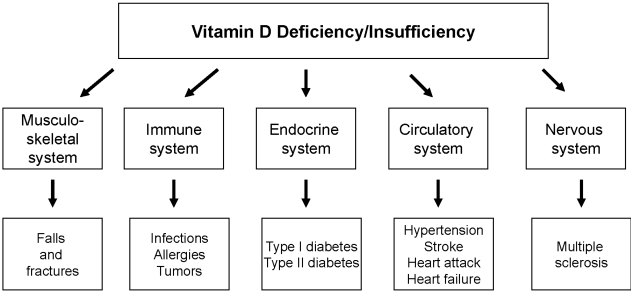
It is becoming increasingly clear that vitamin D has a broad range of actions in the human body. Besides its well-known effects on calcium/phosphate homeostasis, vitamin D influences muscle function, cardiovascular homeostasis, nervous function, and the immune response. Vitamin D deficiency/insufficiency has been associated with muscle weakness and a high incidence of various chronic diseases such as cardiovascular disease, cancer, multiple sclerosis, and type 1 and 2 diabetes. Most importantly, low vitamin D status has been found to be an independent predictor of all-cause mortality. Several recent randomized controlled trials support the assumption that vitamin D can improve muscle strength, glucose homeostasis, and cardiovascular risk markers. In addition, vitamin D may reduce cancer incidence and elevated blood pressure. Since the prevalence of vitamin D deficiency/insufficiency is high throughout the world, there is a need to improve vitamin D status in the general adult population. However, the currently recommended daily vitamin D intake of 5-15 µg is too low to achieve an adequate vitamin D status in individuals with only modest skin synthesis. Thus, there is a need to recommend a vitamin D intake that is effective for achieving adequate circulating 25-hydroxyvitamin D concentrations (>75 nmol/L).
Keywords: cancer; cardiovascular; diet; mortality; ultraviolet B radiation; vitamin D.
Figures
References
-
- Bischoff-Ferrari H.A., Willett W.C., Wong J.B., Stuck A.E., Staehelin H.B., Orav E.J., Thoma A., Kiel D.P., Henschkowski J. Prevention of nonvertebral fractures with oral vitamin D and dose dependency: a meta-analysis of randomized controlled trials. Arch. Intern. Med. 2009;169:551–561. - PubMed
-
- McKenna M.J. Differences in vitamin D status between countries in young adults and the elderly. Am. J. Med. 1992;93:69–77. - PubMed
-
- Vieth R. Vitamin D and cancer mini-symposium: the risk of additional vitamin D. Ann. Epidemiol. 2009;19:441–445. - PubMed
-
- Patel M., Dimaano R., Li-Ng M., Talwar S.A., Mikhail M., Pollack S., Yeh J.K. Vitamin D intake to attain a desired serum 25-hydroxyvitamin D concentration. Am. J. Clin. Nutr. 2008;87:1952–1958. - PubMed
Publication types
MeSH terms
Substances
LinkOut - more resources
Full Text Sources
Other Literature Sources
Medical
