


Chemopreventive activity of vitamin E in breast cancer: a focus on γ- and δ-tocopherol
- PMID: 22254089
- PMCID: PMC3257724
- DOI: 10.3390/nu3110962
Chemopreventive activity of vitamin E in breast cancer: a focus on γ- and δ-tocopherol
Abstract
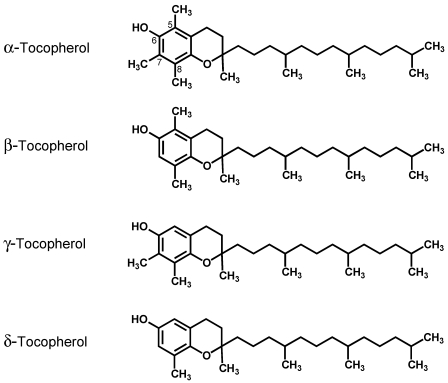
Vitamin E consists of eight different variants: α-, β-, γ-, and δ-tocopherols (saturated phytyl tail) and α-, β-, γ-, and δ-tocotrienols (unsaturated phytyl tail). Cancer prevention studies with vitamin E have primarily utilized the variant α-tocopherol. To no avail, a majority of these studies focused on variant α-tocopherol with inconsistent results. However, γ-tocopherol, and more recently δ-tocopherol, have shown greater ability to reduce inflammation, cell proliferation, and tumor burden. Recent results have shown that γ-enriched mixed tocopherols inhibit the development of mammary hyperplasia and tumorigenesis in animal models. In this review, we discuss the possible differences between the variant forms, molecular targets, and cancer-preventive effects of tocopherols. We recommend that a γ-enriched mixture, γ- and δ-tocopherol, but not α-tocopherol, are promising agents for breast cancer prevention and warrant further investigation.
Keywords: vitamin E; anti-inflammatory; apoptosis; breast cancer; case-control studies; cell proliferation; estrogen receptor (ER); nuclear factor (erythroid-derived 2)-like 2 (Nrf2); peroxisome proliferator activated receptor γ (PPARγ); tocopherols.
Figures
References
-
- Taylor P.R., Qiao Y.L., Abnet C.C., Dawsey S.M., Yang C.S., Gunter E.W., Wang W., Blot W.J., Dong Z.W., Mark S.D. Prospective study of serum vitamin E levels and esophageal and gastric cancers. J. Natl. Cancer Inst. 2003;95:1414–1416. - PubMed
-
- Constantinou C., Papas A., Constantinou A.I. Vitamin E and cancer: An insight into the anticancer activities of vitamin E isomers and analogs. Int. J. Cancer. 2008;123:739–752. - PubMed
-
- Brigelius-Flohe R., Traber M.G. Vitamin E: Function and metabolism. FASEB J. 1999;13:1145–1155. - PubMed
-
- McLaughlin P.J., Weihrauch J.L. Vitamin E content of foods. J. Am. Diet. Assoc. 1979;75:647–665. - PubMed
-
- Traber M.G. Vitamin E regulatory mechanisms. Annu. Rev. Nutr. 2007;27:347–362. - PubMed
Publication types
MeSH terms
Substances
Grants and funding
LinkOut - more resources
Full Text Sources
Medical
