


Instantaneous assessment of autonomic cardiovascular control during general anesthesia
- PMID: 22256307
- PMCID: PMC3299323
- DOI: 10.1109/IEMBS.2011.6092083
Instantaneous assessment of autonomic cardiovascular control during general anesthesia
Abstract
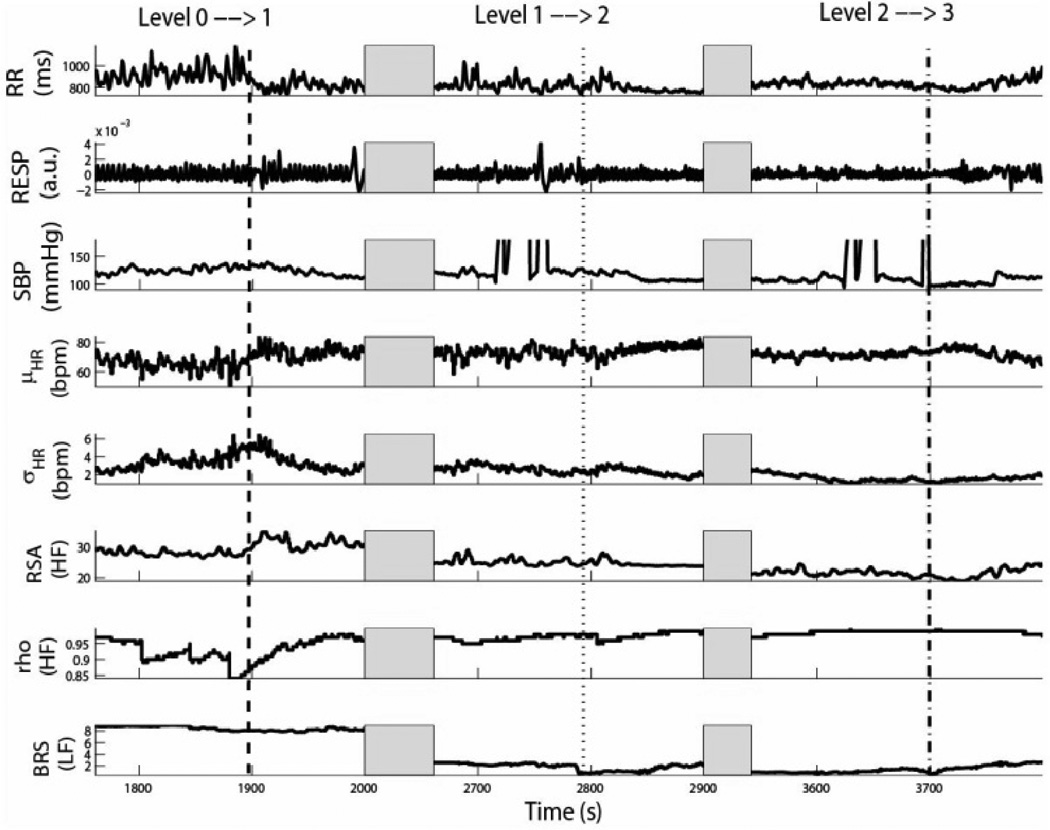
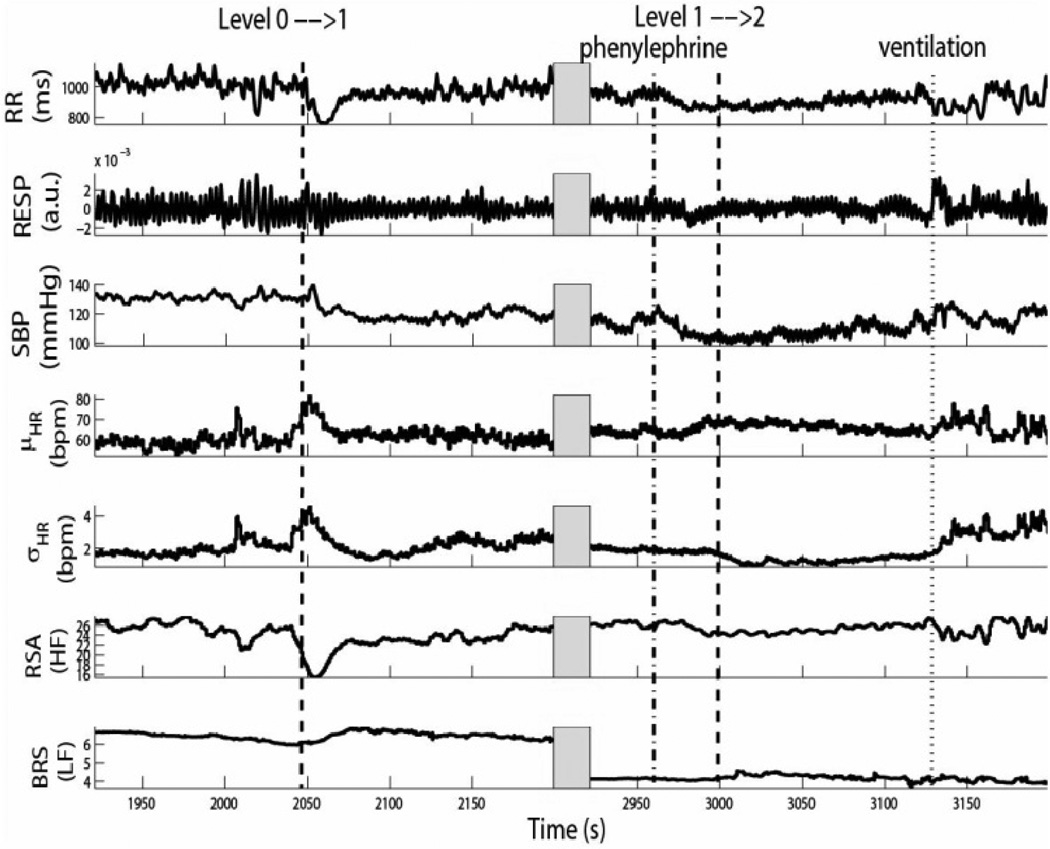
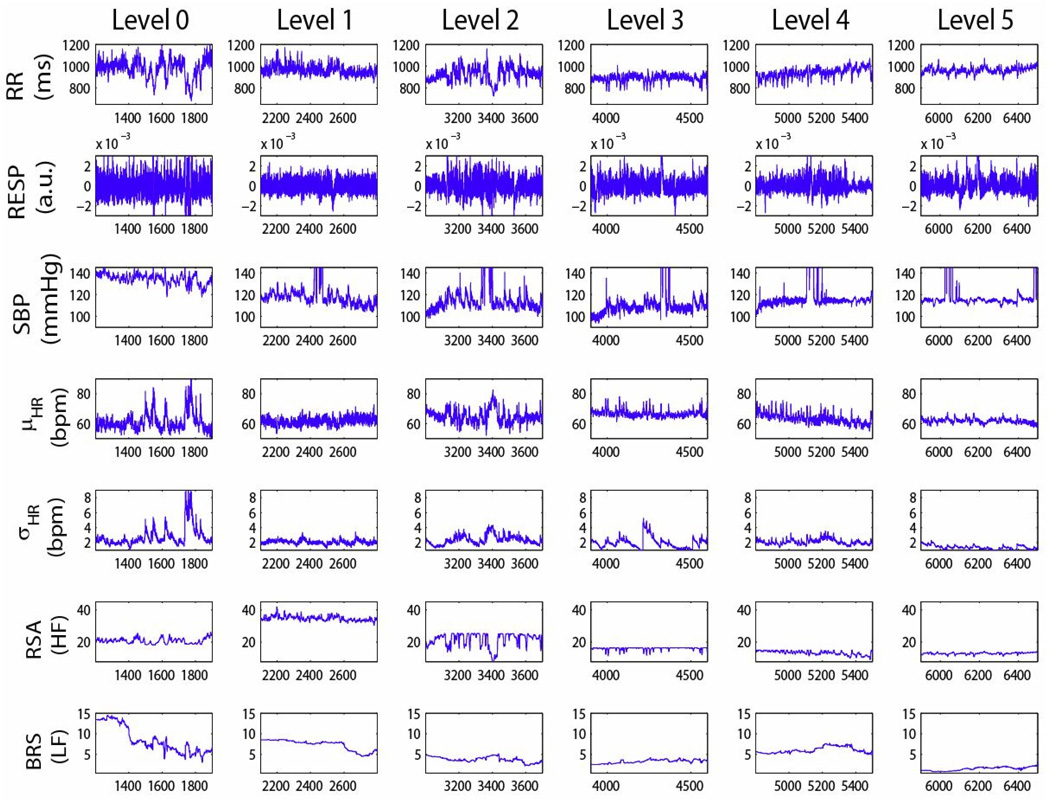
We present a comprehensive probabilistic point process framework to estimate and monitor the instantaneous heartbeat dynamics as related to specific cardiovascular control mechanisms and hemodynamics. Assessment of the model's statistics is established through the Wiener-Volterra theory and a multivariate autoregressive (AR) structure. A variety of instantaneous cardiovascular metrics, such as heart rate (HR), heart rate variability (HRV), respiratory sinus arrhythmia (RSA), and baroreceptor-cardiac reflex (BRS), can be rigorously derived within a parametric framework and instantaneously updated with an adaptive algorithm. Instantaneous metrics of nonlinearity, such as the bispectrum of heartbeat intervals, can also be derived. We have applied the proposed point process framework to experimental recordings from healthy subjects in order to monitor cardiovascular regulation under propofol anesthesia. Results reveal interesting dynamic trends across different pharmacological interventions, confirming the ability of the algorithm to track important changes in cardiorespiratory elicited interactions, and pointing at our mathematical approach as a promising monitoring tool for an accurate, noninvasive assessment of general anesthesia.
Figures
References
-
- Barbieri R, Parati G, Saul JP. Closed- versus open-loop assessment of heart rate baroreflex. IEEE Mag. Eng. Med. Biol. 2001;vol. 20(no. 2):33–42. - PubMed
-
- Barbieri R, Matten EC, Alabi AA, Brown EN. A point-process model of human heartbeat intervals: new definitions of heart rate and heart rate variability. Am J. Physiol. Heart Cicr. Physiol. 2005;vol. 288:424–435. - PubMed
-
- Barbieri R, Brown EN. Analysis of heart beat dynamics by point process adaptive filtering. IEEE Trans. Biomed. Engin. 2006;vol. 53(no. 1):4–12. - PubMed
Publication types
MeSH terms
Substances
Grants and funding
LinkOut - more resources
Full Text Sources
Research Materials