


Predictors of and reasons for pacifier use in first-time mothers: an observational study
- PMID: 22257532
- PMCID: PMC3323436
- DOI: 10.1186/1471-2431-12-7
Predictors of and reasons for pacifier use in first-time mothers: an observational study
Abstract
Background: The use of pacifiers is commonplace in Australia and has been shown to be negatively associated with breastfeeding duration. In order to influence behaviour related to the use of pacifiers it is important to understand the reasons for their use. The primary aim of this observational study was to investigate who (if anyone) advises first-time mothers to give a pacifier and the reasons for which they first give (or try to give) a pacifier to their infant. Additionally, this study investigated the predictors of pacifier use and the relationship between pacifier use and breastfeeding duration.
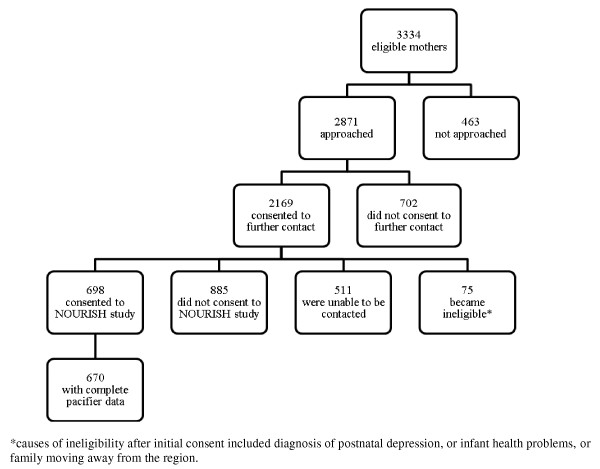
Methods: In total, 670 Australian first-time mothers recruited as part of the NOURISH trial completed a questionnaire regarding infant feeding and pacifier use.
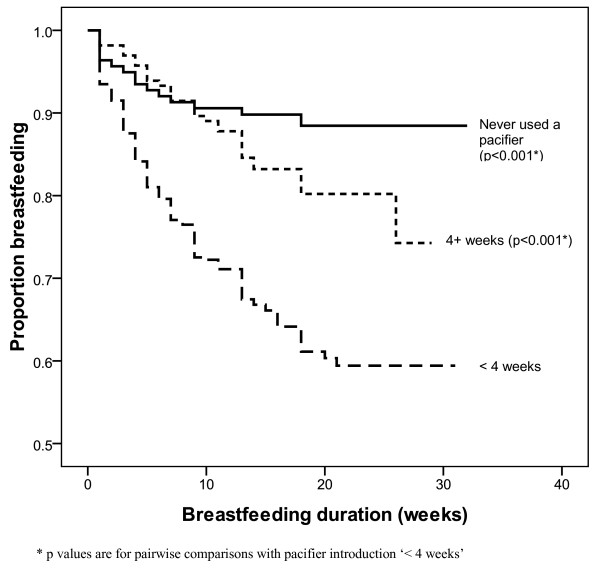
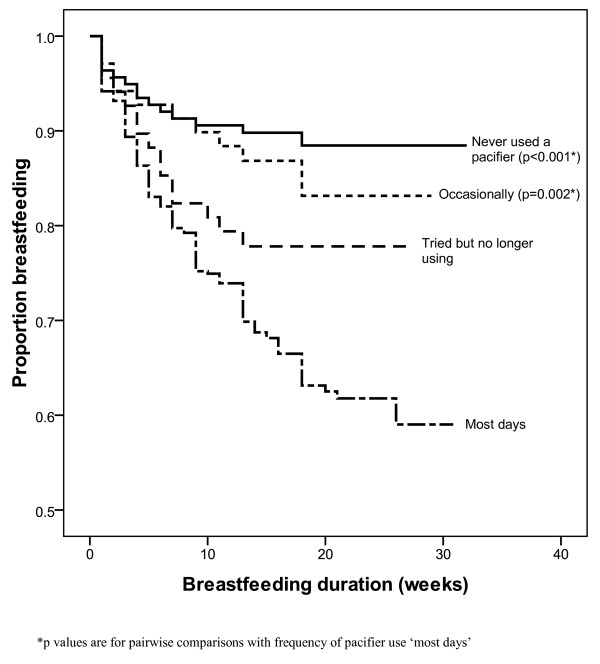
Results: Pacifiers were introduced by 79% of mothers, of whom 28.7% were advised to use a pacifier by their mother/mother-in-law with a further 22.7% being advised by a midwife. The majority of mothers used a pacifier in order to soothe their infant (78.3%), to help put them to sleep (57.4%) and to keep them comforted and quiet (40.4%). Pacifiers given to infants before four weeks (adjHR 3.67; 95%CI 2.14-6.28) and used most days (adjHR 3.28; 95%CI 1.92-5.61) were significantly associated with shorter duration of breastfeeding.
Conclusions: This study identifies an opportunity for educating new mothers and their support network, particularly their infant's grandmothers, with regards to potential risks associated with the early and frequent use of a pacifier, and alternative methods for soothing their infant, in order to reduce the use of pacifiers and their potentially negative effect on breastfeeding duration.
Figures
References
-
- Horta BL, Bahl R, Martines JC, Victora CG. Evidence on the long-term effects of breastfeeding. Systematic reviews and meta-analysis. Geneva: World Health Organization. 2007.
-
- Ip S, Chung M, Raman G, Chew P, Magila N, DeVine D, Trikalinos T, lau J. AHRQ Publication No 07-E007. Rockville, MD: Agency for Healthcare Research and Quality; 2007. Breastfeeding and maternal and child health outcomes in developed countries.
-
- Amir LH, Donath SM. Socioeconomic status and rates of breastfeeding in Australia: evidence from three recent national health surveys. Med J Aust. 2008;189(5):254–256. - PubMed
-
- Barros FC, Victora CG, Semer TC, Tonioli Filho S, Tomasi E, Weiderpass E. Use of pacifiers is associated with decreased breast-feeding duration. Pediatrics. 1995;95(4):497–499. - PubMed
Publication types
MeSH terms
LinkOut - more resources
Full Text Sources
Medical
