


Effect of supplementation with cholecalciferol and calcium on 2-y bone mass accrual in HIV-infected children and adolescents: a randomized clinical trial
- PMID: 22258265
- PMCID: PMC3278244
- DOI: 10.3945/ajcn.111.024786
Effect of supplementation with cholecalciferol and calcium on 2-y bone mass accrual in HIV-infected children and adolescents: a randomized clinical trial
Abstract
Background: Skeletal abnormalities have been reported in HIV-infected children and adolescents. Although the etiology is not well understood, vitamin D deficiency may be involved.
Objective: The study objective was to evaluate the effect of vitamin D and calcium supplementation on bone mass accrual in HIV-infected youth.
Design: Perinatally HIV-infected children were randomly assigned to receive vitamin D (100,000 IU cholecalciferol given every 2 mo) and calcium (1 g/d) (supplemented group) or double placebo (placebo group) for 2 y. The total-body bone mineral content (TBBMC), total-body bone mineral density (TBBMD), spine bone mineral content (SBMC), and spine bone mineral density (SBMD) were assessed by using dual-energy X-ray absorptiometry at baseline and at 2 annual follow-up visits.
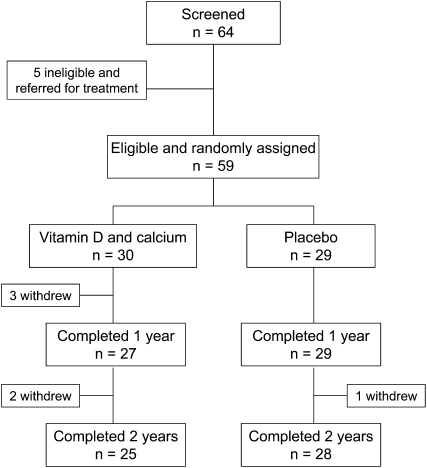
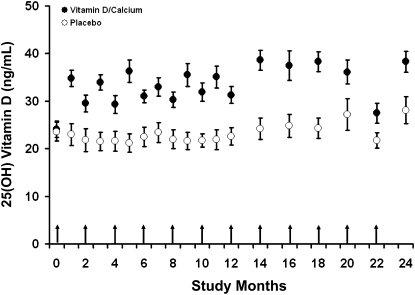
Results: Fifty-nine participants, aged 6-16 y, were randomly assigned to either the supplemented (n = 30) or the placebo (n = 29) group. At enrollment, supplemented and placebo groups did not differ with respect to age, sex, dietary intakes of vitamin D and calcium, mean baseline serum 25-hydroxyvitamin D [25(OH)D] concentration, TBBMC, TBBMD, SBMC, or SBMD. Significant increases in serum 25(OH)D were observed in the supplemented group but not in the placebo group. TBBMC, TBBMD, SBMC, and SBMD increased significantly at 1 and 2 y in both groups. No between-group differences were observed at any time before or after adjustment for stage of sexual maturation by mixed linear model analysis.
Conclusion: One gram of calcium per day and oral cholecalciferol at a dosage of 100,000 IU every 2 mo administered to HIV-infected children and adolescents did not affect bone mass accrual despite significant increases in serum 25(OH)D concentrations. This trial was registered at clinicaltrials.gov as NCT00724178.
Figures
References
-
- Mora S, Sala N, Bricalli D, Chiuimello G, Zuin G, Chiumella G, Vigano A. Bone mineral loss through increased bone turnover in HIV-infected children treated with highly active antiretroviral therapy. AIDS 2001;15:1823–9 - PubMed
-
- O'Brien KO, Razavi M, Henderson R, Caballero B, Ellis K. Bone mineral content in girls perinatally infected with HIV. Am J Clin Nutr 2001;73:821–6 - PubMed
-
- Arpadi SM, Horlick M, Thornton J, Wang J, Kotler D. Bone mineral content is lower in HIV-infected children. J Acquir Imm Def Syndr 2002;29:450–4 - PubMed
-
- Mora S, Zamproni I, Beccio S, Bianchi R, Giacomet V, Viganò A. Longitudinal changes of bone mineral density and metabolism in antiretroviral-treated human immunodeficiency virus-infected children. J Clin Endocrinol Metab 2004;89:24–8 - PubMed
-
- Rojo Conejo P, Ramos Amador JT, García Piñar L, Ruano Fajardo C, Sánchez Granados JM, González Tomé MI, Ruiz Contreras J. Decreased bone mineral density in HIV-infected children receiving highly active antiretroviral therapy. Anal Pediatr (Barc) 2004;60:249–53 - PubMed
Publication types
MeSH terms
Substances
Associated data
Grants and funding
LinkOut - more resources
Full Text Sources
Medical
