. 2011;1(1):23-30.
doi: 10.1159/000322827. Epub 2011 Jan 17.

Overnutrition and the Cardiorenal Syndrome: Use of a Rodent Model to Examine Mechanisms

Overnutrition and the Cardiorenal Syndrome: Use of a Rodent Model to Examine Mechanisms

Adam Whaley-Connell et al. Cardiorenal Med. 2011.

Abstract

Obesity has reached epidemic proportions with far-reaching health care and economic implications. Overnutrition, characterized by excess intake of carbohydrates and fats, has been associated with end-organ damage in several tissues, including the heart and the kidney. Furthermore, overnutrition is one of the most important modifiable and preventable causes of morbidity and mortality associated with cardiovascular and kidney diseases. Insulin resistance and compensatory hyperinsulinemia as well as associated mechanisms, including enhanced renin-angiotensin-aldosterone system activity, inflammation, and oxidative stress, have been implicated in obesity-related cardiorenal injury. In this review, the effect of overnutrition on heart and kidney disease is assessed in a rodent model of overnutrition and obesity, the Zucker obese rat.

Keywords: Cardiorenal syndrome; Heart/kidney disease; Obesity; Overnutrition; Zucker rat model.


Figures

Fig. 1
Fig. 1
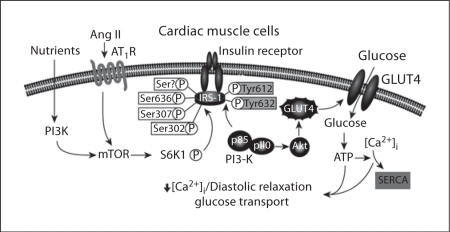
Impact of overnutrition and Ang II on insulin metabolic signaling in the heart.
Fig. 2
Fig. 2
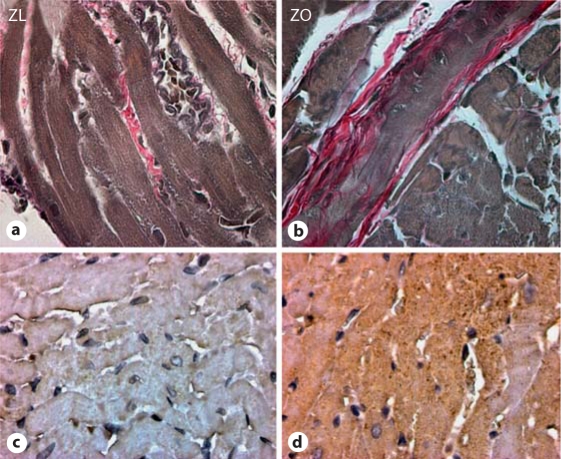
The ZO rat heart manifests increased interstitial fibrosis (a, b) compared to the ZL rat heart due to increases in oxidative stress, i.e. 3-nitrotyrosine (c, d). The ZO rat heart (a) displays increased intensity of staining compared to the ZL rat heart (b) with Verhoeff-Van Gieson stain, which stains collagen pink. The ZO rat heart (c) displays increased intensity of immunostaining for 3-nitrotyrosine compared to the ZL rat heart (d).
Fig. 3
Fig. 3
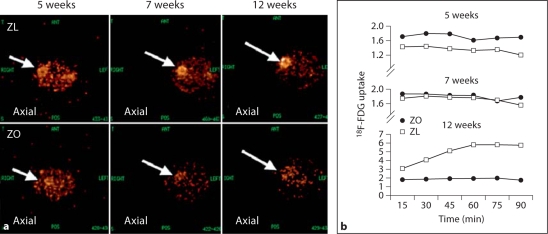
Time course of micro-PET determination of insulin/glucose uptake in ZO rats. a Representative images of decreased 18F-FDG uptake in the ZO (bottom panel) compared to the ZL rat (top panel) at 5, 7 and 12 weeks of age. b Time course of 18F-FDG uptake over 90 min. At 12 weeks, there is a trend to decreased uptake in ZO compared to ZL rats.
Fig. 4
Fig. 4
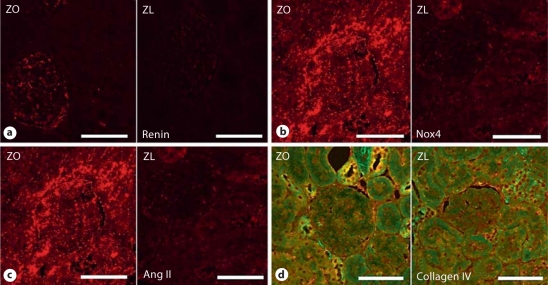
ZO rat kidney manifests increased RAS activation with increases in juxtaglomerular renin (a) as well as tissue Ang II in the proximal tubule (c) compared to ZL controls. Tissue-based RAS increased vascular enzyme complex NADPH oxidase and subunits such as renal gp91-phox (Nox4) in the kidney (b). Activation of NADPH oxidase is critical in the generation of oxidative stress as it relates to structural remodeling and abnormal collagen deposition in the ZO rat kidney, as shown by staining with Verhoeff-Van Gieson stain, which stains collagen pink (d).
Fig. 5
Fig. 5
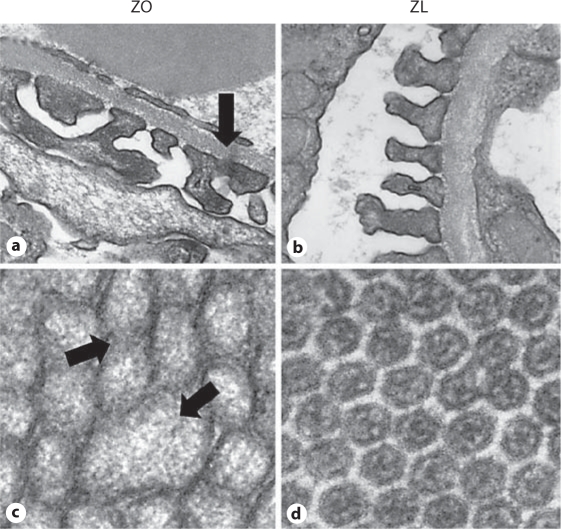
Podocyte foot process and PTC remodeling in the ZO compared to the ZL rat. a Images of ultrastructural analysis of the glomerular filtration barrier utilizing transmission electron microscopy. The ZO rat (a) displays podocyte foot process effacement and fusion (arrow) with loss of the slit-pore diaphragm compared to the ZL rat (b), findings consistent with the development of proteinuria. The development of proteinuria is coupled with parallel findings of structural remodeling of proximal tubule microvilli in ZO (c) compared to ZL rats (d). The ZO rat demonstrates enlarged microvilli with multiple abnormal forms (arrows) which are not found in ZL rats.

References

    1. Flegal KM, Carroll MD, Ogden CL, Curtin LR. Prevalence and trends in obesity among US adults, 1999–2008. JAMA. 2010;303:235–241. - PubMed
    1. Sturm R. Increases in morbid obesity in the USA: 2000–2005. Public Health. 2007;121:492–496. - PMC - PubMed
    1. Bell AC, Adair LS, Popkin BM. Ethnic differences in the association between body mass index and hypertension. Am J Epidemiol. 2002;155:346–353. - PubMed
    1. Sowers JR. Obesity as a cardiovascular risk factor. Am J Med. 2003;115(suppl 8A):37S–41S. - PubMed
    1. Alley DE, Chang VW. The changing relationship of obesity and disability, 1988–2004. JAMA. 2007;298:2020–2027. - PubMed

LinkOut - more resources