Clinical Trial
. 2012 Mar;91(3):497-505.
doi: 10.1038/clpt.2011.254. Epub 2012 Jan 18.

Population pharmacokinetics and pharmacodynamics of piperaquine in children with uncomplicated falciparum malaria

Affiliations
Clinical Trial

Population pharmacokinetics and pharmacodynamics of piperaquine in children with uncomplicated falciparum malaria

J Tarning et al. Clin Pharmacol Ther. 2012 Mar.

Abstract

Dihydroartemisinin-piperaquine is being increasingly used as a first-line artemisinin combination treatment for malaria. The aim of this study was to describe the pharmacokinetic and pharmacodynamic properties of piperaquine in 236 children with uncomplicated falciparum malaria in Burkina Faso. They received a standard body weight-based oral 3-day fixed-dose dihydroartemisinin-piperaquine regimen. Capillary plasma concentration-time profiles were characterized using nonlinear mixed-effects modeling. The population pharmacokinetics of piperaquine were described accurately by a two-transit-compartment absorption model and a three-compartment distribution model. Body weight was a significant covariate affecting clearance and volume parameters. The individually predicted day 7 capillary plasma concentration of piperaquine was an important predictor (P < 0.0001) of recurrent malaria infection after treatment. Young children (2-5 years of age) received a significantly higher body weight-normalized dose than older children (P = 0.025) but had significantly lower day 7 piperaquine concentrations (P = 0.024) and total piperaquine exposures (P = 0.021), suggesting that an increased dose regimen for young children should be evaluated.


Figures

Figure 1
Figure 1
Final structural model for piperaquine population pharmacokinetics in children with uncomplicated falciparum malaria in Burkina Faso. CL, elimination clearance; F, relative oral bioavailability; ktr, transit absorption rate constant; Q, intercompartment clearance; VC, apparent volume of distribution of the central compartment; VP, apparent volume of distribution of the peripheral compartment.
Figure 2
Figure 2
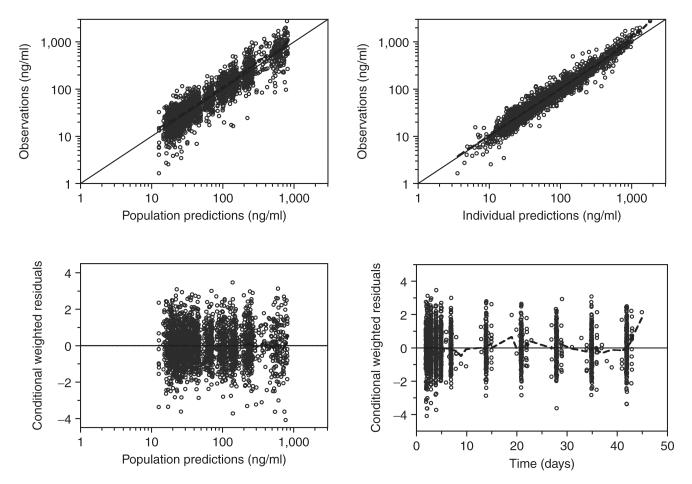
Goodness-of-fit diagnostics of the final population pharmacokinetics model of piperaquine in children with uncomplicated falciparum malaria in Burkina Faso. Open circles: observed data points; broken line: a locally weighted least-squares regression; solid line: line of identity. The observed capillary plasma piperaquine concentrations, population predictions, and individual predictions were transformed into their logarithms (base 10).
Figure 3
Figure 3
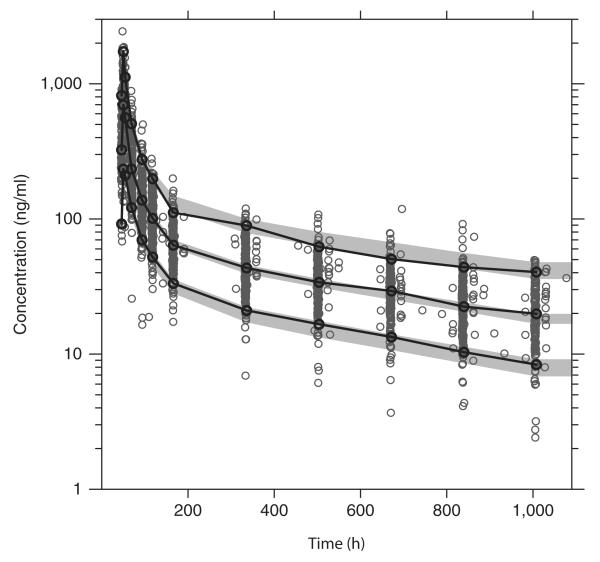
Prediction-corrected visual predictive check of the final model describing the population pharmacokinetics of piperaquine in children with uncomplicated falciparum malaria in Burkina Faso. Open circles: observed data points; solid lines: 5th, 50th, and 95th percentiles of the observed data; shaded area, 95% confidence interval of simulated (n = 2,000) 5th, 50th, and 95th percentiles. Capillary plasma piperaquine concentrations were transformed into their logarithms (base 10).
Figure 4
Figure 4
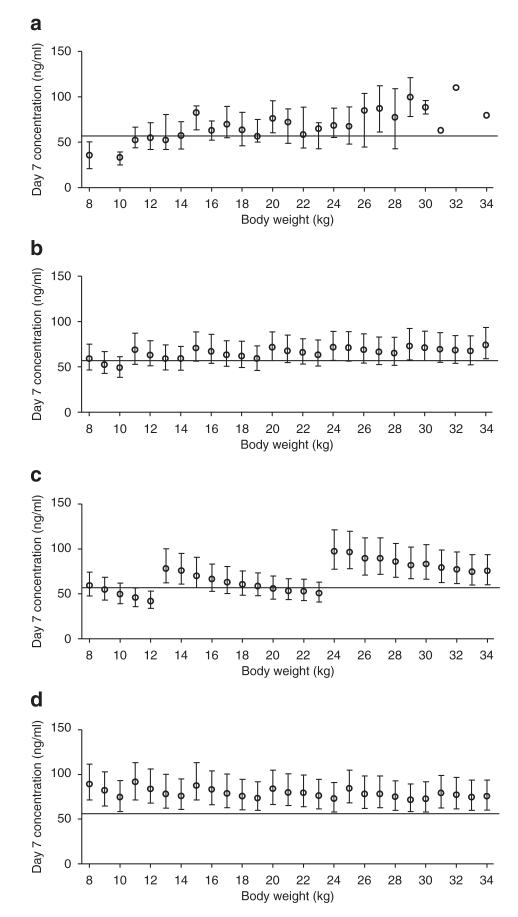
Observed and simulated day 7 capillary piperaquine concentrations stratified for body weight (1,000 simulated patients at each body weight) after different dose regimens. Black circles: median values ± interquartile range; black solid horizontal line: cutoff value for therapeutic failure (57 ng/ml for capillary concentrations). (a) Observed day 7 capillary concentrations; (b) predicted day 7 capillary concentrations after the dose regimen used in this study; (c) predicted day 7 capillary concentrations after the dose regimen proposed by Sigma-tau; (d) predicted day 7 capillary concentrations after an increased dose regimen to achieve >75% of concentrations above the defined cutoff at each body weight (Table 3).

References

    1. Pashynska VA, Van den heuvel H, Claeys M, Kosevich MV. Characterization of noncovalent complexes of antimalarial agents of the artemisinin-type and FE(III)-heme by electrospray mass spectrometry and collisional activation tandem mass spectrometry. J. Am. Soc. Mass Spectrom. 2004;15:1181–1190. - PubMed
    1. World Health Organization Guidelines for the treatment of malaria. 2010.
    1. Zwang J, et al. Safety and efficacy of dihydroartemisinin-piperaquine in falciparum malaria: a prospective multi-centre individual patient data analysis. PLoS ONE. 2009;4:e6358. - PMC - PubMed
    1. Nankabirwa J, et al. Efficacy, safety, and tolerability of three regimens for prevention of malaria: a randomized, placebo-controlled trial in Ugandan schoolchildren. PLoS ONE. 2010;5:e13438. - PMC - PubMed
    1. Bojang KA, et al. Prevention of the recurrence of anaemia in Gambian children following discharge from hospital. PLoS ONE. 2010;5:e11227. - PMC - PubMed

Publication types