


Ergonomic positioning or equipment for treating carpal tunnel syndrome
- PMID: 22259003
- PMCID: PMC6486220
- DOI: 10.1002/14651858.CD009600
Ergonomic positioning or equipment for treating carpal tunnel syndrome
Abstract
Background: Non-surgical treatment, including ergonomic positioning or equipment, are sometimes offered to people experiencing mild to moderate symptoms from carpal tunnel syndrome (CTS). The effectiveness and duration of benefit from ergonomic positioning or equipment interventions for treating CTS are unknown.
Objectives: To assess the effects of ergonomic positioning or equipment compared with no treatment, a placebo or another non-surgical intervention in people with CTS.
Search methods: We searched the Cochrane Neuromuscular Disease Group Specialized Register (14 June 2011), the Cochrane Central Register of Controlled Trials (CENTRAL) (2011, Issue 2, in The Cochrane Library), MEDLINE (1966 to June 2011), EMBASE (1980 to June 2011), CINAHL Plus (1937 to June 2011), and AMED (1985 to June 2011). We also reviewed the reference lists of randomised or quasi-randomised trials identified from the electronic search.
Selection criteria: Randomised or quasi-randomised controlled trials comparing ergonomic positioning or equipment with no treatment, placebo or another non-surgical intervention in people with CTS.
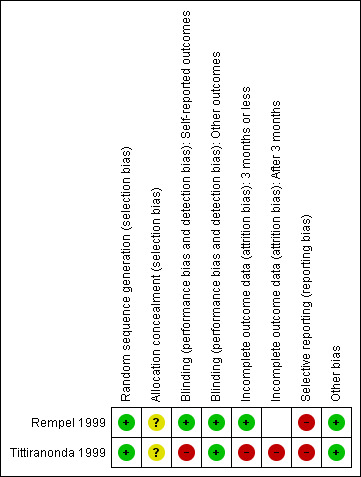
Data collection and analysis: Two review authors independently selected trials for inclusion, extracted data and assessed risk of bias of included studies. We calculated risk ratios (RR) and mean differences (MD) with 95% confidence intervals (CI) for the primary and secondary outcomes. We pooled results of clinically and statistically homogeneous trials, where possible, to provide estimates of the effect of ergonomic positioning or equipment.
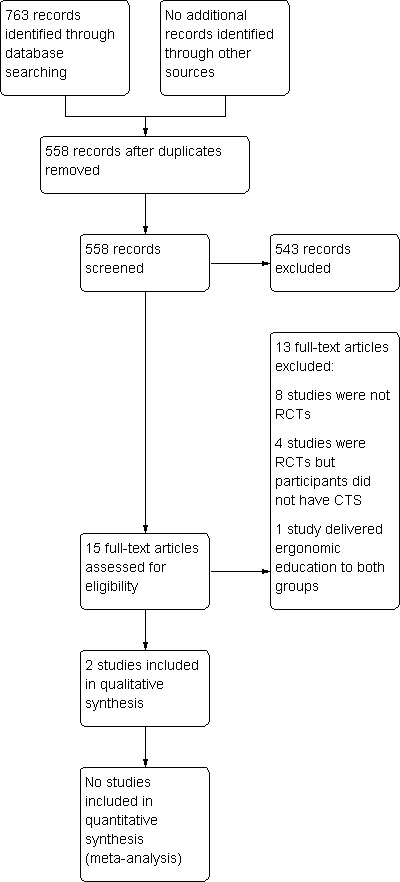
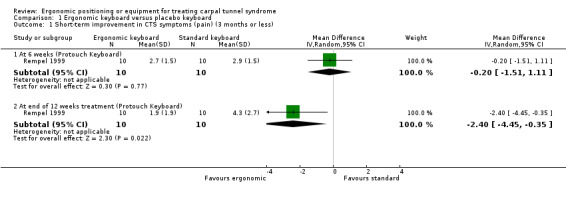
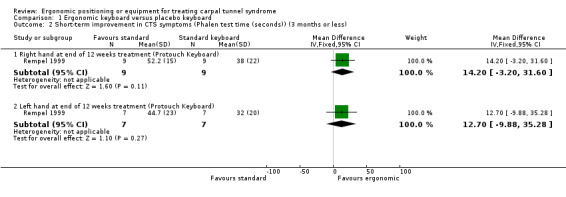
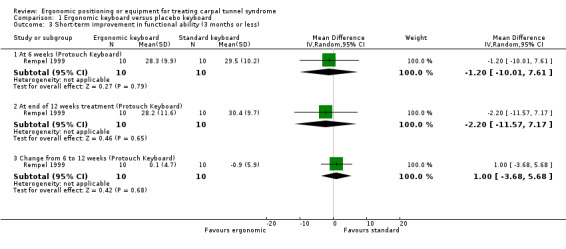
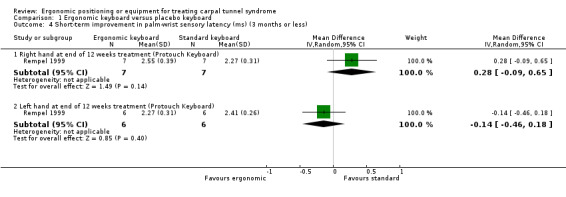
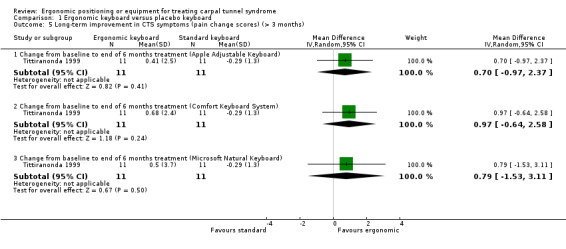
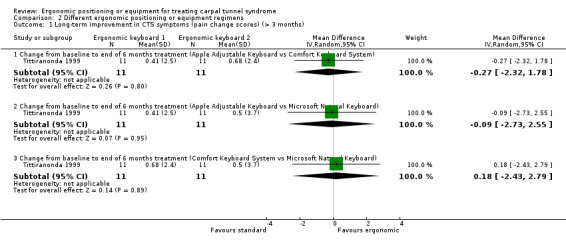
Main results: We included two trials (105 participants) comparing ergonomic versus placebo keyboards. Neither trial assessed the primary outcome (short-term overall improvement) or adverse effects of interventions. In one small trial (25 participants) an ergonomic keyboard significantly reduced pain after 12 weeks (MD -2.40; 95% CI -4.45 to -0.35) but not six weeks (MD -0.20; 95% CI -1.51 to 1.11). In this same study, there was no difference between ergonomic and standard keyboards in hand function at six or 12 weeks or palm-wrist sensory latency at 12 weeks. The second trial (80 participants) reported no significant difference in pain severity after six months when using either of the three ergonomic keyboards versus a standard keyboard. No trials comparing (i) ergonomic positioning or equipment with no treatment, (ii) ergonomic positioning or equipment with another non-surgical treatment, or (iii) different ergonomic positioning or equipment regimes, were found.
Authors' conclusions: There is insufficient evidence from randomised controlled trials to determine whether ergonomic positioning or equipment is beneficial or harmful for treating carpal tunnel syndrome.
Conflict of interest statement
None known.
Figures
References
References to studies included in this review
Rempel 1999 {published data only}
-
- Rempel D, Tittiranonda P, Burastero S, Hudes M, So Y. Effect of keyboard keyswitch design on hand pain. Journal of Occupational and Environmental Medicine 1999;41(2):111‐9. [PUBMED: 10029956] - PubMed
Tittiranonda 1999 {published data only}
-
- Tittiranonda P, Rempel D, Armstrong T, Burastero S. Effect of four computer keyboards in computer users with upper extremity musculoskeletal disorders. American Journal of Industrial Medicine 1999;35(6):647‐61. [PUBMED: 10332518] - PubMed
References to studies excluded from this review
Andersen 2003 {published data only}
-
- Andersen JH, Thomsen JF, Overgaard E, Lassen CF, Brandt LPA, Vilstrup I, et al. Computer use and carpal tunnel syndrome: a 1‐year follow‐up study. JAMA: Journal of the American Medical Association 2003;289(22):2963‐9. - PubMed
Atroshi 2007 {published data only}
-
- Atroshi I, Gummesson C, Ornstein E, Johnsson R, Ranstam J. Carpal tunnel syndrome and keyboard use at work: a population‐based study. Arthritis & Rheumatism 2007;56(11):3620‐5. - PubMed
Bernaards 2006 {published data only}
Boyd 2005 {published data only}
-
- Boyd KU, Gan BS, Ross DC, Richards RS, Roth JH, MacDermid JC. Outcomes in carpal tunnel syndrome: symptom severity, conservative management and progression to surgery. Clinical & Investigative Medicine 2005;28(5):254‐60. - PubMed
Conlon 2009 {published data only}
-
- Conlon CF, Krause N, Rempel DM. A randomized controlled trial evaluating an alternative mouse or forearm support on change in median and ulnar nerve motor latency at the wrist. American Journal of Industrial Medicine 2009;52(4):304‐10. - PubMed
Marangoni 2010 {published data only}
-
- Marangoni AH. Effects of intermittent stretching exercises at work on musculoskeletal pain associated with the use of a personal computer and the influence of media on outcomes. Work 2010;36(1):27‐37. - PubMed
Porrata 2007 {published data only}
-
- Porrata H, Porrata A, Sosner J. New carpal ligament traction device for the treatment of carpal tunnel syndrome unresponsive to conservative therapy. Journal of Hand Therapy 2007;20(1):20‐8. - PubMed
Shafer Crane 2005 {published data only}
-
- Shafer Crane GA, Meyer RA, Schlinger MC, Bennett DL, Robinson KK, Rechtien JJ. Effect of occupational keyboard typing on magnetic resonance imaging of the median nerve in subjects with and without symptoms of carpal tunnel syndrome. American Journal of Physical Medicine and Rehabilitation 2005;84(4):258‐66. - PubMed
Simmer‐Beck 2006 {published data only}
-
- Simmer‐Beck M, Bray KK, Branson B, Glaros A, Weeks J. Comparison of muscle activity associated with structural differences in dental hygiene mirrors. Journal of Dental Hygiene 2006;80:1. - PubMed
Stevenson 2005 {published data only}
-
- Stevenson JR, Blake JM, Douglas TF, Kercheval DM. Does continuous passive motion during keyboarding affect hand blood flow and wrist function? A prospective case report. Work 2005;24(2):145‐55. - PubMed
Thomsen 2008 {published data only}
Werner 2005a {published data only}
-
- Werner RA, Franzblau A, Gell N. Randomized controlled trial of nocturnal splinting for active workers with symptoms of carpal tunnel syndrome. Archives of Physical Medicine and Rehabilitation 2005;86(1):1‐7.. - PubMed
Werner 2005b {published data only}
-
- Werner RA, Franzblau A, Gell N, Hartigan AG, Ebersole M, Armstrong TJ. Incidence of carpal tunnel syndrome among automobile assembly workers and assessment of risk factors. Journal of Occupational & Environmental Medicine 2005;47(10):1044‐50. - PubMed
Additional references
Atroshi 1999
-
- Atroshi I, Gummesson C, Johnsson R, Ornstein E, Ranstam J, Rosen I. Prevalence of carpal tunnel syndrome in a general population. JAMA: Journal of the American Medical Association 1999;282:153‐8. [MEDLINE: ] - PubMed
Braun 1989
-
- Braun RM, Davidson K, Doehr S. Provocative testing in the diagnosis of dynamic carpal tunnel syndrome. Journal of Hand Surgery (American Volume) 1989;14:195‐7. [MEDLINE: ] - PubMed
Charles 2009
-
- Charles J, Fahridin S, Britt H. Carpal tunnel syndrome. Australian Family Physician 2009;38(9):665. - PubMed
Concannon 2000
-
- Concannon MJ, Brownfield ML, Puckett CL. The incidence of recurrence after endoscopic carpal tunnel release. Plastic & Reconstructive Surgery 2000;105:1662‐5. [MEDLINE: ] - PubMed
Dwan 2008
Dwan 2011
Fagarasanu 2003
-
- Fagarasanu M, Kumar S. Carpal tunnel syndrome due to keyboarding and mouse tasks: a review. International Journal of Industrial Ergonomics 2003;31(2):119‐36.
Gelfman 2009
Gerritsen 2002
-
- Gerritsen AAM, Krom MCTFM, Struijs MA, Scholten RJPM, Vet HCW, Bouter LM. Conservative treatment options for carpal tunnel syndrome: a systematic review of randomised controlled trials. Journal of Neurology 2002;249:272‐80. - PubMed
Goodyear‐Smith 2004
Hagberg 1992
-
- Hagberg M, Morgenstern H, Kelsh M. Impact of occupations and job tasks on the prevalence of carpal tunnel syndrome. Scandinavian Journal of Work, Environment & Health 1992;18:337‐45. [MEDLINE: ] - PubMed
Herbert 2000
-
- Herbert R, Gerr F, Dropkin J. Clinical evaluation and management of work‐related carpal tunnel syndrome. American Journal of Industrial Medicine 2000;37:62‐74. - PubMed
Higgins 2002
-
- Higgins JPT, Thompson SG. Quantifying heterogeneity in meta‐analysis. Statistics in Medicine 2002;21:1539‐58. - PubMed
Higgins 2011
-
- Higgins JPT, Green S (editors). Cochrane Handbook of Systematic Reviews of Interventions Version 5.1.0. [Updated March 2011]. The Cochrane Collaboration. Available from www.cochrane‐handbook.org.
Huisstede 2010
-
- Huisstede BM, Hoogvliet P, Randsdorp MS, Glerum S, Middelkoop M, Koes BW. Carpal tunnel syndrome. Part 1: Effectiveness of nonsurgical treatments ‐ a systematic review. Archives of Physical Medicine and Rehabilitation 2010;91:981‐1004. - PubMed
Katims 1989
-
- Katims JJ, Rouvelas P, Sadler B, Weseley SA. Current perception threshold: Reproducibility and comparison with nerve conduction in evaluation of carpal tunnel syndrome. Transactions of the American Society for Artificial Internal Organs 1989;35:280‐4. [MEDLINE: ] - PubMed
Katz 1990
-
- Katz JN, Stirrat CR, Larson MG, Fossel AH, Eaton HM, Liang MH. A self‐administered hand symptom diagram for the diagnosis and epidemiologic study of carpal tunnel syndrome. Journal of Rheumatology 1990;17:1495‐8. [MEDLINE: ] - PubMed
Kerwin 1996
-
- Kerwin G, Williams CS, Seiler JG 3rd. The pathophysiology of carpal tunnel syndrome. Hand Clinics 1996;12:243‐51. [MEDLINE: ] - PubMed
Levine 1993
-
- Levine DW, Simmons BP, Koris MJ, Daltroy LH, Hohl GG, Fossel AH, et al. A self‐administered questionnaire for the assessment of severity of symptoms and functional status in carpal tunnel syndrome. Journal of Bone & Joint Surgery 1993;75:1585‐92. [MEDLINE: ] - PubMed
Marshall 2007
Muller 2004
-
- Muller M, Tsui D, Schnurr R, Biddulph‐Deisroth L, Hard J. Effectiveness of hand therapy interventions in primary management of carpal tunnel syndrome: a systematic review. Journal of Hand Therapy 2004;17:210‐28. - PubMed
Newport 2000
-
- Newport ML. Upper extremity disorders in women. Clinical Orthopaedics & Related Research 2000;372:85‐94. [MEDLINE: ] - PubMed
Ono 2010
Piazzini 2007
-
- Piazzini DB, Aprile I, Ferrera PE, Bertolini C, Tonali P, Maggi L, et al. A systematic review of conservative treatment of carpal tunnel syndrome. Clinical Rehabilitation 2007;21:299‐314. - PubMed
Rempel 1998
Rempel 2006
-
- Rempel DM, Krause N, Goldberg R, Benner D, Hudes M, Goldener GU. A randomised controlled trial evaluating the effects of two workstation interventions on upper body pain and incident musculoskeletal disorders among computer operators. Occupational and Environmental Medicine 2006;63:300‐6. - PMC - PubMed
Rosenthal 1987
-
- Rosenthal EA. Tenosynovitis: tendon and nerve entrapment. Hand Clinics 1987;3:585‐607. [MEDLINE: ] - PubMed
Sadosky 2008
-
- Sadosky A, McDermott AM, Brandendburg NA, Stauss M. A review of the epidemiology of painful diabetic peripheral neuropathy, postherpetic neuralgia, and less commonly studies neuropathic pain conditions. Pain Practice 2008;8(1):45‐56. - PubMed
Scholten 2007
Szabo 1992
-
- Szabo RM, Madison M. Carpal tunnel syndrome. Orthopedic Clinics of North America 1992;23:103‐9. [MEDLINE: ] - PubMed
Szabo 1994
-
- Szabo RM, Steinberg DR. Nerve entrapment syndromes in the wrist. Journal of the American Academy of Orthopedic Surgeons 1994;2:115‐23. - PubMed
References to other published versions of this review
Publication types
MeSH terms
LinkOut - more resources
Full Text Sources
Medical
Research Materials
