


Marfan syndrome with a complex chromosomal rearrangement including deletion of the FBN1 gene
- PMID: 22260333
- PMCID: PMC3339390
- DOI: 10.1186/1755-8166-5-5
Marfan syndrome with a complex chromosomal rearrangement including deletion of the FBN1 gene
Abstract
Background: The majority of Marfan syndrome (MFS) cases is caused by mutations in the fibrillin-1 gene (FBN1), mapped to chromosome 15q21.1. Only few reports on deletions including the whole FBN1 gene, detected by molecular cytogenetic techniques, were found in literature.
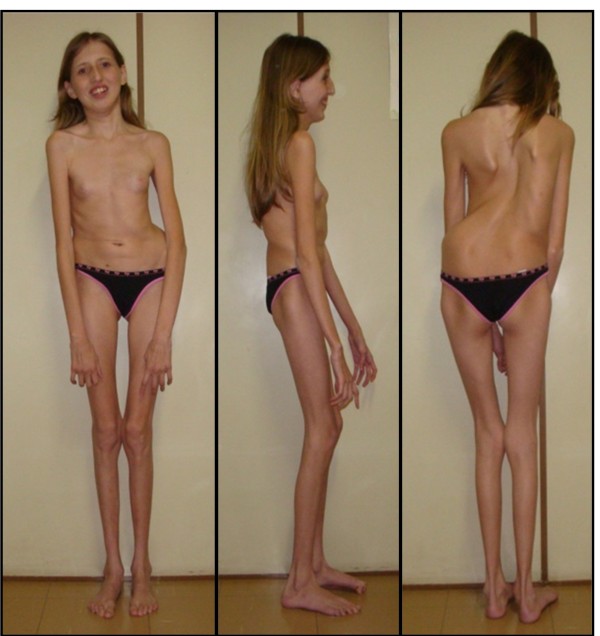
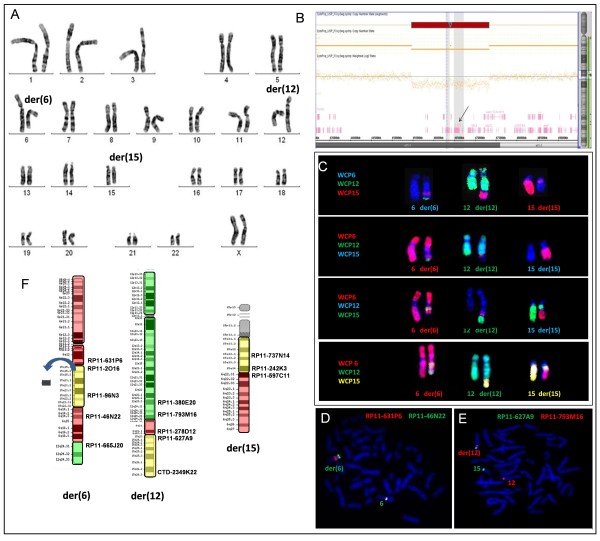
Results: We report here on a female patient with clinical symptoms of the MFS spectrum plus craniostenosis, hypothyroidism and intellectual deficiency who presents a 1.9 Mb deletion, including the FBN1 gene and a complex rearrangement with eight breakpoints involving chromosomes 6, 12 and 15.
Discussion: This is the first report of MFS with a complex chromosome rearrangement involving a deletion of FBN1 and contiguous genes. In addition to the typical clinical findings of the Marfan syndrome due to FBN1 gene haploinsufficiency, the patient presents features which may be due to the other gene deletions and possibly to the complex chromosome rearrangement.
Figures
References
-
- Turner CL, Emery H, Collins AL, Howarth RJ, Yearwood CM, Cross E, Duncan PJ, Bunyan DJ, Harvey JF, Foulds NC. Detection of 53 FBN1 mutations (41 novel and 12 recurrent) and genotype-phenotype correlations in 113 unrelated probands referred with Marfan syndrome, or a related fibrillinopathy. American journal of medical genetics. 2009;149A(2):161–170. doi: 10.1002/ajmg.a.32593. - DOI - PubMed
-
- Hilhorst-Hofstee Y, Hamel BC, Verheij JB, Rijlaarsdam ME, Mancini GM, Cobben JM, Giroth C, Ruivenkamp CA, Hansson KB, Timmermans J, Moll HA, Breuning MH, Pals G. The clinical spectrum of complete FBN1 allele deletions. European journal of human genetics. 2011;19(3):247–252. doi: 10.1038/ejhg.2010.174. - DOI - PMC - PubMed
-
- Loeys BL, Dietz HC, Braverman AC, Callewaert BL, De Backer J, Devereux RB, Hilhorst-Hofstee Y, Jondeau G, Faivre L, Milewicz DM, Pyeritz RE, Sponseller PD, Wordsworth P, De Paepe AM. The revised Ghent nosology for the Marfan syndrome. Journal of medical genetics. 2010;47(7):476–85. doi: 10.1136/jmg.2009.072785. - DOI - PubMed
-
- Mizuguchi T, Collod-Beroud G, Akiyama T, Abifadel M, Harada N, Morisaki T, Allard D, Varret M, Claustres M, Morisaki H, Ihara M, Kinoshita A, Yoshiura K, Junien C, Kajii T, Jondeau G, Ohta T, Kishino T, Furukawa Y, Nakamura Y, Niikawa N, Boileau C, Matsumoto N. Heterozygous TGFBR2 mutations in Marfan syndrome. Nature genetics. 2004;36(8):855–60. doi: 10.1038/ng1392. - DOI - PMC - PubMed
LinkOut - more resources
Full Text Sources
Miscellaneous
