


Treating chronically ill people with diabetes mellitus with limited life expectancy: implications for performance measurement
- PMID: 22260627
- PMCID: PMC4811190
- DOI: 10.1111/j.1532-5415.2011.03784.x
Treating chronically ill people with diabetes mellitus with limited life expectancy: implications for performance measurement
Abstract
Objectives: To develop an algorithm to identify individuals with limited life expectancy and examine the effect of limited life expectancy on glycemic control and treatment intensification in individuals with diabetes mellitus.
Design: Individuals with diabetes mellitus and coexisting congestive heart failure, chronic obstructive pulmonary disease, dementia, end-stage liver disease, and/or primary or metastatic cancer with limited life expectancy were identified. To validate the algorithm, 5-year mortality was assessed in individuals identified as having limited life expectancy. Rates of meeting performance measures for glycemic control between individuals with and without limited life expectancy were compared. In individuals with uncontrolled glycosylated hemoglobin (HbA(1c) ) levels, the effect of limited life expectancy on treatment intensification within 90 days was examined.
Setting: One hundred ten Department of Veterans Affairs facilities; October 2006 to September 2007.
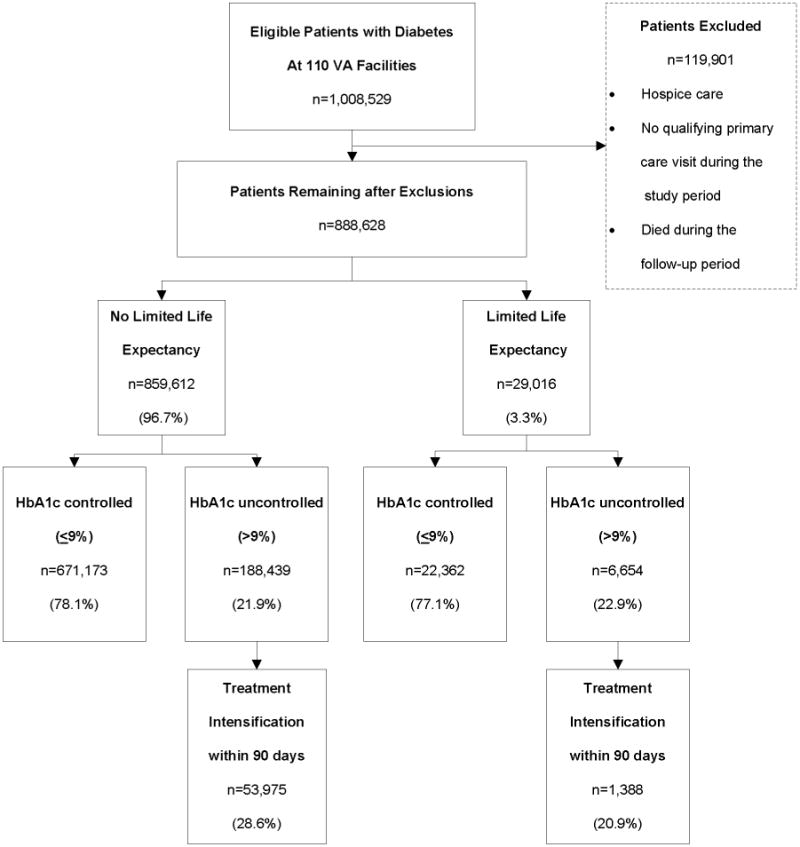
Participants: Eight hundred eighty-eight thousand six hundred twenty-eight individuals with diabetes mellitus.
Measurements: HbA(1c) ; treatment intensification within 90 days of index HbA(1c) reading.
Results: Twenty-nine thousand sixteen (3%) participants had limited life expectancy. Adjusting for age, 5-year mortality was five times as high in participants with limited life expectancy than in those without. Participants with limited life expectancy had poorer glycemic control than those without (glycemic control: 77.1% vs 78.1%; odds ratio (OR) = 0.84, 95% confidence interval (CI) = 0.81-0.86) and less-frequent treatment intensification (treatment intensification: 20.9% vs 28.6%; OR = 0.71, 95% CI = 0.67-0.76), even after controlling for patient-level characteristics.
Conclusion: Participants with limited life expectancy were less likely than those without to have controlled HbA(1c) levels and to receive treatment intensification, suggesting that providers treat these individuals less aggressively. Quality measurement and performance-based reimbursement systems should acknowledge the different needs of this population.
© 2012, Copyright the Authors Journal compilation © 2012, The American Geriatrics Society.
Conflict of interest statement
Figures
Comment in
-
Diabetes mellitus performance measures in individuals with limited life expectancy.J Am Geriatr Soc. 2012 Feb;60(2):361-3. doi: 10.1111/j.1532-5415.2011.03783.x. J Am Geriatr Soc. 2012. PMID: 22332676 Free PMC article. No abstract available.
References
-
- Boyd CM, Darer J, Boult C, et al. Clinical Practice Guidelines and Quality of Care for Older Patients with Multiple Comorbid Diseases. JAMA. 2005;294:716–724. - PubMed
-
- California Healthcare Foundation/American Geriatrics Society Panel on Improving Care for Elders with Diabetes. Guidelines for Improving the Care of the Older Person with Diabetes Mellitus. Journal of the American Geriatrics Society. 2003;51(5 Suppl Guidelines):S265–S280. - PubMed
-
- Veterans Health Affairs, Departmentof Defense. VA/DoD Clinical Practice Guideline for the Management of Diabetes Mellitus. 2010 Aug; Version 4.0. Release date:
-
- Office of Quality and Performance. FY 2011 Q1 Clinical Measures Specification Manual. Vol. 2. Veterans Health Administration; Oct 1, 2010.
-
- Lee DS, Austin PC, Rouleau JL, et al. Predicting mortality among patients hospitalized for heart failure: Derivation and validation of a clinical model. JAMA. 2003;290:2581–2587. - PubMed
Publication types
MeSH terms
Substances
Grants and funding
LinkOut - more resources
Full Text Sources
Medical
Miscellaneous
