. 2012 Apr 12;119(15):3571-7.
doi: 10.1182/blood-2011-06-364182. Epub 2012 Jan 19.

A clinically relevant population of leukemic CD34(+)CD38(-) cells in acute myeloid leukemia

Affiliations

A clinically relevant population of leukemic CD34(+)CD38(-) cells in acute myeloid leukemia

Jonathan M Gerber et al. Blood. .

Abstract

Relapse of acute myeloid leukemia (AML) is thought to reflect the failure of current therapies to adequately target leukemia stem cells (LSCs), the rare, resistant cells presumed responsible for maintenance of the leukemia and typically enriched in the CD34(+)CD38(-) cell population. Despite the considerable research on LSCs over the past 2 decades, the clinical significance of these cells remains uncertain. However, if clinically relevant, it is expected that LSCs would be enriched in minimal residual disease and predictive of relapse. CD34(+) subpopulations from AML patients were analyzed by flow cytometry throughout treatment. Sorted cell populations were analyzed by fluorescence in situ hybridization for leukemia-specific cytogenetic abnormalities (when present) and by transplantation into immunodeficient mice to determine self-renewal capacity. Intermediate (int) levels of aldehyde dehydrogenase (ALDH) activity reliably distinguished leukemic CD34(+)CD38(-) cells capable of engrafting immunodeficient mice from residual normal hematopoietic stem cells that exhibited relatively higher ALDH activity. Minimal residual disease detected during complete remission was enriched for the CD34(+)CD38(-)ALDH(int) leukemic cells, and the presence of these cells after therapy highly correlated with subsequent clinical relapse. ALDH activity appears to distinguish normal from leukemic CD34(+)CD38(-) cells and identifies those AML cells associated with relapse.


Figures
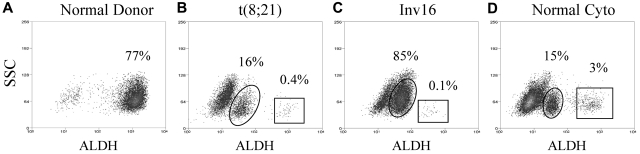
Figure 1
Figure 1
Staining patterns of a normal donor and diagnostic AML samples. Representative flow cytometric staining patterns of ALDH activity by side scatter (SSC) are displayed for CD34+CD38 cells isolated from: (A) a normal donor, (B) a patient (patient 9) with t(8;21) AML, (C) a patient (patient 1) with Inv16 AML, and (D) a patient (patient 17) with normal cytogenetic (cyto) AML. The AML samples, but not the normal marrows, contained a discrete CD34+CD38ALDHint population (circled). In the patients with CBF AML, this CD34+CD38ALDHint population was essentially completely leukemic by FISH. The CD34+CD38ALDHlow population from the CBF AMLs was also almost entirely leukemic by FISH. In contrast, the small CD34+CD38ALDHhigh populations (boxed) from CBF AML patients lacked the leukemia-specific FISH marker. The percentages of CD34+CD38 cells composed of the CD34+CD38ALDHint and CD34+CD38ALDHhigh populations are listed on each dot plot.
Figure 2
Figure 2
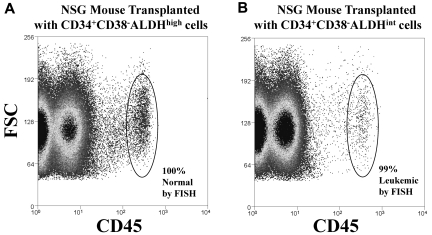
Mouse engraftment. CD34+CD38ALDHhigh or CD34+CD38ALDHint cells were isolated from the diagnostic sample of a patient (patient 4) with Inv16 AML and then transplanted into irradiated NSG mice. After 3 months, bone marrow was harvested from the transplanted mice, and engraftment was demonstrated by the presence of human CD45+ cells (circled), which were then isolated and analyzed by FISH for the Inv16 abnormality. Representative plots of CD45 versus forward scatter (FSC) are shown for mice transplanted with 1000 cells of: (A) CD34+CD38ALDHhigh cells that generated normal (by FISH) human hematopoietic engraftment of mice or (B) CD34+CD38ALDHint cells that produced leukemic (by FISH) engraftment of mice. Human chimerism data are shown in Table 3.
Figure 3
Figure 3
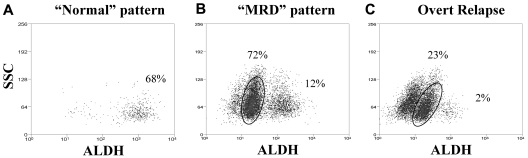
Staining patterns after therapy. Representative examples of (A) “normal” and (B) “MRD” staining patterns, as well as (C) overt clinical relapse. CD34+CD38 cells are shown by ALDH versus side scatter (SSC). (A) An AML patient (patient 17) with normal cytogenetics, in durable CR exhibiting the “normal” pattern with no detectable CD34+CD38ALDHint population. The comparison diagnostic pattern for this patient is shown in Figure 1D. (B) An AML patient (patient 1) with Inv16 AML, demonstrating the “MRD” pattern while still in CR; the circled CD34+CD38ALDHint population was 95% leukemic by FISH. The comparison diagnostic pattern is shown in Figure 1C. (C) A patient (patient 9) with t(8;21) AML, in overt relapse resembling the original diagnostic pattern (shown in Figure 1B). The percentages of CD34+CD38 cells composed of the CD34+CD38ALDHint and CD34+CD38ALDHhigh populations are listed on each dot plot.
Figure 4
Figure 4
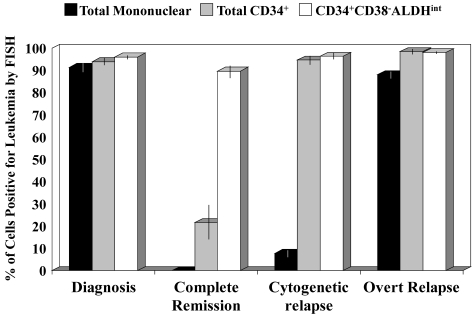
Percentages of cell populations positive for leukemia by FISH in each disease phase. Data are shown only for those patient samples with a FISH-detectable cytogenetic abnormality and a detectable CD34+CD38ALDHint population. All 3 cell populations were highly leukemic at diagnosis. The CD34+CD38ALDHint population was highly enriched for leukemic cells (≥ 85%) in all disease phases, including complete cytogenetic remission (P > .5). In contrast, the total CD34+ population contained only a minority of leukemic cells (average, 22%; P < .001 vs diagnosis) in complete cytogenetic remission (patients 1, 15, and 16) but rose to more than or equal to 95% leukemic with progression to cytogenetic (patients 5, 7, and 12), or overt (patients 1 and 7-9) relapse (P = .001 for differences in total CD34+ and in mononuclear cell FISH percentages across all 4 disease phases).
Figure 5
Figure 5
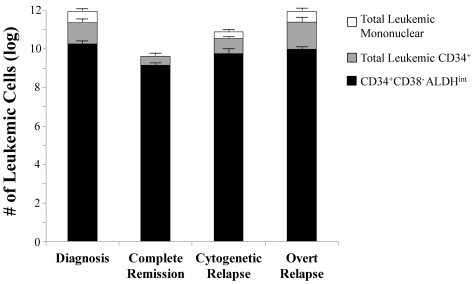
Composition of the total leukemic burden by cell populations in each disease phase. Data are shown only for those patient samples with a FISH-detectable cytogenetic abnormality and a detectable CD34+ CD38ALDHint population. The total leukemic burden is assumed to be 1012 cells at diagnosis. Each vertical bar represents the total leukemic (mononuclear) cell burden (based on FISH) for each disease phase: initial diagnosis (patients 1-3, 5, 6, 8-13, and 22), cytogenetic CR with the “MRD” pattern (patients 1, 15, and 16), cytogenetic relapse (with FISH, but not morphologic, evidence of disease; patients 5, 7, and 12), and at overt relapse (patients 1 and 7-9). The CD34+ CD38ALDHint cells represented an average of 2% (range, 0.3%-7%) of the total leukemic burden at initial diagnosis, 34% (range, 9%-51%) in cytogenetic CR, 8% (range, 2%-12%) in cytogenetic relapse, and 1% (range, 0.5%-2%) at overt relapse (P < .001). The CD34+ CD38ALDHint population constituted an average of 8% (5%-13%) of the total leukemic CD34+ cells at initial diagnosis, 34% (range, 9%-51%) in cytogenetic CR (P < .001 vs initial diagnosis), 18% (range, 7%-37%) in cytogenetic relapse, and 7% (range, 2%-16%) in overt relapse. Although the total leukemic burden decreased by more than 2 logs from diagnosis to cytogenetic CR (P < .001), the absolute size CD34+ CD38ALDHint population decreased only by 1 log (P = .4).

Comment in

  • ALDH marks leukemia stem cell.
    Fleischman AG. Fleischman AG. Blood. 2012 Apr 12;119(15):3376-7. doi: 10.1182/blood-2012-02-406751. Blood. 2012. PMID: 22500050

References

    1. Jemal A, Clegg LX, Ward E, et al. Annual report to the nation on the status of cancer, 1975-2001, with a special feature regarding survival. Cancer. 2004;101(1):3–27. - PubMed
    1. Dohner H, Estey EH, Amadori S, et al. Diagnosis and management of acute myeloid leukemia in adults: recommendations from an international expert panel, on behalf of the European LeukemiaNet. Blood. 2010;115(3):453–474. - PubMed
    1. Cheson BD, Bennett JM, Kopecky KJ, et al. Revised recommendations of the International Working Group for Diagnosis, Standardization of Response Criteria, Treatment Outcomes, and Reporting Standards for Therapeutic Trials in Acute Myeloid Leukemia. J Clin Oncol. 2003;21(24):4642–4649. - PubMed
    1. Bonnet D, Dick JE. Human acute myeloid leukemia is organized as a hierarchy that originates from a primitive hematopoietic cell. Nat Med. 1997;3(7):730–737. - PubMed
    1. Jones RJ, Matsui WH, Smith BD. Cancer stem cells: are we missing the target? J Natl Cancer Inst. 2004;96(8):583–585. - PubMed

Publication types

MeSH terms